
How can one diabetes pill end up on the medication list of someone who does not even have diabetes? Jardiance is a good example. It started as a blood sugar medicine, and its FDA label now also covers heart failure and chronic kidney disease, which is why so many people are surprised to find it in their pill organizer.

This guide uses the Boehringer Ingelheim label on DailyMed, plus CMS pricing, to explain what Jardiance does, the side effects people ask about most, and the warnings that matter. If you are older, take a water pill, or have surgery coming up, take a closer look at the warnings section.
What Jardiance is used for
Jardiance (empagliflozin) is a sodium-glucose co-transporter 2 (SGLT2) inhibitor. It makes the kidneys pass more glucose into the urine. According to the label, it is used:
- to reduce the risk of cardiovascular death and hospitalization for heart failure in adults with heart failure
- to reduce the risk of kidney function decline, end-stage kidney disease, cardiovascular death and hospitalization in adults with chronic kidney disease at risk of progression
- to reduce the risk of cardiovascular death in adults with type 2 diabetes and established cardiovascular disease
- with diet and exercise to improve blood sugar control in adults and children 10 and older with type 2 diabetes
The label says it is not recommended for blood sugar control in type 1 diabetes, and not recommended for blood sugar control in type 2 diabetes when eGFR is below 30, because it is unlikely to work there. See what your eGFR means.

Doses and how to take it
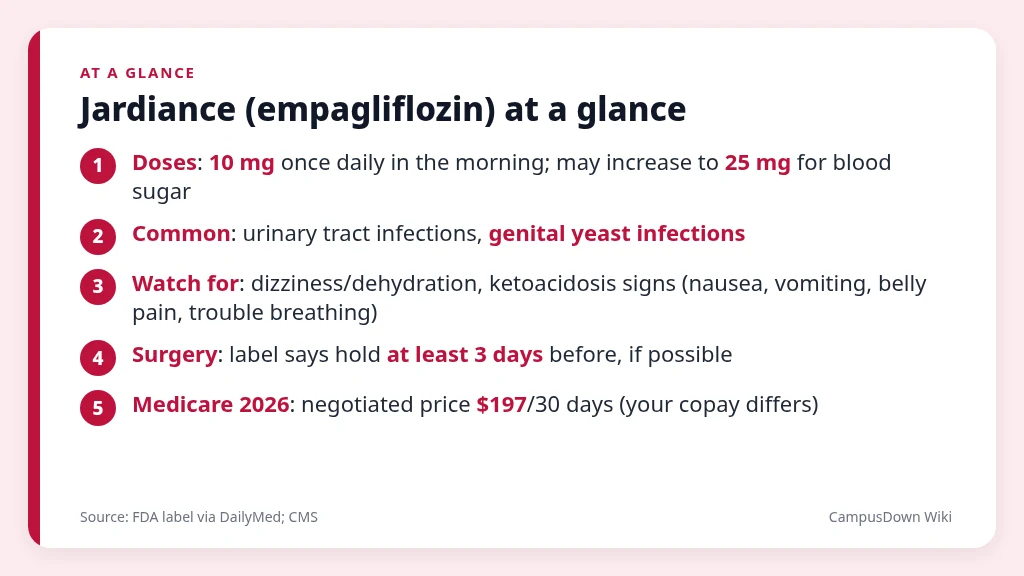
The label lists 10 mg once daily in the morning, with or without food. For extra blood sugar control, the dose may be increased to 25 mg once daily in people who tolerate 10 mg. Tablets come in 10 mg and 25 mg. If you miss a dose, the label says take it as soon as possible and do not double up.
Your clinician checks kidney function and fluid status before starting. That step matters more than it sounds, as the story below shows.
Example scenario: the hot week in July
- Who
- Ruth, 76, a retired church secretary with heart failure, started Jardiance 10 mg alongside her furosemide (a water pill).
- What happened
- During a heat wave she gardened in the morning, drank less than usual to avoid extra bathroom trips, and stood up quickly from her kitchen chair.
- How it felt
- The room tilted and she grabbed the counter, frightened she was having a stroke, and then embarrassed when her daughter found her sitting on the floor.
- What they did
- Her daughter called the cardiology nurse line. The nurse asked about fluids, heat and her water pill, had Ruth sit and drink, and arranged a same-week visit with blood work.
- How it turned out
- Her blood pressure and kidney labs were rechecked, her care team adjusted her water pill, and they gave her a written plan for hot days and sick days. Ruth kept taking Jardiance and now keeps a water bottle by her chair.
This is an illustrative example, not a real patient or a review.
Ruth's story is an illustration, not a real patient, and every plan is different. The label lists older age, kidney problems and loop diuretics as reasons to watch for dehydration and low blood pressure.
Side effects and warnings
In the label's pooled trials, urinary tract infections were reported in 7.6% (placebo), 9.3% (10 mg) and 7.6% (25 mg), and female genital yeast infections in 1.5%, 5.4% and 6.4%. Male genital yeast infections were reported in 0.4%, 3.1% and 1.6%. Increased urination and thirst were also more common than with placebo.
Get help now if
Seek care right away for nausea, vomiting, stomach pain, unusual tiredness or trouble breathing (possible ketoacidosis, which the label says can occur even when blood sugar is below 250 mg/dL); pain, tenderness, redness or swelling in the genital or anal area with fever (possible Fournier's gangrene); or signs of a serious allergic reaction.
Other label warnings:
- Dehydration and low blood pressure, especially if you are 75 or older, have an eGFR below 60, or take loop diuretics.
- Low blood sugar when combined with insulin or sulfonylureas such as glipizide; your clinician may lower those doses.
- Lower-limb infections or ulcers: check your feet and report sores.
- Surgery: hold Jardiance at least 3 days before surgery or procedures with prolonged fasting, if possible, and restart when you are eating and drinking normally.
Most-asked questions about Jardiance
Jardiance vs Farxiga: what is the difference?
Both are SGLT2 inhibitors. Jardiance is empagliflozin and Farxiga is dapagliflozin, and both labels cover type 2 diabetes, heart failure and chronic kidney disease, with different doses and details. Which one you get often depends on your plan's formulary. See our Farxiga guide.
Why people ask: "jardiance vs farxiga" is the #1 Google suggestion for "jardiance vs," and "empagliflozin vs dapagliflozin" is #1 for "empagliflozin vs" (US autocomplete, November 2026).
Can I take Jardiance with metformin?
Yes, they are often prescribed together, and a combination tablet (Synjardy) exists. They work in different ways; ask your clinician about kidney checks for both. See our metformin guide.
Why people ask: "jardiance and metformin" is #4 for "jardiance and," and "empagliflozin and metformin" is #1 for "empagliflozin and" (US, November 2026).
Why do I get yeast infections on Jardiance, and what helps?
Extra glucose in the urine raises the risk of genital yeast infections, which the label lists among the most common side effects. Gentle daily hygiene and prompt treatment help; call your clinician if symptoms return or you have pain with fever.
Why people ask: "jardiance yeast infection" is #1 for "jardiance yeast," with "treatment" and "men" variants at #2 and #3 (US, November 2026).
How long should I stop Jardiance before surgery?
The label says at least 3 days before surgery or procedures with prolonged fasting, if possible. Tell your surgeon and anesthesia team you take it.
Why people ask: "empagliflozin how long to hold before surgery" is #1 for "empagliflozin how long," and "jardiance and anesthesia" is #1 for "jardiance and" (US, November 2026).
How much does Jardiance cost?
CMS negotiated a Medicare price of $197 for a 30-day supply, effective January 1, 2026, compared with a 2023 list price of $573. What you pay depends on your Part D plan's copay or coinsurance. Outside Medicare, ask your pharmacist about plan coverage and manufacturer programs.
Why people ask: "jardiance cost without insurance" is #2 for "jardiance cost," and "jardiance coupon" appears in the top suggestions for "jardiance" (US, November 2026).
Does Jardiance cause weight loss?
Jardiance is not approved as a weight-loss medicine. Because it removes glucose through the urine, some people notice a change in weight, but results vary.
Why people ask: "jardiance weight loss" is #1 for "jardiance weight" (US, November 2026).
Before your next appointment, check it for yourself: do you know your latest eGFR, your sick-day plan, and when to pause Jardiance before a procedure?
Related on CampusDown
You can learn more about heart failure, daily weights in heart failure, chronic kidney disease and diabetes goals in older adults.
Frequently asked questions
- Should Jardiance be taken in the morning?
- The label lists once daily in the morning, with or without food.
- Is Jardiance used for type 1 diabetes?
- No. The label says it is not recommended for blood sugar control in type 1 diabetes because it may increase the risk of diabetic ketoacidosis.
- Can Jardiance cause low blood sugar?
- The risk rises when it is combined with insulin or a sulfonylurea; your clinician may adjust those doses.
- What if I miss a dose?
- The label says take it as soon as possible and do not double up the next dose.
Jardiance can protect the heart and kidneys, but it asks you to pay attention to fluids, hygiene and procedures. Learn more about your own sick-day plan with your pharmacist, and never stop it on your own without asking.
Browse more guides like this in the Medicines hub.
This article is for general education and does not replace advice from your own doctor, nurse or pharmacist.