
Your doctor says Farxiga is for your diabetes, your heart and your kidneys. How can one tablet be about all three, and what should you watch for?

This guide uses MedlinePlus's drug information on dapagliflozin and the FDA prescribing information for Farxiga (revised June 2024) to explain the basics. It is general information, not a prescription; your prescriber and pharmacist decide whether and how you take it. If you want to learn more about its sibling, take a closer look at empagliflozin (Jardiance).
Drug class and how it works
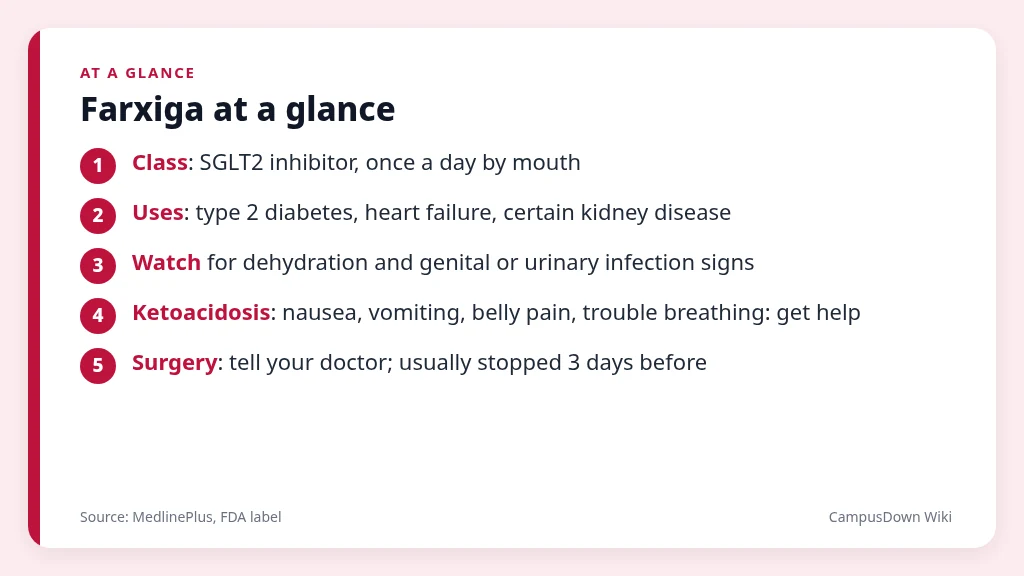
Dapagliflozin is in a class called sodium-glucose co-transporter 2 (SGLT2) inhibitors. MedlinePlus says it works by helping the kidneys remove glucose (sugar) and excess fluid through the urine. That explains both its benefits (blood sugar and fluid effects) and its main cautions (fluid loss and infections linked to sugar in the urine). Brand-name Farxiga's generic name is dapagliflozin; ask your pharmacist what version your plan dispenses.

What it is used for
MedlinePlus says dapagliflozin is used:
- To lower blood sugar in people with type 2 diabetes
- To reduce the risk of being hospitalized for heart failure in certain adults with type 2 diabetes
- To reduce the risk of hospitalization for heart failure and death in adults with heart failure
- To reduce the risk of worsening kidney disease, heart failure hospitalization and death in certain adults with kidney disease
The FDA label lists similar uses and some limits: it is not recommended to improve blood sugar in type 1 diabetes, and not recommended for blood-sugar control in type 2 diabetes with an eGFR below 45 (it is likely to be ineffective for that purpose). For what eGFR means, see the eGFR guide. Weight loss isn't a labeled use, though MedlinePlus notes that SGLT2 inhibitors may lead to some weight loss and lower blood pressure in people with diabetes.
How it is taken
- A tablet by mouth, once a day, with or without food, at around the same time each day (MedlinePlus).
- Take it exactly as directed; don't take more or less or more often.
- The label lists 5 mg and 10 mg tablets. For blood-sugar control, the label's starting dosage is 5 mg once daily, which may be raised to 10 mg; for the other uses it is 10 mg once daily. Your prescriber chooses the dose for your situation, and kidney function may change it.
- It helps control your condition but is not a one-time fix: continue taking it even if you feel well, and don't stop without talking to your doctor.
- Drink fluids as your doctor advises. MedlinePlus says to follow instructions about drinking enough fluids and to ask how much water is right for you.
Before you start, tell your doctor or pharmacist
Per MedlinePlus: your allergies; every prescription, over-the-counter drug, supplement and herbal product; alcohol use (including binge drinking), a low-sodium diet or an infection; heart failure, pancreas problems, urinary tract problems or infections, low blood pressure, genital yeast infections, or kidney or liver disease; and, for men, if you have never been circumcised. Also say if you're eating or drinking less, following a ketogenic diet, or have had diarrhea, vomiting or heavy sweating. Tell them about pregnancy or breastfeeding (MedlinePlus says not to breastfeed while taking it).
Because it can change blood sugar, learn the symptoms of low blood sugar, especially if you also take insulin or other diabetes medicines. See also metformin if it's part of your plan.
Side effects
Tell your doctor if these are severe or don't go away (MedlinePlus): urinating a lot (including at night), stuffy or runny nose, sore throat, leg or arm pain, constipation. The FDA label lists the most common adverse reactions as female genital yeast infections, nasopharyngitis and urinary tract infections.
Call your doctor right away for:
- Urinary infection signs: frequent, urgent, burning or painful urination; cloudy, red, pink or brown or strong-smelling urine; less urine; fever, back pain, nausea or vomiting
- Dehydration: dry mouth, dark urine, decreased sweating, dry skin; see dehydration signs
- Genital infection signs: in women, odor, white or yellowish lumpy discharge or itching; in men, redness, itching, swelling, rash, foul discharge or pain on the penis
- Pelvic or rectal pain
- Feeling tired, weak or uncomfortable with fever and pain, tenderness, redness or swelling of the genitals or the area between the genitals and the rectum: the FDA label warns of a serious, life-threatening infection that has occurred (necrotizing fasciitis of the perineum, "Fournier's gangrene"), so don't wait
- Dizziness or fainting when standing: get up slowly, resting your feet on the floor first
Get help now if
If you have nausea, vomiting, stomach-area pain, tiredness or trouble breathing, these can be signs of ketoacidosis. MedlinePlus says to stop taking dapagliflozin and call your doctor immediately or get emergency care, and, if possible, check ketones in your urine even if your blood sugar is below 250 mg/dL.
Sick days, surgery and missed doses
- Illness, infection, fever, stress or injury: MedlinePlus says to ask your doctor what to do, since these affect blood sugar and your dose needs.
- Surgery, including dental: tell the surgeon or dentist; your doctor will probably tell you to stop it at least 3 days before surgery (the FDA label says to withhold it for at least 3 days, if possible, before major surgery or procedures with prolonged fasting).
- Missed dose: take it when you remember unless it's almost time for the next one; don't double up.
- Keep a written medication list and bring it to visits; see heart failure daily weights if it's part of your heart failure plan.
Farxiga vs Jardiance
Both are SGLT2 inhibitors, as MedlinePlus's list of diabetes pills shows, and both have heart and kidney uses on their labels. Which fits you depends on your conditions, kidney function, cost and coverage; that's a conversation for your prescriber. See empagliflozin (Jardiance) for its own details, and diabetes in older adults for goals that vary with age.
Questions for your pharmacist
- Is my dose the starting dose or a higher one?
- How much water should I drink each day?
- What should I do on a sick day with vomiting or diarrhea?
- When should I stop it before a procedure?
- Which genital or urinary symptoms mean I should call right away?
Example scenario: the embarrassing itch
- Who
- Octavian, 63, a retired mail carrier in Pittsburgh, Pennsylvania, started a new diabetes and heart medicine and noticed genital itching and redness after two weeks.
- What happened
- He assumed it was irritation and waited, embarrassed to mention it.
- How it felt
- He felt ashamed and worried.
- What they did
- He remembered the leaflet that listed those symptoms, called his pharmacist, who told him to contact his doctor, and the clinic saw him that week. He also started a water and fluids routine his clinic recommended.
- How it turned out
- Octavian said the leaflet's honest list made it easier to speak up.
This is an illustrative example, not a real patient or a review.
Octavian's story is an illustrative example. Never stop or change a prescribed medicine without talking to your prescriber.
Most-asked questions about Farxiga
Is there a generic Farxiga?
Its generic name is dapagliflozin; ask your pharmacist what your plan dispenses.
Why people ask: "farxiga generic" is #2 for "farxiga" (US autocomplete, November 2026).
What are the side effects of Farxiga?
Frequent urination, nose and throat symptoms and constipation are listed as milder effects; genital or urinary infections, dehydration and ketoacidosis symptoms need a call.
Why people ask: "farxiga side effects" is #3 for "farxiga" (US autocomplete, November 2026).
What is Farxiga used for?
Type 2 diabetes, reducing heart failure hospitalization and certain kidney disease risks, per MedlinePlus.
Why people ask: "farxiga uses" is #4 for "farxiga" (US autocomplete, November 2026).
How is Farxiga different from Jardiance?
Both are SGLT2 inhibitors with overlapping uses; your prescriber chooses based on your conditions and coverage.
Why people ask: "farxiga vs jardiance" is #5 for "farxiga" (US autocomplete, November 2026).
What is the generic name for Farxiga?
Dapagliflozin.
Why people ask: "farxiga generic name" is #6 for "farxiga" (US autocomplete, November 2026).
What does Farxiga 10 mg mean?
The label lists 5 mg and 10 mg tablets; the FDA label says 10 mg is the recommended daily dose for heart and kidney uses, and your prescriber sets yours.
Why people ask: "farxiga 10 mg" is #7 for "farxiga" (US autocomplete, November 2026).
What drug class is Farxiga?
A sodium-glucose co-transporter 2 (SGLT2) inhibitor.
Why people ask: "farxiga drug class" is #8 for "farxiga" (US autocomplete, November 2026).
How is Farxiga dosed?
Once a day by mouth with or without food, at the dose your prescriber chooses.
Why people ask: "farxiga dosing" is #10 for "farxiga" (US autocomplete, November 2026).
Does Farxiga help the heart?
MedlinePlus says it is used to reduce the risk of heart failure hospitalization in certain adults.
Why people ask: "farxiga uses for heart" is #3 for "farxiga uses" (US autocomplete, November 2026).
Is Farxiga used for kidney disease?
MedlinePlus says it is used to reduce the risk of worsening kidney disease in certain adults with kidney disease.
Why people ask: "farxiga uses kidney disease" is #4 for "farxiga uses" (US autocomplete, November 2026).
Related on CampusDown
You can learn more about the medicines hub and check it for yourself in the eGFR guide. For fluid loss in detail, see dehydration signs.
Frequently asked questions
- When should I take Farxiga?
- Once a day, at about the same time each day, with or without food.
- Can I stop it when I feel fine?
- No; it helps control your condition, so don't stop without talking to your doctor.
- Should I stop it before surgery?
- Tell your surgeon; doctors usually stop it at least 3 days before.
- What is the most serious warning sign?
- Nausea, vomiting, stomach pain, tiredness or trouble breathing (possible ketoacidosis) needs urgent care.
- Can it cause yeast infections?
- Yes; genital yeast infections are among the most common reactions listed on the FDA label.
Dapagliflozin helps kidneys clear sugar and fluid, so drink as directed, watch for infection and ketoacidosis signs, and tell your clinicians before surgery or on sick days.
Browse more guides like this in the Medicines hub.
This article is for general education and does not replace advice from your own doctor, nurse or pharmacist.