
Your post-op patient says her calf feels tight and warm. Ten minutes later, she says she can't catch her breath. What do you do first?

A DVT care plan comes down to two jobs: prevent clots, and recognize a clot that is moving. This guide follows OpenStax's Medical-Surgical Nursing chapters on thrombotic disorders (16.6) and the postoperative care plan (27.4) and MedlinePlus's DVT topic. It is a study aid, not orders. If a patient has sudden shortness of breath, chest pain or a fast heart rate, tell the nurse immediately and call for help per facility policy. To learn more about the breathing exam, take a closer look at lung sounds.
What DVT and PE are
OpenStax describes deep vein thrombosis (DVT) as a clot in a deep vein, most often in the leg or pelvis. If it loosens and travels to the lungs, it becomes a pulmonary embolism (PE), a medical emergency. OpenStax lists risk factors including immobility, surgery, cancer and chemotherapy, previous DVT or PE and genetic clotting disorders; later chapters add smoking and use of oral contraceptives or hormone replacement therapy. MedlinePlus says sitting still for a long time raises risk.

Assessment cues
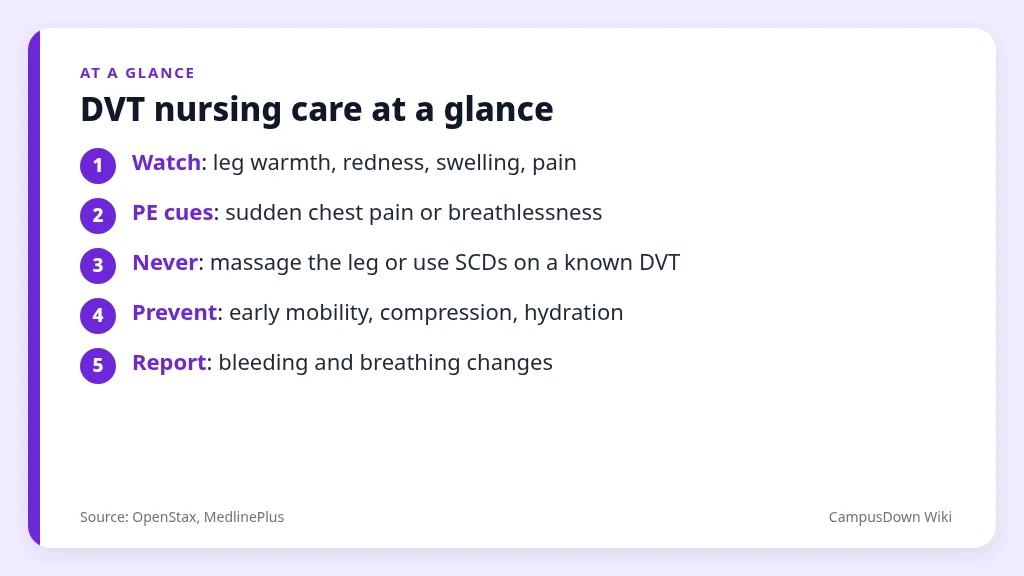
OpenStax says common DVT findings include pain or tenderness, swelling, warmth and redness of the affected leg or calf. For a possible PE, look for:
- sudden chest pain worsened by deep breathing or movement
- tachycardia, cough or coughing blood (hemoptysis)
- looking pale, working harder to breathe at rest or appearing anxious
- a drop in oxygen saturation, especially with walking
Review clotting labs such as PT, PTT and INR, and note that the provider may use imaging, such as venous ultrasound, to confirm DVT. For a full exam, see the head-to-toe assessment; for labs, the lab values cheat sheet.
Get help now if
Sudden shortness of breath, chest pain, a racing heartbeat or coughing blood can mean a PE. Stay with the patient, call for the nurse or rapid response immediately and follow orders; don't leave to finish charting.
Common nursing diagnoses
OpenStax care plans for thrombotic disorders point to problems such as impaired gas exchange, acute pain, impaired mobility, risk for bleeding and risk for infection, and to patient education needs. Your instructor will tell you which NANDA wording your program expects.
Interventions (student view)
Under supervision, and only as ordered and taught:
- Protect oxygenation and hemodynamic stability. OpenStax says supplemental oxygen and raising the head of the bed to a high Fowler's position can help a patient with an acute PE; tell the provider.
- Don't massage or rub the affected leg, and teach the patient not to either.
- Activity per orders. OpenStax's thrombotic disorders chapter teaches bed rest and avoiding further ambulation for an acute DVT; facility practice differs, so follow the provider's activity order.
- Neurovascular checks. OpenStax recommends a neurovascular assessment (the "6Ps") and capillary refill every shift, more often after a clot-removal procedure.
- Anticoagulant therapy as ordered. OpenStax lists first-line therapies as heparin by IV infusion, subcutaneous low-molecular-weight heparin or direct oral anticoagulants; see heparin vs warfarin and apixaban (Eliquis). Check labs per policy and the exact order; never change a rate or dose yourself.
- Watch for bleeding, such as new bruises, nosebleeds, blood in urine or stool, and report it.
- Monitor breathing, oxygen saturation, pain, swelling and warmth; trend them.
Prevention
OpenStax's prevention steps for at-risk patients include:
- Early mobilization and frequent walking, or passive range of motion exercises for patients who can't walk
- Adequate hydration
- Sequential compression devices (SCDs), sleeves that inflate and deflate to move blood in the legs of a bed-bound patient
- Compression hose to help venous return and reduce swelling
- Anticoagulants when ordered
OpenStax is explicit: SCDs should never be used if the patient already has a DVT, because pressure could dislodge the clot and raise the risk for PE, stroke or heart attack. If you aren't sure whether a patient has a DVT, ask before applying one.
MedlinePlus adds general advice for travel: on a long car or plane trip, take breaks, walk or stretch.
Patient teaching
- Why the blood thinner matters and why missing doses is risky; OpenStax says therapy may be short-term (for example, 6 months) or longer
- Bleeding signs to report
- Not to rub or massage the leg
- Moving as allowed and drinking fluids as advised
- Avoiding smoking, and discussing hormone medicines with the provider
- When to call 911: sudden shortness of breath, chest pain or coughing blood
Evaluating the plan
OpenStax's examples of improvement include the patient reporting less shortness of breath with a normal respiratory rate and oxygen saturation, less pain, swelling, warmth and redness, being able to name risk factors, and being able to explain why adherence to anticoagulants matters.
Study tips
- Use cue, action, rationale for each intervention.
- Memorize the two "nevers": no leg massage, and no SCDs on a known DVT.
- Practice an SBAR for new leg swelling and another for sudden breathlessness; see SBAR handoff.
- Learn that a fast heart rate and falling oxygen saturation can be early; see types of shock for related patterns.
Questions for your instructor
- What does our unit require before applying SCDs?
- What activity order do we expect for a new DVT?
- Which bleeding signs do we report immediately?
- What would our rapid response triggers be for a suspected PE?
- Which nursing diagnoses does our exam prefer?
Example scenario: the tight calf
- Who
- Irving, 27, a nursing student in Madison, Wisconsin, was helping a post-op patient walk when she reported a tight, warm calf and then felt short of breath.
- What happened
- He froze for a second, worried he'd done something wrong.
- How it felt
- He felt scared but remembered his notes.
- What they did
- He sat her down, stayed with her, pressed the call light and told the nurse about the calf and breathing change. The nurse called the provider, and Irving later wrote his SBAR in his notes.
- How it turned out
- Irving said knowing the cues made the scary moment manageable.
This is an illustrative example, not a real patient or a review.
Irving's story is an illustrative example. Real situations follow your instructor, your facility and the provider's orders.
Most-asked questions about the DVT nursing care plan
What are the DVT nursing interventions for ATI?
Check your course materials; the main ideas are oxygenation, no leg massage, no SCDs on a known DVT, anticoagulant monitoring and bleeding watch.
Why people ask: "dvt nursing interventions ati" is #2 for "dvt nursing interventions" (US autocomplete, November 2026).
What are the nursing diagnoses for DVT?
Common ones include impaired gas exchange, acute pain, impaired mobility and risk for bleeding; your instructor sets the wording.
Why people ask: "dvt nursing diagnosis" is #4 for "dvt nursing interventions" (US autocomplete, November 2026).
What does a DVT nursing care plan include?
Assessment, diagnoses, interventions, teaching and evaluation, as laid out above.
Why people ask: "dvt nursing care plan" is #5 for "dvt nursing interventions" (US autocomplete, November 2026).
What is DVT nursing management?
Protect oxygenation, give anticoagulants as ordered, watch for bleeding and PE and teach the patient.
Why people ask: "dvt nursing management" is #6 for "dvt nursing interventions" (US autocomplete, November 2026).
What is the DVT nursing assessment?
Look for leg pain, swelling, warmth and redness, and for breathing changes that could signal PE.
Why people ask: "dvt nursing assessment" is #8 for "dvt nursing interventions" (US autocomplete, November 2026).
What are DVT nursing considerations?
Don't massage the leg, don't use SCDs on a known DVT and report sudden breathlessness.
Why people ask: "dvt nursing considerations" is #9 for "dvt nursing interventions" (US autocomplete, November 2026).
What are DVT nursing actions?
Support breathing, notify the provider, follow activity and anticoagulant orders, monitor and teach.
Why people ask: "dvt nursing actions" is #10 for "dvt nursing interventions" (US autocomplete, November 2026).
What is in a DVT prevention nursing care plan?
Early mobilization, hydration, compression, SCDs when appropriate and anticoagulants when ordered.
Why people ask: "dvt prevention nursing care plan" is #7 for "dvt nursing care plan" (US autocomplete, November 2026).
How do I write a risk for DVT nursing care plan?
Name the risk factors, the preventive interventions and the expected outcomes, as OpenStax's examples do.
Why people ask: "risk for dvt nursing care plan" is #9 for "dvt nursing care plan" (US autocomplete, November 2026).
Related on CampusDown
You can learn more about the nursing student hub and check it for yourself in the heparin vs warfarin guide. For handoff in detail, see SBAR handoff.
Frequently asked questions
- Should I massage a swollen leg?
- No; OpenStax says avoid massaging or rubbing the affected leg.
- Can SCDs be used with a DVT?
- No; OpenStax says never, because the clot could dislodge.
- What are PE warning signs?
- Sudden shortness of breath, chest pain worse with breathing, fast heart rate, cough or coughing blood.
- What treats a DVT?
- A blood thinner as ordered, such as heparin, low-molecular-weight heparin or a DOAC.
- How can travelers lower risk?
- MedlinePlus advises taking breaks, walking or stretching on long trips.
DVT care rests on two skills: prevent clots with movement and the right devices, and recognize a moving clot fast. Know the cues, avoid the "nevers" and report sudden breathing changes immediately.
Browse more guides like this in the Nursing Student and NCLEX hub.
This article is for general education and does not replace advice from your own doctor, nurse or pharmacist.