
Two patients arrive with sky-high glucose, one breathing fast and deep with a fruity breath smell, the other drowsy and dry. Both need the ICU, but they are not the same problem. How do you tell them apart on an exam, and at the bedside?
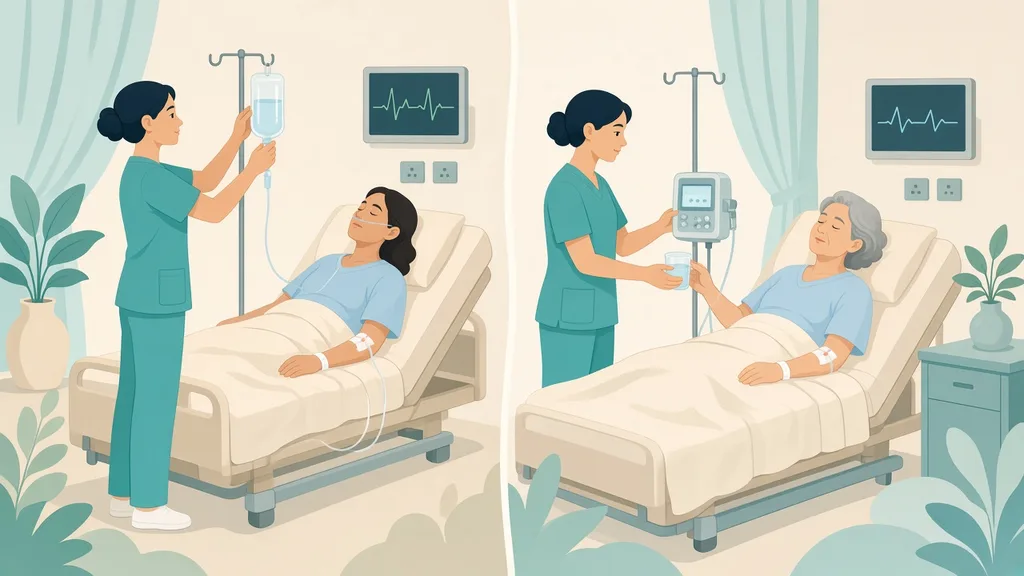
This guide uses OpenStax Medical-Surgical Nursing (section 21.2, Diabetes Mellitus, Table 21.6) and the 2024 ADA/EASD/JBDS/AACE/DTS consensus report on hyperglycaemic crises in adults. It is for education only. Follow your instructor, facility policy and the provider's orders. If you want to learn more about insulin products, take a closer look at the insulin types chart.
The comparison table (OpenStax Table 21.6)
| DKA (diabetic ketoacidosis) | HHS (hyperosmolar hyperglycemic state) | |
|---|---|---|
| Usually seen in | Type 1 diabetes | More common in type 2 diabetes |
| Onset | Within 24 hours | Days to weeks |
| Triggers | Sepsis, infection, stress, missed insulin dose | Illness and infection |
| Mechanism | Lack of insulin, so fat breaks down into ketones | Chronic hyperglycemia, severe dehydration, weakness, confusion |
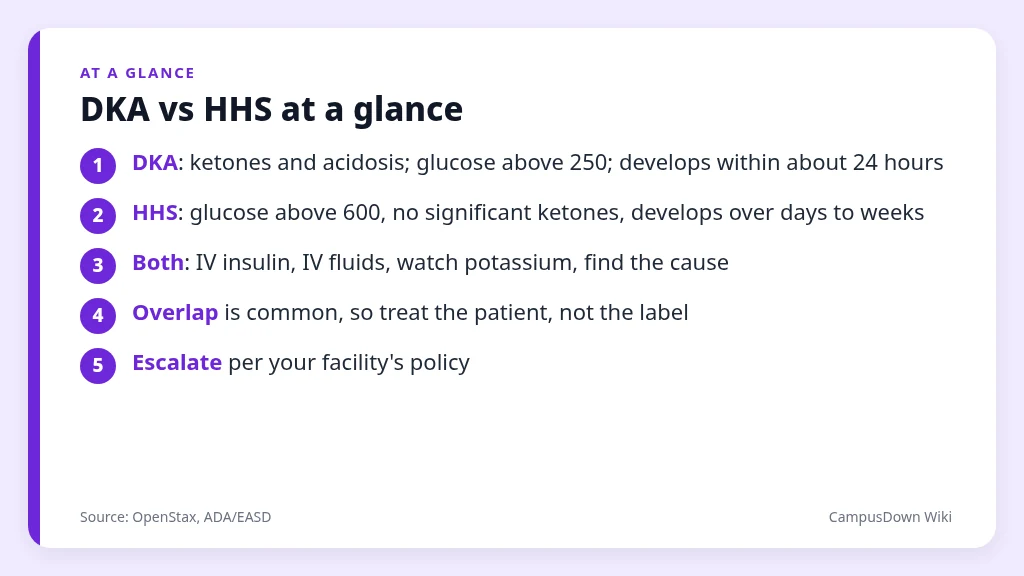
| Glucose | Above 250 mg/dL | Above 600 mg/dL |
| Blood pH | 7.3 or lower | Remains normal |
| Ketones | In blood and urine | None |
| Anion gap | Increased (about above 12) | Normal (about 8 to 12) |
| Mortality | About 1% | Up to 20% |
OpenStax adds that DKA causes metabolic acidosis, diuresis, vomiting, acute kidney injury, dehydration and electrolyte abnormalities, while HHS can cause seizures, coma and organ failure. Review acid-base interpretation in ABG interpretation with ROME.

What the 2024 consensus report adds
- DKA needs three things: hyperglycemia, ketones in blood or urine and metabolic acidosis. HHS is severe hyperglycemia, hyperosmolality and dehydration without significant ketosis or acidosis, though mild ketones may be present.
- DKA often develops over hours to a few days; HHS over days to weeks. Both may present with polyuria, polydipsia, weight loss, vomiting, dehydration and change in cognitive state.
- Clinical overlap occurs in more than one-third of people with hyperglycemic crises.
- The glucose threshold has been relaxed for DKA: the report says some people, including those on SGLT2 inhibitors, can have DKA with glucose below 200 mg/dL (euglycemic DKA).
- It notes a rise in DKA hospitalizations, especially in adults under 45.
OpenStax describes Kussmaul respirations as rapid, deep breathing at a consistent pace, a finding associated with metabolic acidosis in DKA. Follow your unit's assessment priorities.
Get help now if
Very high blood glucose with vomiting, deep fast breathing, confusion, extreme thirst or drowsiness is an emergency. Call 911 or the rapid response team right away.
Treatment is shared (OpenStax)
OpenStax says treatment happens in the ICU and is the same in both:
- IV insulin (titrated according to glucose and ketone levels in DKA)
- Aggressive IV fluid hydration
- Monitoring and correcting electrolytes, especially potassium
- Evaluating for the underlying cause such as infection
See IV fluids: isotonic and hypotonic and how to check blood sugar.
Why potassium needs attention
The consensus report explains that most people with DKA present with normal or high serum potassium despite total-body potassium depletion, because acidosis and insulin deficiency move potassium out of cells, and that hypokalemia is common after insulin treatment begins. For that reason your orders and labs guide potassium replacement. Review potassium normal range for nursing and high potassium (hyperkalemia).
Nursing priorities (general)
- Airway, breathing and circulation first; follow protocols
- Frequent glucose, ketone and lab monitoring per orders
- Neurologic checks (confusion is a clue in both)
- Fluid status and urine output
- Look for triggers such as infection, missed insulin or new medicines
- Teach prevention later: sick-day plans, never skipping insulin without guidance, and when to call
Questions to ask your instructor or preceptor
- What are our unit's DKA and HHS order sets?
- How often do we check glucose and electrolytes?
- Which numbers define "resolution" on this unit?
- How do we handle patients on SGLT2 inhibitors?
- What teaching do we give before discharge?
Example scenario: the "normal" glucose
- Who
- Leontine, 23, a nursing student in Nashville, Tennessee, helped care for a patient with type 1 diabetes who was vomiting and breathing fast, but whose glucose was only moderately high.
- What happened
- She assumed it couldn't be DKA without a glucose over 250.
- How it felt
- She felt confused and worried about missing something.
- What they did
- She told her preceptor, who explained that DKA can occur without very high glucose in some situations and that the team would check ketones and acid-base status; the provider was called. Leontine wrote down the pattern and asked for the facility's protocol.
- How it turned out
- Leontine said the exam table was a start but the patient came first.
This is an illustrative example, not a real patient or a review.
Leontine's story is an illustrative example. Always follow your facility's policy and the provider's orders.
Most-asked questions about DKA versus HHS
What are the symptoms of DKA vs HHS?
Both can cause polyuria, polydipsia, weight loss, vomiting, dehydration and mental changes; DKA adds acidosis signs such as deep fast breathing, and HHS develops more slowly.
Why people ask: "dka vs hhs symptoms" is #2 for "dka vs hhs" (US autocomplete, November 2026).
How does treatment differ for DKA vs HHS?
OpenStax says it is the same: IV insulin, aggressive IV fluids, electrolyte monitoring (especially potassium) and finding the cause.
Why people ask: "dka vs hhs treatment" is #3 for "dka vs hhs" (US autocomplete, November 2026).
What are the criteria for DKA vs HHS?
DKA: high glucose, ketones and acidosis (pH 7.3 or lower in OpenStax). HHS: glucose above 600, normal pH and no significant ketones.
Why people ask: "dka vs hhs criteria" is #4 for "dka vs hhs" (US autocomplete, November 2026).
Is there a DKA vs HHS chart?
Yes; see the table above based on OpenStax Table 21.6.
Why people ask: "dka vs hhs chart" is #5 for "dka vs hhs" (US autocomplete, November 2026).
What are the labs for DKA vs HHS?
Glucose, pH, ketones and anion gap differ, and electrolytes such as potassium need close monitoring.
Why people ask: "dka vs hhs labs" is #6 for "dka vs hhs" (US autocomplete, November 2026).
What is the blood sugar level for DKA vs HHS?
OpenStax lists above 250 mg/dL for DKA and above 600 mg/dL for HHS; euglycemic DKA is possible.
Why people ask: "dka vs hhs blood sugar level" is #7 for "dka vs hhs" (US autocomplete, November 2026).
What are the glucose levels in DKA vs HHS?
Above 250 mg/dL in DKA per OpenStax, above 600 in HHS; the consensus report notes some DKA cases are below 200.
Why people ask: "dka vs hhs glucose levels" is #8 for "dka vs hhs" (US autocomplete, November 2026).
What is the pathophysiology of DKA vs HHS?
In DKA, lack of insulin leads to fat breakdown into ketones and acidosis; in HHS, chronic hyperglycemia causes severe dehydration with little ketosis.
Why people ask: "dka vs hhs pathophysiology" is #9 for "dka vs hhs" (US autocomplete, November 2026).
What is DKA vs HHS in nursing?
Two hyperglycemic emergencies with shared care priorities: ICU monitoring, IV insulin, fluids, electrolytes and cause-finding.
Why people ask: "dka vs hhs nursing" is #10 for "dka vs hhs" (US autocomplete, November 2026).
What are nursing interventions for DKA vs HHS?
Airway and breathing checks, frequent glucose and lab monitoring, neuro checks, fluid status, trigger search and teaching, following provider orders.
Why people ask: "dka vs hhs nursing interventions" is #2 for "dka vs hhs nursing" (US autocomplete, November 2026).
What does DKA and HHS nursing cover?
Recognizing each condition, monitoring and following the shared treatment plan, and preventing recurrence.
Why people ask: "dka and hhs nursing" is #3 for "dka vs hhs nursing" (US autocomplete, November 2026).
Where can I find DKA and HHS nursing questions?
The sources here don't include exam questions; your course materials do, and the table above is a good study guide.
Why people ask: "dka and hhs nursing questions" is #4 for "dka vs hhs nursing" (US autocomplete, November 2026).
Related on CampusDown
You can learn more about the nursing student hub and check it for yourself in the insulin types chart. For acid-base in detail, see ABG interpretation with ROME, and for risk-factor background see prediabetes.
Frequently asked questions
- Which develops faster, DKA or HHS?
- DKA, within about 24 hours per OpenStax; HHS takes days to weeks.
- Which has ketones?
- DKA; HHS has none or only mild ketones.
- Is treatment different?
- OpenStax says it is the same in both: IV insulin, fluids, potassium monitoring and finding the cause.
- Can DKA happen with normal glucose?
- The consensus report says some cases, including with SGLT2 inhibitors, have glucose below 200 mg/dL.
- Can the two overlap?
- Yes; the report says overlap occurs in more than one-third of cases.
DKA and HHS are both hyperglycemic emergencies that need ICU-level care. Know the table, the shared treatment, the overlap, the potassium issue and the triggers, and let the patient's findings and your facility's orders lead.
Browse more guides like this in the Nursing Student and NCLEX hub.
This article is for general education and does not replace advice from your own doctor, nurse or pharmacist.