
You've been handed a meter and told to "check your sugar," and the first stick feels awkward. How hard can it be? The steps are simple, but small mistakes, like testing with sticky fingers or old strips, can give numbers that mislead you. Here's a clear, step-by-step way to check, and a way to track the numbers so they help.

This guide is based on the VA Veterans Health Library (How to Check Your Blood Glucose) and the American Diabetes Association's meter guide (based on the 2023 Standards of Care). We explain in detail what the steps are. Your diabetes care team decides when and how often you test and what your targets are.
Why check at all
The VA says keeping track of the sugar in your blood is an important part of self-care and gives you and your team information about how food, exercise, medicine and other factors make your glucose go up and down. The ADA adds that it also helps track progress toward treatment goals and shows when numbers are high or low due to meals, activity, medicines (including insulin), illness or stress.

What you need
- A glucose meter (the VA says not to share it with others)
- Test strips, with the expiration date checked and stored properly
- A lancet and a matching lancing device
- A sharps container for used lancets
- A notebook or log
Your meter's own instructions come first; for a specific model, see the Contour Next One meter guide.
Step by step
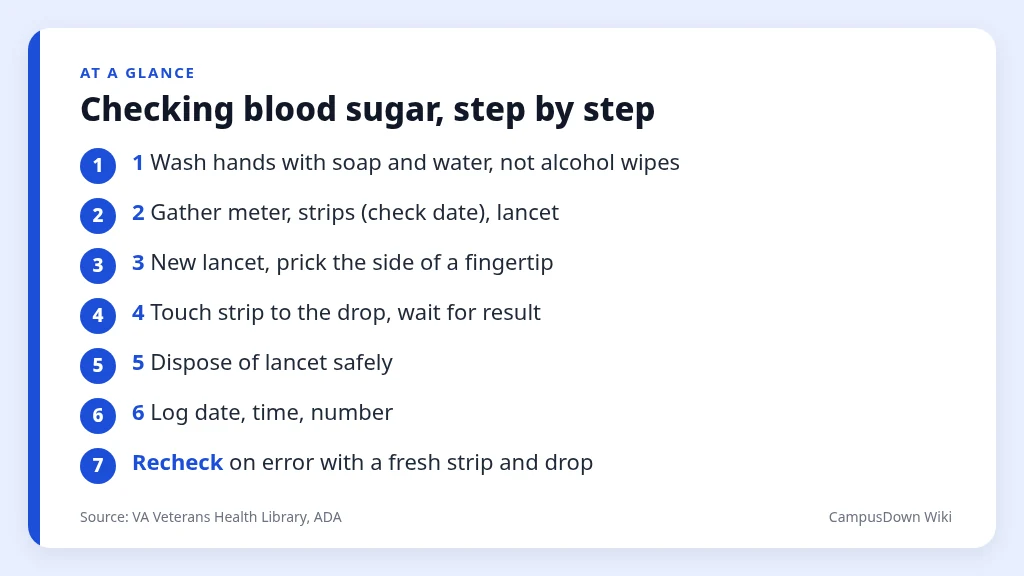
- Wash your hands with soap and water, then dry them. The VA says don't use alcohol wipes, and that food or lotion on your fingers gives incorrect numbers. The ADA agrees that food or other substances can affect the reading.
2. Gather supplies and check the strip date. The ADA says don't use expired strips or test with a low-battery meter. 3. Insert a new lancet each time into the lancing device. 4. Prick the side of the fingertip, and alternate fingers. The ADA tip: don't "over squeeze" the finger. 5. Touch the edge of the test strip to the blood drop and keep it there until the meter shows the result (after the meter prompts you, per the VA). 6. Dispose of the lancet in a heavy-duty container with rigid sides, such as a laundry detergent container, says the VA. 7. Read and record the result.
If the number looks wrong
The VA says if you see an error message, recheck with a fresh strip and a fresh blood drop. Also recheck if the number isn't what you expect, such as too low without symptoms or too high for no reason. If you feel unwell, don't wait; treat symptoms as real. For low-sugar signs and what to do, see hypoglycemia in older adults.
When to test
The ADA says people using insulin may need to check:
- Fasting or on waking
- Before meals and snacks
- At bedtime
- Before exercise
- When low blood sugar is suspected, and after treating a low until it rises to target
- Before and during critical tasks such as driving
It also says to talk with your diabetes care team about when you should check. People not on insulin may be told something different, so ask.
Keep a log
The VA suggests using a notebook, chart or logbook and writing the date, time and number, which helps you see patterns such as high sugar after certain foods. Take the log to your visits, because it helps your provider decide whether to change your plan. Some meters and apps store readings too; ask your team how they'd like to see them. More on goals and care at diabetes in older adults.
Checking without finger sticks
Some people use a continuous glucose monitor (CGM) instead of, or alongside, finger sticks. Whether one suits you is a question for your doctor. Learn more in the guides to the Dexcom G7, the FreeStyle Libre 3 Plus, meter vs CGM and CGM Medicare coverage.
Get help now if
If you have a high or low reading with symptoms such as confusion, fainting, vomiting or trouble breathing, call 911 or your emergency number. For other concerns, call your doctor.
Example scenario: the sticky-finger reading
- Who
- Magnus, 78, a retired shipyard welder in Mobile, Alabama, had started checking his sugar each morning after his doctor added a new medicine. His wife, Ilse, 76, a retired seamstress, noticed he often tested right after peeling oranges.
- What happened
- His readings were bouncing from day to day, and one morning the number was so high he panicked and almost skipped breakfast.
- How it felt
- Magnus felt anxious and a little foolish about the whole routine. Ilse felt she'd failed to notice sooner.
- What they did
- Ilse called the pharmacy, where the pharmacist went through the meter steps with them. Hands washed with soap and water, a fresh lancet, the side of the fingertip, a recheck with a new strip when a number seemed off. They started a notebook with the date, time and number and brought it to his next visit, where his doctor reviewed the pattern and answered their questions.
- How it turned out
- Magnus said the numbers made sense once he stopped fighting the meter. Ilse said the notebook turned an awkward chore into a routine.
This is an illustrative example, not a real patient or a review.
Magnus's story is an illustrative example. Your care team decides your testing plan.
Most-asked questions about checking blood sugar
How do I check blood sugar at home?
Wash and dry hands, use a new lancet on the side of a fingertip, touch the strip to the drop and read the result, then log it.
Why people ask: "how to check blood sugar at home" is #2 for "how to check blood sugar" (US autocomplete, November 2026).
How do I check blood sugar at home with a finger stick?
Prick the side of the fingertip with a fresh lancet, alternate fingers and don't squeeze too hard.
Why people ask: "how to check blood sugar at home with finger" is #3 for "how to check blood sugar" (US autocomplete, November 2026).
How do I check blood sugar levels?
A home meter is the common way; ask your team how often. Lab tests and CGMs are other options.
Why people ask: "how to check blood sugar levels" is #4 for "how to check blood sugar" (US autocomplete, November 2026).
How can I check blood sugar without pricking?
Some people use a CGM; ask your doctor whether one suits you.
Why people ask: "how to check blood sugar without pricking" is #8 for "how to check blood sugar" (US autocomplete, November 2026).
How do I use a glucose meter?
Follow the ADA steps: wash hands, insert a strip, lance the fingertip, touch the strip to the drop and read the screen.
Why people ask: "how to use a glucose meter" is #1 for "how to use a glucose meter" (US autocomplete, November 2026).
How do I use a blood sugar meter?
The same steps; check strip dates and meter battery first.
Why people ask: "how to use a blood sugar meter" is #3 for "how to use a glucose meter" (US autocomplete, November 2026).
How to test blood sugar at home?
Use a meter with the steps above and log the numbers.
Why people ask: "how to test blood sugar at home" is #1 for "how to test blood sugar at home" (US autocomplete, November 2026).
Related on CampusDown
You can learn more about diabetes in older adults and take a closer look at the Contour Next One.
Frequently asked questions
- Should I use alcohol wipes on my finger?
- The VA says no; wash with soap and water.
- Can I reuse a lancet?
- The VA says use a new lancet each time.
- Which finger and where?
- The side of the fingertip, alternating fingers, per the VA.
- What if the number seems wrong?
- Recheck with a fresh strip and drop; tell your team if it keeps happening.
Clean hands, fresh supplies and a simple log make home testing reliable. Ask your team when to test and what to do with the numbers.
Browse more guides like this in the Home Medical Devices hub.
This article is for general education and does not replace advice from your own doctor, nurse or pharmacist.