
Is your parent really ready to go home, or just ready to leave the hospital bed? Those are different questions, and the gap between them is where many falls, missed medicines and return trips to the emergency room begin. A good discharge plan closes that gap before the wheelchair reaches the door.

This guide is built on Medicare's official "Your discharge planning checklist," with practical additions for families caring for an older adult. If a discharge date has already been mentioned, take a closer look at the medication and safety steps today.
Who plans the discharge
Medicare's checklist says your doctor and the staff, such as a discharge planner, social worker, ombudsman or nurse, will work with you, and that you and your caregiver are members of the planning team. Ask early in the stay who the case manager or discharge planner is, and write down their name and number. A family meeting, sometimes called a discharge planning meeting, is a good time to raise concerns and decide who does what.

The checklist, step by step
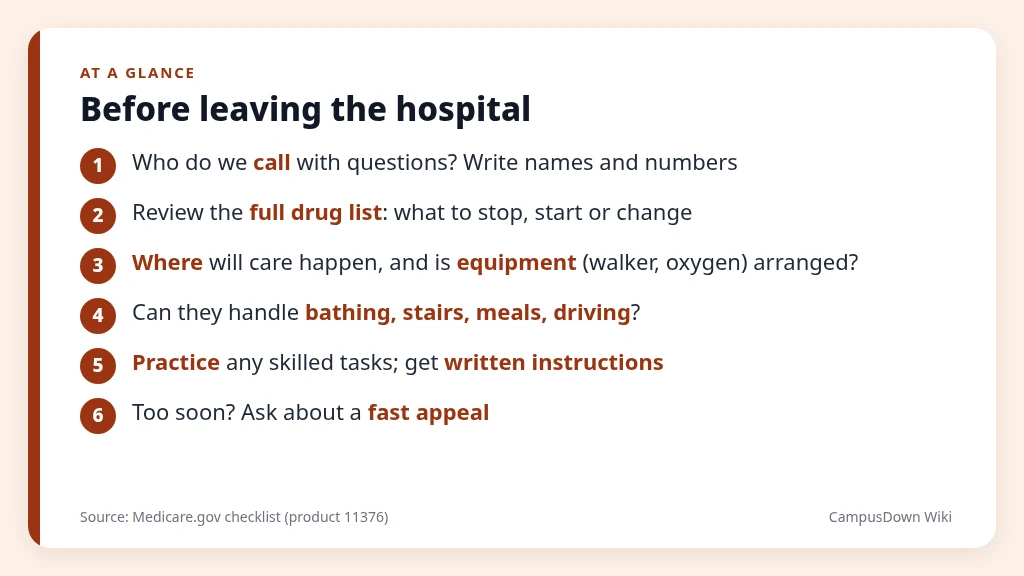
Medicare's checklist suggests you:
- Write down names and phone numbers of people to call with questions.
2. Ask about complications to watch for and what to do about them. 3. List every drug: prescriptions, over-the-counter drugs, vitamins and herbal supplements taken at home, and any changes during the stay. Review it with staff and ask which to continue, at what dose, and share the updated list with all providers. 4. Ask where care will happen after discharge and whether there are options like home health care; tell staff what you prefer. 5. Ask about medical equipment, such as a walker, whether Medicare covers it, and who arranges delivery. 6. Check readiness for daily activities: bathing, dressing, using the bathroom, climbing stairs, cooking, shopping, cleaning, paying bills, and getting to appointments. 7. Learn and practice any skilled tasks, like changing a bandage or giving a shot. 8. Talk to a social worker about coping and about insurance coverage and costs. 9. Get written discharge instructions you can read and understand, plus a summary of current health status, and bring them and the drug list to follow-up visits.
For caregivers, the checklist adds: be honest about what help you can give, ask for training, and pick up prescriptions and special foods before discharge day.
Lists are easy to nod along to. Here is how one family used it.
Example scenario: three new pills and one old one
- Who
- Rosa, 84, a retired cafeteria cook admitted for heart failure, lives with her son Daniel, 58, who works night shifts.
- What happened
- On discharge day she was handed a stack of papers listing three new medicines, and Daniel noticed her old water pill was still in her weekly pill box at home.
- How it felt
- Daniel felt overwhelmed and frightened of getting it wrong; Rosa was tired and confused, and kept saying she just wanted to sleep in her own bed.
- What they did
- Daniel asked the nurse to sit down with the full drug list, crossed out the old medicine, asked for a daily weight log and the warning signs to call about, and requested a home health referral and a shower chair.
- How it turned out
- Rosa went home with an updated pill box, a scale by the bed and a nurse visit scheduled for the next week. When her weight rose two days in a row, Daniel called the clinic early, and her medicine was adjusted without another hospital stay.
This is an illustrative example, not a real patient or a review.
Rosa's story is an illustration, not a real case. Your discharge plan should come from your loved one's care team.
Extra tips for older adults
- Watch for confusion. Hospital stays can trigger delirium in older adults. Report new or worsening confusion before discharge.
- Know the status. Ask whether your parent was an inpatient or under observation, because it affects rehab coverage; see observation vs inpatient.
- Choose post-acute care carefully. If rehab is needed, review Medicare's SNF rules and compare facilities on Medicare's Care Compare. For home care, see Medicare home health.
Get help now if
If you believe the discharge is unsafe or too soon, say so in writing and ask about a fast appeal before the deadline on the Important Message from Medicare or Notice of Medicare Non-Coverage. Read the steps in detail in fast appeals.
Most-asked questions about discharge planning
What should discharge planning for elderly patients include?
Contacts, warning signs, a reconciled drug list, where care will happen, equipment, help with daily activities, caregiver training, written instructions and follow-up appointments, per Medicare's checklist.
Why people ask: "discharge planning for elderly patients" is the #1 Google suggestion and "discharge planning for elderly" is #2 for "discharge planning elderly" (US autocomplete, November 2026).
What is a discharge planning meeting?
A conversation among the patient, family and care team, often including a case manager, social worker, nurse and therapist, to agree on the plan for leaving. Ask for one if it is not offered.
Why people ask: "what is a discharge planning meeting" is #5 for "discharge planning elderly" (US, November 2026).
Can an elderly person discharge themselves from the hospital?
Adults who can make their own decisions generally may choose to leave, sometimes called leaving against medical advice, but it can carry health and coverage risks. Talk with the team first.
Why people ask: "can an elderly person discharge themselves from hospital" is #4 for "discharge planning elderly" (US, November 2026).
Who are hospital discharge planners?
Usually nurses or social workers in case management who coordinate the plan, referrals and equipment. Ask for their name early in the stay.
Why people ask: "hospital discharge planners" is #8 for "hospital discharge" (US, November 2026).
On the morning of discharge, check it for yourself: medications filled, equipment delivered, follow-up booked, and a phone number for questions after hours.
Frequently asked questions
- When does discharge planning start?
- Medicare's checklist encourages using it throughout the stay, not just on the last day.
- Will Medicare pay for a walker or hospital bed at home?
- Part B covers medically necessary durable medical equipment ordered by your provider; ask who will arrange delivery.
- What if my parent can't manage at home?
- Ask about home health, rehab, or other settings, and talk with a social worker about costs and community resources.
- Where can caregivers get help?
- The checklist lists Medicare, the Long-Term Care Ombudsman Program, State Health Insurance Assistance Programs and the National Council on Aging.
A safe discharge is a plan the whole family understands before leaving. Learn more about each step with the care team, and keep the updated drug list where everyone can see it.
Browse more guides like this in the Senior Health and Medicare hub.
This article is for general education and does not replace advice from your own doctor, nurse or pharmacist.