
What do you do when the hospital says your father is going home tomorrow and you know he cannot climb his own front steps? Many families do not realize Medicare gives them a formal, fast way to ask an independent reviewer to look again, and that the clock starts with a piece of paper they may have signed without reading.
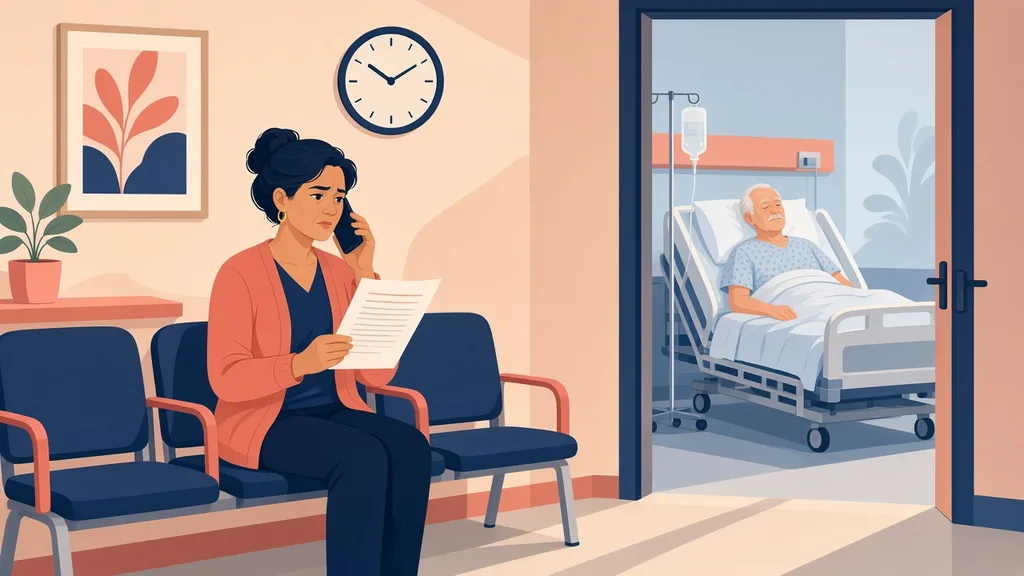
This guide follows Medicare.gov's fast appeals page step by step. It covers Original Medicare and notes where Medicare Advantage differs. If a discharge is scheduled in the next day or two, take a closer look at the deadlines now.
When a fast appeal applies
A fast appeal lets an independent reviewer, called a Beneficiary and Family Centered Care Quality Improvement Organization (BFCC-QIO), decide whether your covered services should continue. It applies to inpatient hospital discharges and to services ending in other settings such as a skilled nursing facility, home health, hospice or comprehensive outpatient rehabilitation. Medicare.gov says you can also ask for a fast appeal while still in the hospital if you were admitted as an inpatient and the hospital changed your status to outpatient getting observation services; see observation vs inpatient.

Step 1: Find the notice
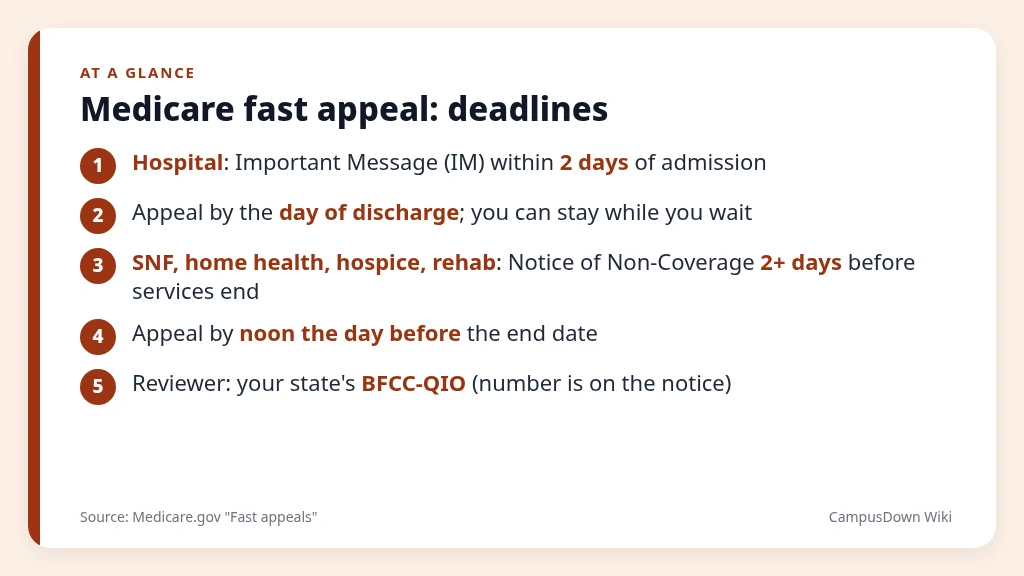
- In a hospital: within 2 days of admission and before discharge, you should get the Important Message from Medicare about Your Rights (IM). If it was given more than 2 days before discharge, the hospital must give you a copy or a new one before you leave.
- In other settings: you should get a Notice of Medicare Non-Coverage at least 2 days before covered services end.
If you did not get the notice, ask for it. It includes the end date, your rights and the BFCC-QIO's contact information.
Step 2: Call before the deadline
- Hospital: follow the IM's directions no later than the day you are scheduled to be discharged. If you do, you can stay while you wait for the decision and won't have to pay for the stay except applicable coinsurance or deductibles.
- Other settings: follow the notice's instructions no later than noon the day before the end date.
If you miss the deadline, you can still ask for review, but different rules apply and you may owe costs after the original end date.
Step 3: The review
The BFCC-QIO notifies the hospital or provider, which must give you a detailed notice explaining why services are ending. The reviewer asks why you think coverage should continue, looks at the medical records, and decides within one day of getting the information in a hospital, or by close of business the day after it has what it needs in other settings.
Rights on paper only help if someone uses them. The story below shows what that looks like in a real-feeling evening.
Example scenario: the Thursday-night notice
- Who
- Sam, 83, a retired machinist recovering from pneumonia in the hospital, still short of breath walking to the bathroom; Anjali, 47, his daughter, a pharmacist who lives 20 minutes away.
- What happened
- On Thursday evening a nurse said Sam would be discharged home Friday morning. Anjali found the Important Message from Medicare in a folder of papers he had signed on admission.
- How it felt
- She felt a surge of anger and fear, picturing him alone on the stairs, and guilt that she could not take time off. Sam was embarrassed and insisted he would "manage."
- What they did
- That night Anjali called the BFCC-QIO number on the IM, explained his oxygen needs and stair problem, and asked the case manager to note her concerns and send the records.
- How it turned out
- The reviewer agreed his discharge was premature. Sam stayed two more days, was evaluated for home oxygen and home health, and went home with a safer plan. Anjali now reads every notice the day it is given.
This is an illustrative example, not a real patient or a review.
Sam and Anjali are an illustration, not real people; outcomes depend on the medical record and the reviewer.
Get help now if
A fast appeal is not a way to stay when it is medically safe to leave; if you lose and stay past the end date, you may owe costs. Ask the care team about safety concerns first, and appeal when you believe care is ending too soon.
Medicare Advantage differences
Medicare.gov notes that if you are in a Medicare Advantage plan, you can ask your plan for an appeal, but different rules apply, and plan coverage after a favorable decision may depend on whether the plan authorized the inpatient admission. Call the plan and the BFCC-QIO number on your notice. Compare plan types in Medicare Advantage vs Medigap.
Most-asked questions about fast appeals
How do I appeal a discharge from rehab or a nursing facility?
Use the Notice of Medicare Non-Coverage and call the BFCC-QIO listed on it no later than noon the day before the end date. See Medicare's SNF rules.
Why people ask: "medicare appeal discharge from rehab" is #2 for "medicare appeal discharge" (US autocomplete, November 2026).
How do I appeal a hospital discharge?
Follow the Important Message from Medicare and call the BFCC-QIO no later than your scheduled discharge day; you can stay while you wait.
Why people ask: "medicare appeal discharge from hospital" is #3 for "medicare appeal discharge" (US, November 2026).
How long does a Medicare fast appeal take?
In a hospital, the reviewer decides within one day of getting the needed information; in other settings, by close of business the day after.
Why people ask: "how long does a medicare appeal take" is #2 for "medicare fast track appeal" (US, November 2026).
What phone number do I call?
The number for your state's BFCC-QIO is printed on the IM or the Notice of Medicare Non-Coverage. Medicare.gov says BFCC-QIOs are run by Commence or Acentra, depending on your state.
Why people ask: "medicare appeal discharge phone number" is #4 for "medicare appeal discharge" (US, November 2026).
At admission, check it for yourself: ask for the IM, read it in detail, and save the reviewer's phone number in your phone.
Related on CampusDown
Plan the move home with hospital discharge planning and learn about Medicare home health after discharge.
Frequently asked questions
- Does an appeal cost anything?
- If you appeal on time from a hospital, you generally don't pay for the extra days while waiting, except usual coinsurance or deductibles.
- Can a family member file the appeal?
- The notices name the patient, but a representative can help; ask the BFCC-QIO what authorization it needs.
- What if the reviewer says no?
- Medicare.gov describes further appeal steps; ask the BFCC-QIO and check the timelines on your decision letter.
- Do I have to sign the Important Message?
- Signing shows you received it, not that you agree with the discharge.
A fast appeal turns a hallway argument into an independent review with clear deadlines. Learn more about your rights on the day of admission, not the night before discharge.
Browse more guides like this in the Senior Health and Medicare hub.
This article is for general education and does not replace advice from your own doctor, nurse or pharmacist.