
When did you last wash your CPAP hose? If you had to think about it, you are in good company. Cleaning is the CPAP chore people skip most, and the late-night TV ads for "CPAP sanitizers" make it sound as if you need a special machine to do it.
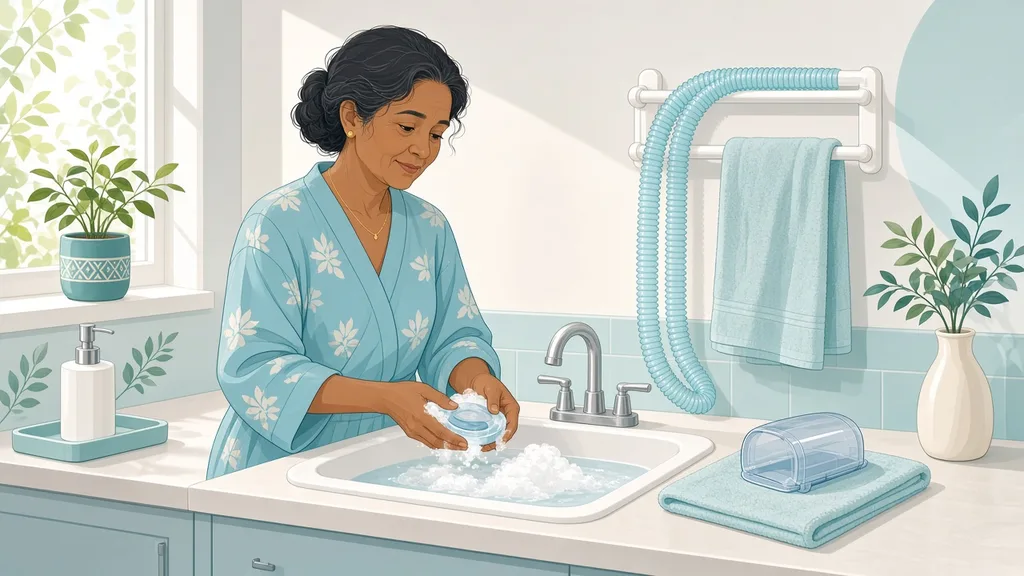
You do not. The FDA and CPAP manufacturers say most parts can be cleaned with mild soap and warm water. This guide uses the FDA's consumer update and safety communications and ResMed's AirSense 11 and AirFit F20 user guides, checked in November 2026. Always follow the manual for your own machine and mask first.
Why cleaning matters
The FDA explains that germs from your lungs, throat or mouth can get into the mask and hose as you breathe, and germs from your skin can transfer to the mask. Dust, mold and allergens can also get in. A dirty machine, filter, hose or mask "can make you sick," the FDA says, and dirt can also make the machine more likely to break.

The daily routine
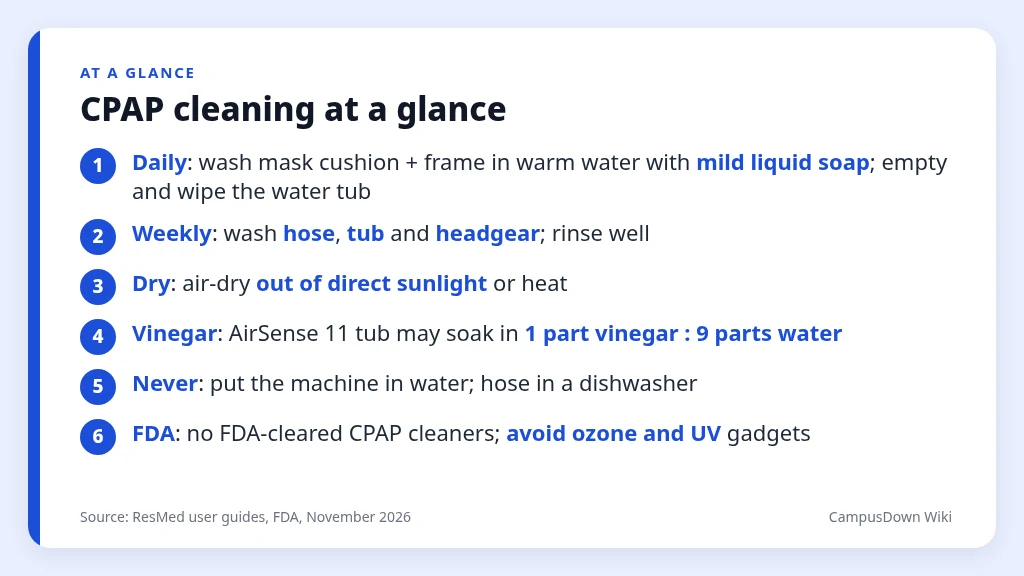
Mask (cushion, frame and elbow). ResMed's AirFit F20 guide says, daily or after each use:
- Take the mask apart.
2. Rinse the frame, elbow and cushion under running water, using a soft brush until dirt is gone. 3. Soak up to ten minutes in warm water (about 86°F / 30°C) with mild liquid detergent. 4. Brush the elbow's moving parts and around the vent holes. 5. Rinse under running water. 6. Air-dry out of direct sunlight.
Nasal pillows and other masks have similar steps; check your own mask's guide.
Water tub. For the AirSense 11, empty the humidifier tub, wipe it with a clean disposable cloth, let it dry out of direct sunlight, and refill. Use distilled water in the HumidAir 11 Standard tub.
The weekly routine
Hose (air tubing): wash in warm water with mild dishwashing liquid, rinse thoroughly, and hang to air-dry out of direct sunlight or heat. ResMed says do not put tubing in a dishwasher or washing machine.
Water tub and outlet connector (AirSense 11): wash in warm water with mild dishwashing liquid or soak in 1 part vinegar to 9 parts water at room temperature, then rinse. ResMed says the tub and outlet connector may go in a dishwasher.
Headgear: hand-wash in warm water with mild liquid detergent, rinse until detergent-free, squeeze out the water, and air-dry.
Machine: wipe the outside with a dry cloth (ResMed) or a damp towel (FDA). Never put any part with an electrical cord into water.
Key point
ResMed says components should not be washed in water hotter than 131°F (55°C), and some cleaning products can damage the mask or leave vapors you could inhale if not rinsed well. Plain mild soap is the safe default.
Filters and parts that wear out
- Air filter (AirSense 11): replace every six months, sooner if it has holes or is clogged. It is not washable. ResMed's website suggests checking filters twice a month.
- Tub: replace if it leaks or becomes cracked, cloudy or pitted. White mineral deposits can be removed with the vinegar solution.
- Hose: replace if it has holes, tears or cracks.
- Anything with visible cracking, discoloration or tears should be thrown out and replaced, ResMed says.
Medicare's PAP policy (LCD L33718) lists the usual maximum it covers for these parts:
| Part | Usual maximum |
|---|---|
| Standard tubing (A7037) | 1 per 3 months |
| Heated tubing (A4604) | 1 per 3 months |
| Disposable filters (A7038) | 2 per month |
| Non-disposable filter (A7039) | 1 per 6 months |
| Humidifier water chamber (A7046) | 1 per 6 months |
Our CPAP mask types guide lists the mask and cushion limits.
Example scenario: the hose behind the nightstand
- Who
- Rosalind, 58, a pharmacy billing clerk in Columbus, Ohio, had used CPAP for four years and was proud of rarely missing a night.
- What happened
- Over one humid summer she noticed a musty smell when she put the mask on and saw dark specks inside the hose where it dipped behind her nightstand. She had been rinsing the mask but had not washed the hose in months.
- How it felt
- She felt grossed out, then anxious, wondering whether she had been breathing mold all summer. A TV ad for an ozone CPAP sanitizer suddenly looked tempting, and she nearly ordered one that night.
- What they did
- She called her equipment supplier first. They sent a new hose under her plan's replacement allowance and walked her through the weekly wash. She read the FDA's warning about ozone cleaners and skipped the gadget. She also started hanging the hose over the shower rod to dry on Sunday mornings.
- How it turned out
- The smell was gone with the new hose, and her routine now takes about ten minutes on Sundays. She mentioned the episode to her doctor at her next visit, who said to call if she ever had cough or fever.
This is an illustrative example, not a real patient or a review.
Rosalind is an illustrative example, not a real patient. If you notice mold or feel unwell, talk to your doctor and replace the parts.
The FDA's warning about ozone and UV "CPAP cleaners"
In a February 2020 safety communication and a later consumer update, the FDA said:
- There are no FDA-cleared or approved devices for cleaning, disinfecting or sanitizing CPAP machines.
- Products sold for this purpose mostly use ozone gas or ultraviolet (UV) light. Both can break down hoses and masks.
- The FDA has received reports of cough, difficulty breathing, nasal irritation, headaches and asthma attacks after ozone products were used to clean CPAP parts. Ozone can leak into the room, and levels inside the equipment can stay above safe limits for hours.
- UV light may not reach all surfaces and can damage parts; the FDA has no evidence these devices protect you from unsafe UV exposure.
The FDA has authorized one device, as an add-on after regular cleaning, to reduce bacteria on specific CPAP masks and hoses. In an August 2024 update it identified this as the SoClean3+. The FDA stresses that an add-on device does not replace the manufacturer's cleaning steps.
ResMed adds that repeated ozone use may damage its machines over time and that its limited warranty excludes damage caused by ozone devices. If you have a recalled Philips machine, the FDA says ozone may worsen the foam problem; see our Philips recall guide.
Get help now if
Never use bleach, alcohol or scented products on a mask unless your manual allows it, and never submerge the machine itself. If you develop cough, fever, sinus pain or breathing trouble, talk to your doctor rather than just cleaning harder.
Most-asked questions about cleaning a CPAP
How do I clean my CPAP hose?
Weekly, wash it in warm water with mild dishwashing liquid, rinse well, and hang it to air-dry out of direct sunlight. Do not put it in a dishwasher or washing machine.
Why people ask: "how to clean cpap hose" is the #1 Google suggestion for "how to clean cpap" (US autocomplete, November 2026).
Can I clean my CPAP with vinegar?
Some manufacturers allow it for certain parts. ResMed allows soaking the AirSense 11 tub and outlet connector in 1 part vinegar to 9 parts water. Check your own manual before using vinegar on a mask or hose.
Why people ask: "how to clean cpap with vinegar" is #10 and "how to clean cpap hose vinegar" is #9 for "how to clean cpap" (US, November 2026).
How do I clean the CPAP water tank?
Empty and wipe it daily, refill with the water type your manual specifies, and wash it weekly with mild soap or a diluted vinegar soak if allowed.
Why people ask: "how to clean cpap water tank" is #7 for "how to clean cpap" (US, November 2026).
Do I need a CPAP cleaning machine?
The FDA says no. Mild soap and water work for most parts, there are no FDA-cleared CPAP cleaners, and only one add-on bacterial-reduction device is authorized.
Why people ask: "cpap cleaning machine" is #1 for "cpap cleaning," and "cpap cleaner ozone" is #9 for "cpap cleaner" (US, November 2026).
Put the hose wash on your calendar, and check it for yourself against your manual: the steps vary a little by brand.
Related on CampusDown
Fix comfort problems in CPAP dry mouth and leaks, learn the settings on the ResMed AirSense 11, and see how cleaning differs for the waterless ResMed AirMini.
Frequently asked questions
- Can I use tap water in my CPAP humidifier?
- It depends on the tub. ResMed's HumidAir 11 Standard tub takes distilled water only.
- Can I put CPAP parts in the dishwasher?
- Only parts your manual allows. ResMed allows the AirSense 11 tub and outlet connector, not the tubing or mask.
- Are CPAP wipes enough?
- Wipes can help between washes, but manufacturers still call for washing with mild soap and water. Follow your manual.
- How often should I replace my CPAP filter?
- ResMed says every six months for the AirSense 11 filter, sooner if dirty or damaged.
A clean CPAP needs soap, water, a towel and a schedule, not a gadget. Talk to your doctor if you have symptoms, and learn more from your machine's manual in detail.
Browse more guides like this in the Home Medical Devices hub.
This article is for general education and does not replace advice from your own doctor, nurse or pharmacist.