
Is the gray machine on your nightstand one of the CPAPs from the Philips recall, and if it is, is it safe to keep sleeping with it tonight? Millions of people asked that question in 2021, and many are still asking it in 2026 because their machine never got replaced, or because they inherited a used one.
This guide uses the FDA's recall recommendations, FDA safety communications and Philips Respironics' own recall documents, checked in November 2026. It explains which machines were affected, how to check yours, what the risks were, and what the FDA says to do. We do not give legal advice about lawsuits or claims.
What happened in June 2021
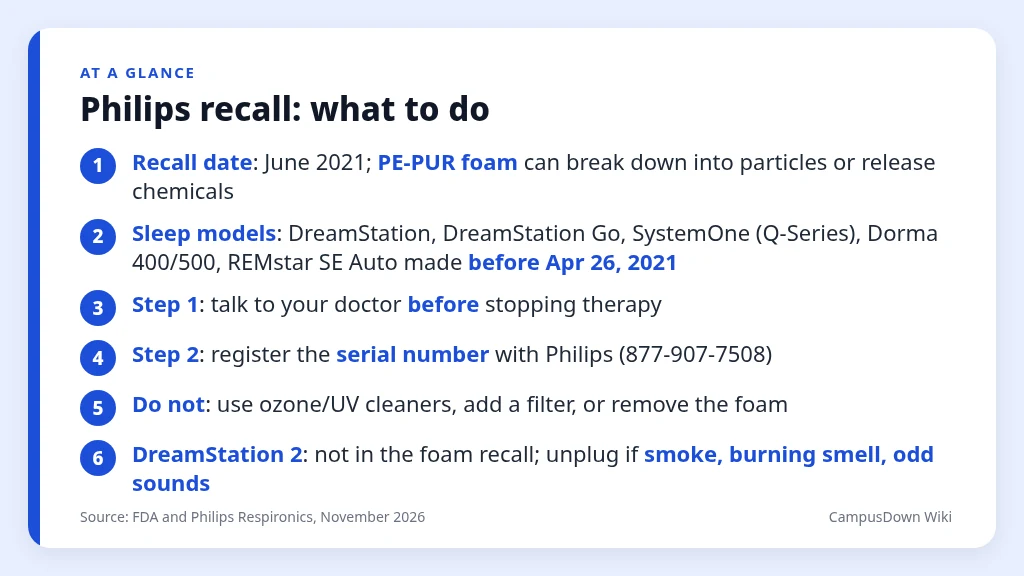
In June 2021, Philips Respironics recalled certain ventilators, BiPAP machines and CPAP machines. According to the FDA, the polyester-based polyurethane (PE-PUR) foam used to reduce sound and vibration could break down. If it did, black pieces of foam or chemicals you cannot see could be breathed in or swallowed by the person using the device. The FDA says the recall affected 15 million devices worldwide.
The FDA notes that foam breakdown may be worsened by hot and humid conditions and by cleaning methods the manufacturer does not recommend, such as ozone cleaners.

Which sleep machines were recalled
Philips' U.S. recall letter lists these CPAP and BiPAP sleep devices, covering all serial numbers made before April 26, 2021:
- DreamStation (the first-generation model, often called DreamStation 1)
- DreamStation Go
- SystemOne (Q-Series)
- Dorma 400 and Dorma 500
- REMstar SE Auto
The recall also included several bilevel and ventilator models, such as DreamStation ST/AVAPS, DreamStation ASV, SystemOne ASV4, C-Series units and Trilogy 100/200 ventilators. If you use a ventilator, the FDA's advice is different: do not stop or change ventilator use until you have talked to your health care provider.
Key point
The DreamStation 2 was not part of the June 2021 foam recall. Philips says repaired and replacement sleep devices use silicone sound-abatement foam.
How to check your serial number
- Find the serial number on your device. Philips' website shows where it is on each model.
2. Go to Philips' recall page (philips.com/src-update) and start the registration. When you enter the serial number, the site tells you whether the device is affected. 3. Or call Philips at 877-907-7508 (press 2 for Spanish). 4. Keep your registration confirmation number with the serial number; Philips asks for both later. 5. If your device is not on the list, the FDA suggests asking the durable medical equipment (DME) supplier who gave it to you to check.
Under the consent decree's remediation plan, the FDA says registered patients get notice of their options: a repaired device, a replaced device, or for certain devices, the option of a partial refund.
Should you stop using it?
This is the hardest part, and the FDA does not give a one-size answer. Its guidance:
- Talk to your health care provider about whether to stop, switch to another device, or keep using the recalled one while you wait.
- For some patients, stopping may involve greater risk than continuing. Untreated sleep apnea has its own health risks.
- If you and your provider decide the benefits outweigh the risks, you may continue using it.
- Your provider may also discuss other treatments: positional therapy, an oral appliance, surgery, or lifestyle steps such as weight loss, avoiding alcohol and stopping smoking.
The FDA also lists three things not to do with a recalled CPAP or BiPAP:
- Do not use ozone or UV light cleaners.
- Do not add an extra filter; it may change how the device works and will not block chemicals from the foam.
- Do not try to remove the foam yourself.
The health risks the FDA described
For inhaled or swallowed foam particles, the FDA lists possible irritation of the skin, eyes, nose and airway, inflammatory response, headache, asthma, and toxic or cancer-causing effects. For chemicals released from the foam, it lists headache, dizziness, irritation, hypersensitivity reactions, nausea or vomiting, and toxic and cancer-causing effects.
Philips says that, based on testing it published through July 2023 with independent labs, use of its sleep therapy devices is "not expected to result in appreciable harm to health." It says additional testing the FDA requested in October 2023 has been completed. These are the company's conclusions; if you have symptoms you are worried about, talk to your doctor and consider a MedWatch report to the FDA.
Example scenario: the machine in the closet
- Who
- Dale, 69, a retired machinist in Akron, Ohio, had used a DreamStation Auto CPAP since 2019. When the recall hit the news, his wife Bonnie registered it, then life got busy, and neither of them followed up.
- What happened
- In 2026, after a winter of bronchitis, Dale's new primary care doctor asked about his CPAP. He admitted he had stopped using it two years earlier and that the machine was "somewhere in the closet."
- How it felt
- Dale felt foolish and a little scared. He had read headlines about lawsuits and cancer, and he had quietly decided that no treatment was safer than a recalled one. Bonnie felt guilty that she had dropped the ball.
- What they did
- They found the serial number, called 877-907-7508 together, and learned their registration was still on file. Dale's doctor ordered a new sleep evaluation and a non-recalled machine through a local supplier, and reported his bronchitis history in his chart.
- How it turned out
- Dale started therapy again on a different machine. His doctor told him there was no way to say what caused his bronchitis, and that untreated sleep apnea carried risks of its own. Dale says the call took twenty minutes; the worrying had taken two years.
This is an illustrative example, not a real patient or a review.
Dale and Bonnie are an illustrative example, not real patients. Only your doctor can weigh your own risks.
DreamStation 2: the overheating warning
On November 28, 2023, the FDA told users to carefully monitor Philips DreamStation 2 CPAP machines for overheating. It had received more than 270 reports of thermal problems between August 1 and November 15, 2023. The FDA said the issue appeared to be electrical or mechanical, not foam-related, and noted that some DreamStation 2 units were sent as replacements for recalled DreamStation 1 machines.
The FDA's advice: keep the machine away from carpet, fabric or other flammable materials, and unplug it and stop using it if you notice:
- a burning smell, smoke or unusual odor
- a change in how the machine looks
- unexplained changes in performance
- water spilled into it
- unusual sounds
If none of these happen, the FDA said it did not recommend stopping use.
Where things stand in 2026
- April 9, 2024: a federal court entered a consent decree against Philips Respironics. It requires a recall remediation plan and restricts the sale of new CPAP and BiPAP machines from certain Philips facilities in the U.S. until requirements are met. Philips can still service existing devices and sell masks and parts.
- April 25, 2024: final court approval of the U.S. economic loss class settlement.
- 2024: Philips agreed to pay a capped $1.1 billion to resolve U.S. personal injury claims and a medical monitoring class action; the medical monitoring settlement got final approval on December 5, 2024. Philips does not admit fault.
- November 2026: Philips' investor FAQ (dated November 3, 2026) reports an agreement in principle with the U.S. Department of Justice to resolve related criminal and civil investigations, still subject to final documents.
For claims, deadlines or eligibility, talk to a lawyer or the official settlement administrator, not a search ad. You can check it for yourself on the FDA and Philips pages below.
Most-asked questions about the Philips recall
Which Philips CPAP machines are on the recall list?
For sleep devices, Philips' U.S. letter lists DreamStation, DreamStation Go, SystemOne (Q-Series), Dorma 400, Dorma 500 and REMstar SE Auto made before April 26, 2021, plus several BiPAP and ventilator models.
Why people ask: "philips cpap recall list" is the #2 Google suggestion for "philips cpap recall" (US autocomplete, November 2026).
How do I check my Philips CPAP serial number?
Enter it during registration on Philips' recall page or call 877-907-7508. Your DME supplier can also check.
Why people ask: "philips cpap recall serial number" is #8 for "philips cpap recall," and "philips dreamstation recall serial number" is #2 for "philips dreamstation recall" (US, November 2026).
Is the DreamStation 2 recalled?
It was not part of the June 2021 foam recall. The FDA issued a separate November 2023 safety communication about overheating and listed signs that mean you should unplug it.
Why people ask: "dreamstation 2 recall" is #10 for "dreamstation 2" (US, November 2026).
Can I still get a refund or join the lawsuit?
The FDA says some registered devices qualify for a partial refund under the remediation plan. Settlement eligibility and deadlines are legal questions; ask the official administrator or a lawyer.
Why people ask: "philips cpap recall lawsuit" is #4 and "philips cpap recall refund" is #10 for "philips cpap recall" (US, November 2026).
If you still have a recalled machine in a closet, learn more about your options by calling Philips with the serial number in hand.
Related on CampusDown
Compare current machines in our ResMed AirSense 11 guide, read the safe way to clean CPAP equipment, see CPAP vs BiPAP if you used a recalled bilevel machine, and see Inspire if you cannot tolerate CPAP at all.
Frequently asked questions
- Should I stop using my recalled DreamStation tonight?
- Not without talking to your doctor. The FDA says for some patients, stopping may be riskier than continuing.
- Can I use a SoClean or other ozone cleaner on a recalled machine?
- No. The FDA says ozone cleaners may worsen the foam breakdown.
- Does an inline filter make a recalled CPAP safe?
- No. The FDA says not to add a filter to a recalled CPAP or BiPAP.
- Where do I report a problem?
- Tell your doctor and file a report through the FDA's MedWatch Voluntary Reporting Form.
A recalled CPAP is a problem to solve with your doctor, not a reason to quietly stop treating sleep apnea. Talk to your doctor, register the serial number, and take a closer look at your replacement options.
Browse more guides like this in the Home Medical Devices hub.
This article is for general education and does not replace advice from your own doctor, nurse or pharmacist.
References
- FDA: Recommendations for Recalled Philips Ventilators, BiPAP Machines, and CPAP Machines
- FDA: Carefully Monitor Philips DreamStation 2 CPAP Machines for Signs of Overheating
- Philips Respironics: U.S. recall letter (affected devices)
- Philips: Respironics recall FAQ, November 3, 2026
- Philips: June 2021 recall information