
Have you tried CPAP for months, maybe years, and still end up tearing the mask off at 2 a.m.? You may have heard about "the sleep apnea implant," usually by its brand name, Inspire. It is real, FDA-approved, and helpful for some people. It is also surgery, with strict criteria about who it is for.
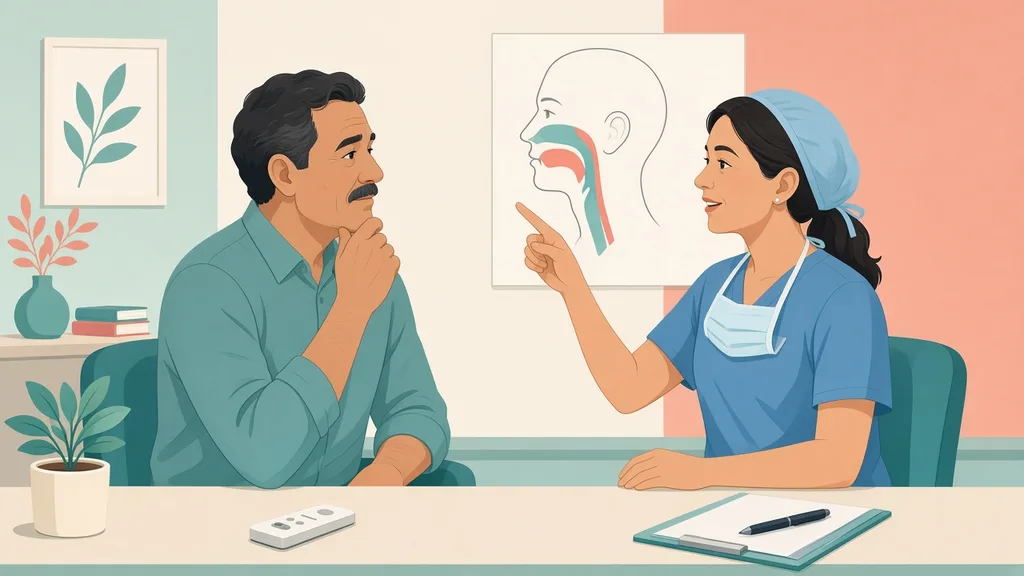
This guide uses the FDA's approval records for the Inspire Upper Airway Stimulation (UAS) system, a Medicare contractor's coverage policy and the original STAR trial, checked in November 2026. It is not a recommendation for or against surgery.
How Inspire works
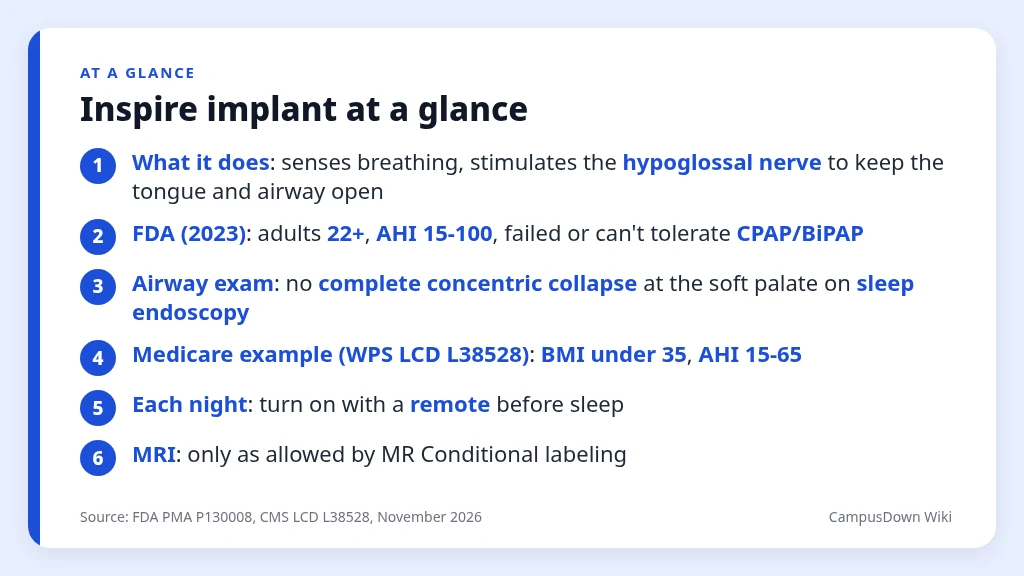
In obstructive sleep apnea, the tongue and soft tissues of the throat relax and block the airway during sleep. Inspire works on the tongue.
According to the FDA, the system includes an implantable pulse generator (a small neurostimulator placed under the skin of the upper chest), a stimulation lead to the hypoglossal nerve, and in the original design a sensing lead that detects breathing effort. External parts include a physician programmer and a patient remote.
Each night, you use the remote to turn therapy on before sleep and off when you wake. The device senses your breathing pattern and sends small pulses that move the tongue forward to help keep the airway open. Your sleep team programs and adjusts the settings at follow-up visits.
The FDA first approved Inspire in April 2014 (PMA P130008). In August 2024, it approved the Inspire V system, built around a new Model 3150 neurostimulator; Inspire said it planned a full U.S. launch in 2025.

Who the FDA says it is for
The FDA expanded Inspire's labeling on June 8, 2023. The current indication covers people with moderate to severe obstructive sleep apnea (AHI 15 to 100) who are 22 or older and who:
- cannot use or tolerate PAP, or did not get rid of their apnea with it, and
- do not have complete concentric collapse at the soft palate.
The labeling defines PAP failure as an AHI above 15 despite PAP use, and PAP intolerance as being unable to use PAP more than 5 nights a week for more than 4 hours a night, or being unwilling to use it (for example, returning the machine).
It is also indicated for some people aged 18 to 21 with AHI 15 to 100, and for ages 13 to 18 with Down syndrome and severe OSA (AHI 10 to 50), with extra conditions such as not being helped by tonsil and adenoid surgery.
The 2023 change raised the AHI upper limit from 65 to 100 and the BMI warning from 32 to 40. The labeling says safety and effectiveness with a BMI over 40 are unknown.
Who should not get it
The FDA lists reasons not to use Inspire, including:
- central or mixed apneas making up more than 25% of the AHI
- a physical blockage of the upper airway that would keep it from working
- conditions that affect nerve control of the upper airway
- being unable to operate the remote without help
- pregnancy or plans to become pregnant
- another implant that might interact with it
- needing MRI scans beyond what the MR Conditional labeling allows
What Medicare usually requires
Medicare coverage is set partly by regional contractors, and their rules can be stricter than the FDA label. For example, Wisconsin Physicians Service's coverage policy (LCD L38528) requires:
- age 22 or older
- BMI under 35
- a sleep study within 24 months of the first implant consultation
- AHI 15 to 65, with central and mixed apneas under 25%
- documented CPAP failure or intolerance, including shared decision-making with a sleep expert
- no complete concentric collapse on a drug-induced sleep endoscopy (DISE), a short procedure where the airway is viewed with a camera during medicated sleep
Private insurers have their own rules. Ask your surgeon's office to check your coverage in detail before scheduling anything.
What the STAR trial showed
The original STAR trial, published in the New England Journal of Medicine in 2014, followed 126 participants. As summarized in Medicare's policy:
- the median AHI fell 68%, from 29.3 to 9.0 events per hour at 12 months
- 66% met the trial's response criteria (at least a 50% drop in AHI and an AHI under 20)
- self-reported daily use was 86%
These are averages from a selected group. Some people respond much less, and the trial excluded people with a BMI over 32 and certain airway shapes.
Example scenario: the long road to "no mask"
- Who
- Leon, 52, a long-haul bus driver from Albuquerque, was diagnosed with moderate sleep apnea after a near-miss on the highway. He tried CPAP for over a year with three different masks.
- What happened
- He could never keep the mask on more than a few hours. His employer's medical exam required treatment, and his supplier's reports kept showing low use. He started reading online "horror stories" and success stories about Inspire late at night.
- How it felt
- He felt trapped: afraid of losing his job, embarrassed that he "couldn't do CPAP," and nervous about anyone cutting near his neck. His wife worried about surgery more than he did.
- What they did
- He asked his sleep doctor whether he was a candidate. He had a new sleep study, a documented CPAP history, a BMI review and a drug-induced sleep endoscopy. His surgeon walked him through the risks and his insurer's criteria, and he talked to two patients from the clinic.
- How it turned out
- Leon qualified and had the implant. It took several adjustment visits before his follow-up sleep study looked good. He still has check-ups, and he keeps his remote on the nightstand where his mask used to be. He says the process was slower than the ads suggested, but it fit his life.
This is an illustrative example, not a real patient or a review.
Leon is an illustrative example, not a real patient. Only your sleep doctor and surgeon can say whether Inspire is right for you.
Questions to ask before surgery
- Have I truly failed CPAP, or would a different mask, pressure or bilevel machine help?
- Do I meet my insurer's criteria, not just the FDA's?
- What did my sleep endoscopy show?
- What are the surgical risks for me, and how will I be followed up?
- What is the plan if the implant helps only partly?
- What MRI limits come with the model I would get?
Get help now if
Inspire is a surgical implant. Risks are discussed with your surgeon and in the device labeling. Do not stop CPAP while you are being evaluated unless your doctor tells you to; untreated sleep apnea has its own risks.
Most-asked questions about Inspire
Inspire vs CPAP: which is better?
CPAP is the usual first treatment for obstructive sleep apnea. Inspire is approved for people who cannot use or tolerate PAP or did not benefit from it, and who meet other criteria. Your sleep doctor can compare them for you.
Why people ask: "inspire vs cpap" is the #1 Google suggestion for "inspire vs" (US autocomplete, November 2026).
How much does Inspire cost?
Costs depend on your insurer and plan. Medicare contractors and private insurers have their own coverage criteria, so ask the surgeon's office to verify coverage before scheduling.
Why people ask: "inspire sleep apnea cost" is #6 for "inspire sleep apnea," and "inspire implant cost" is #4 for "inspire implant" (US, November 2026).
Can I get an MRI with Inspire?
Only as allowed by the system's MR Conditional labeling. The FDA lists needing MRI beyond that labeling as a reason not to use it. Tell every imaging center you have the implant.
Why people ask: "inspire implant mri safety" is #6 for "inspire implant," and "inspire upper airway stimulation system mri safety" is #2 for "inspire upper airway stimulation" (US, November 2026).
How does the Inspire implant work?
It senses your breathing and stimulates the hypoglossal nerve to move the tongue forward during sleep. You turn it on with a remote at bedtime.
Why people ask: "inspire sleep apnea how does it work" is #7 for "inspire sleep apnea" (US, November 2026).
If you are weighing Inspire, learn more by asking your sleep doctor for a copy of your sleep study and your CPAP usage reports.
Related on CampusDown
Before surgery, see whether a different CPAP mask or a newer machine helps, and review obstructive sleep apnea basics.
Frequently asked questions
- Is Inspire FDA-approved?
- Yes. The FDA first approved it in 2014 (PMA P130008) and expanded the labeling in 2023.
- Do I need to try CPAP first?
- Yes. The FDA labeling requires PAP failure or intolerance.
- Can I get Inspire with a high BMI?
- The FDA labeling says results with a BMI over 40 are unknown, and some Medicare contractors require a BMI under 35.
- Is Inspire covered by Medicare?
- It can be, when you meet the contractor's criteria. Ask the surgeon's office to check.
Inspire offers an option for some people who cannot make CPAP work, but it is surgery with strict criteria. Talk to your doctor and take a closer look at both the FDA label and your insurer's rules before deciding.
Browse more guides like this in the Home Medical Devices hub.
This article is for general education and does not replace advice from your own doctor, nurse or pharmacist.
References
- FDA: Inspire Upper Airway Stimulation, P130008/S090 (2023 expanded indication)
- FDA: PMA P130008 database record
- CMS: LCD L38528, Hypoglossal Nerve Stimulation for the Treatment of Obstructive Sleep Apnea
- Strollo PJ et al. Upper-Airway Stimulation for Obstructive Sleep Apnea. N Engl J Med 2014
- NHLBI: Sleep Apnea Treatment