
Has someone in your support group said, "I couldn't handle CPAP, so they switched me to BiPAP," and now you are wondering whether you should ask for one too? It sounds like an upgrade. For most people with sleep apnea, it is not; it is a different tool for a different problem.
This guide compares CPAP, APAP and BiPAP using MedlinePlus, ResMed's user guides for the AirSense 11 and AirCurve 11, and Medicare's coverage policy for PAP devices, checked in November 2026. Which machine you use is a decision for your sleep doctor.
The three in one sentence each
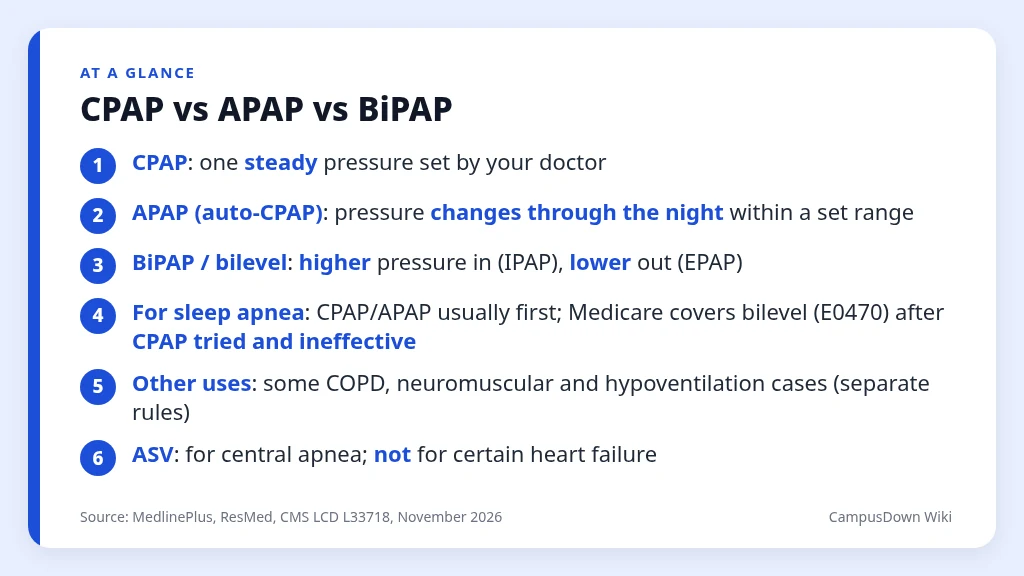
MedlinePlus describes them this way:
- CPAP (continuous positive airway pressure) gives a gentle, steady pressure of air to keep your airway open.
- APAP (autotitrating PAP) changes pressure throughout the night based on your breathing patterns.
- BiPAP or bilevel PAP has a higher pressure when you breathe in and a lower pressure when you breathe out.
"BiPAP" started as a brand name; many clinicians say bilevel PAP or BPAP. The two pressures are called IPAP (inspiratory) and EPAP (expiratory). The difference between them is the pressure support.

Real machines, same-looking boxes
ResMed's current lineup shows how similar these machines can look:
- AirSense 11 CPAP: fixed pressure, 4 to 20 cm H2O range.
- AirSense 11 AutoSet: auto-adjusting (APAP), also 4 to 20 cm H2O.
- AirCurve 11 S: bilevel with set IPAP and EPAP; IPAP 4 to 25, EPAP 3 to 25 cm H2O.
- AirCurve 11 VAuto: auto-adjusting bilevel; IPAP and EPAP 4 to 25 cm H2O, pressure support 0 to 10 cm H2O.
- AirCurve 11 ASV: adaptive servo-ventilation for central and mixed apnea (see below).
ResMed's guides say the AirSense 11 and AirCurve 11 VAuto and S are all indicated for obstructive sleep apnea in people over 66 lb (30 kg). Bilevel machines can reach higher maximum pressures, which is one reason they are used when CPAP pressures become hard to tolerate.
Comfort features blur the lines
Many CPAP and APAP machines already lower pressure slightly as you exhale. ResMed's Expiratory Pressure Relief (EPR) on the AirSense 11 can drop exhale pressure by 1, 2 or 3 cm H2O. That is not true bilevel therapy, but it helps some people who feel they are "breathing out against a wall." Ask about EPR, ramp and mask changes before assuming you need a different machine. Our AirSense 11 guide explains these settings in detail.
When bilevel is used for sleep apnea
For obstructive sleep apnea, CPAP or APAP is the usual first step. Medicare's policy (LCD L33718) spells out the path:
- A CPAP device (E0601) is covered when sleep testing meets Medicare's criteria.
- A bilevel device without a backup rate (E0470) is covered for OSA only if a CPAP has been tried and proven ineffective, either during a sleep-lab titration or at home "despite optimal therapy," meaning proper mask selection and fitting and appropriate pressure settings.
- A bilevel device with a backup rate (E0471) is not considered reasonable and necessary if the primary diagnosis is OSA.
If you switch from CPAP to bilevel within the trial period, Medicare does not require a new sleep test, though the timing of your adherence check may change. Private insurers often follow similar logic.
Key point
"I don't like CPAP" is not the same as "CPAP is ineffective." Medicare expects mask fit and pressure problems to be addressed first. Many comfort complaints are fixed by the mask; see CPAP mask types.
Bilevel for other conditions
MedlinePlus notes PAP can help with airways that collapse during sleep and muscle weakness that makes it hard to breathe. Bilevel machines are used for some people with COPD, neuromuscular disease such as ALS, chest wall disorders and hypoventilation syndromes. Medicare covers those uses under a separate Respiratory Assist Devices policy with its own testing rules.
In the hospital, "BiPAP" also refers to noninvasive ventilation for problems like a COPD flare. That is a monitored, acute treatment, different from a home sleep machine.
ASV: a different device for central apnea
Adaptive servo-ventilation (ASV), such as the AirCurve 11 ASV, treats central or mixed apneas and periodic breathing by adjusting support breath by breath. ResMed's guide says ASV is contraindicated in people with chronic, symptomatic heart failure (NYHA 2 to 4) with an ejection fraction of 45% or less and moderate to severe predominant central sleep apnea, and that patients should be assessed for heart failure before starting. ASV is a specialist decision.
Example scenario: the pressure that felt like a wall
- Who
- Winifred, 67, a retired church organist in Portland, Oregon, has COPD and was diagnosed with severe obstructive sleep apnea. She started on an auto-CPAP with a full-face mask.
- What happened
- As her machine raised pressure in the night, she felt she could not breathe out against it. She woke gasping and anxious, and her data showed she was using it only a few hours a night. A friend told her "BiPAP fixed everything" for her husband.
- How it felt
- She felt panicky at night and discouraged during the day, and she worried her lungs made her "too sick for CPAP." She also felt embarrassed to keep calling the clinic.
- What they did
- Her sleep doctor first tried EPR and a mask refit, then reviewed her data and lung tests. When high pressures were still needed and still not tolerated, they documented CPAP as ineffective and ordered an in-lab titration on a bilevel device.
- How it turned out
- On bilevel, the exhale felt easier and her use climbed above four hours most nights. Her doctor reminded her the switch was based on her specific results, not because bilevel is "better" for everyone.
This is an illustrative example, not a real patient or a review.
Winifred is an illustrative example, not a real patient. Machine changes require your doctor's evaluation.
So which is better?
- For most people with obstructive sleep apnea: CPAP or APAP. APAP adjusts on its own when your pressure needs change during the night; CPAP holds the pressure found in testing, such as an in-lab titration.
- For people who truly cannot tolerate or are not helped by CPAP after mask and comfort fixes: bilevel may be next. Some may consider an Inspire implant if they qualify.
- For certain lung, nerve or muscle conditions: bilevel may be the right first device, under different criteria.
You can learn more by asking your sleep doctor what your sleep study and download data show about your pressure needs.
Get help now if
Do not buy or borrow a used bilevel or CPAP machine and set the pressure yourself. Pressure is a prescription. Tell your doctor about new chest pain, severe headache or increased breathlessness on any PAP machine.
Most-asked questions about CPAP vs BiPAP
What is the difference between CPAP, BiPAP and APAP?
CPAP holds one steady pressure, APAP adjusts pressure through the night, and BiPAP (bilevel) uses a higher pressure for breathing in and a lower one for breathing out.
Why people ask: "cpap vs bipap vs apap" is #3 for "cpap vs bipap," and "difference between cpap and bipap and apap" is #10 for "apap vs cpap" (US autocomplete, November 2026).
Is BiPAP better for sleep apnea?
Not usually as a first step. Medicare covers bilevel for obstructive sleep apnea only after CPAP has been tried and proven ineffective despite proper mask fit and pressure settings.
Why people ask: "cpap vs bipap for sleep apnea" is #4 for "cpap vs bipap," and "bipap vs cpap for sleep apnea" is #4 for "bipap vs" (US, November 2026).
CPAP vs BiPAP for COPD: which one?
It depends on the reason for treatment. People with COPD and sleep apnea often start with CPAP; bilevel is used for some people with COPD and breathing problems under separate criteria. Ask your pulmonologist.
Why people ask: "cpap vs bipap copd" is #8 for "cpap vs bipap" (US, November 2026).
Is APAP or CPAP better?
Neither is better for everyone. APAP adjusts pressure automatically; CPAP holds a fixed pressure set after testing. Your doctor chooses based on your sleep study.
Why people ask: "is apap or cpap better" is #9 for "apap vs cpap" (US, November 2026).
Related on CampusDown
See what to do with a recalled Philips BiPAP or CPAP, and review the basics of obstructive sleep apnea.
Frequently asked questions
- Can I switch myself from CPAP to BiPAP?
- No. It needs a doctor's order, and insurers usually require documentation that CPAP did not work.
- Does BiPAP use a different mask?
- It uses the same types of masks as CPAP; your supplier fits you.
- Is EPR the same as BiPAP?
- No. EPR lowers exhale pressure slightly on a CPAP or APAP machine; bilevel sets two separate pressures.
- What is ASV?
- Adaptive servo-ventilation is a specialized device for central or mixed apnea. It is not used in certain types of heart failure.
CPAP, APAP and bilevel are tools for different problems, not good, better and best. Talk to your doctor about what your data shows, and take a closer look at mask and comfort fixes first.
Browse more guides like this in the Home Medical Devices hub.
This article is for general education and does not replace advice from your own doctor, nurse or pharmacist.