
Is your CPAP machine working fine while the mask is the thing keeping you awake? That is one of the most common complaints sleep clinics hear. A leaking cushion, a strap line on your cheek, or a hose that drags when you roll over can make a good machine feel unbearable.

This guide explains the main CPAP mask types using ResMed's current U.S. mask lineup as real examples, plus the FDA's 2024 magnet recall and Medicare's replacement rules, all checked in November 2026. Your equipment supplier does the actual fitting; use this to know what to ask for. If you are new to CPAP, read about the ResMed AirSense 11 machine too.
The three main types
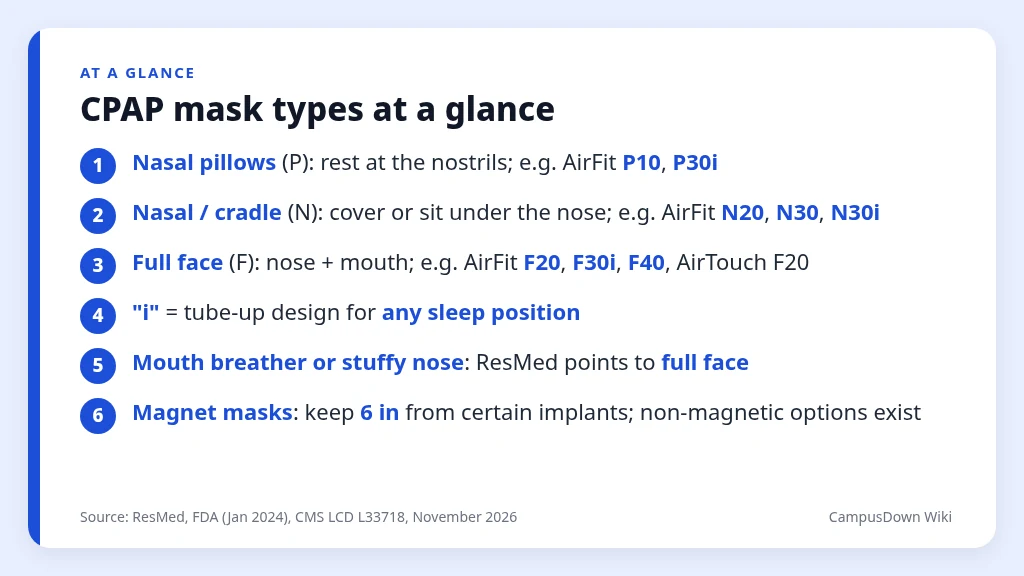
1. Nasal pillows masks. Two soft silicone "pillows" rest at the opening of each nostril. They touch the least of your face.
- ResMed examples: AirFit P10, AirFit P30i
- Good for: people who feel closed-in by masks, wear glasses, or have a beard or mustache
- Watch for: nostril soreness, and air escaping through an open mouth
2. Nasal masks and nasal cradles. A nasal mask covers the nose; a cradle sits under the nose.
- ResMed examples: AirFit N20 and AirTouch N20 (over the nose), AirFit N30 and AirFit N30i (under-the-nose cradle), AirTouch N30i (fabric-covered cushion)
- Good for: many first-time users, people who move around in bed
- Watch for: mouth leaks if you breathe through your mouth
3. Full-face masks. These cover the nose and mouth.
- ResMed examples: AirFit F20, AirTouch F20 (memory foam), AirFit F30i, AirFit F40 and AirTouch F40 (under-the-nose, minimalist), AirTouch F30i Comfort and F30i Clear
- Good for: mouth breathers, people with frequent nasal congestion, allergies or a deviated septum
- Watch for: more surface for leaks, a bulkier feel
ResMed also makes an oral-nasal design, the AirFit X30i, that covers the mouth and sits under the nose.
Key point
How to read ResMed names: "AirFit" means a silicone cushion; "AirTouch" means memory foam or fabric. P = pillows, N = nasal, F = full face, X = oral-nasal, and an "i" means a tube-up design with the hose connecting at the top of your head.

Matching the mask to how you sleep
ResMed's mask guide groups its own models by common needs. Here is a summary:
| Your situation | ResMed models it suggests |
|---|---|
| I sleep on my stomach | AirTouch N30i, AirTouch F30i Clear, AirFit F30i, AirFit N30i, AirFit P30i, AirFit X30i |
| I breathe through my mouth | AirFit F40, AirTouch F30i Clear, AirFit F20, AirTouch F20, AirFit F30i, AirFit X30i |
| I have a beard | AirTouch N30i, AirTouch F20, AirTouch N20, AirFit P10, AirFit N30 |
| Sensitive skin, red lines | AirTouch N30i, AirTouch F20, AirTouch N20, AirFit P10, AirFit N30 |
| Glasses, reading in bed | Under-the-nose designs such as AirFit N30, N30i, P10, P30i, F30i, F40 |
| Stuffy nose, allergies, deviated septum | Full-face masks such as AirFit F20, F40, F30i, AirTouch F20 |
These are a manufacturer's suggestions, not a fitting. Other brands, such as Fisher & Paykel, make masks in the same three types. A supplier can let you try cushion sizes in person.
Example scenario: the beard and the side sleeper
- Who
- Ezekiel, 56, a high school band director in El Paso, started CPAP with a standard full-face mask. He sleeps on his side and has worn a full beard since college.
- What happened
- Every night the cushion pushed against the pillow, broke its seal, and blew air into his eyes. He woke his wife with the hissing and tightened the straps until he had red marks across his cheeks every morning.
- How it felt
- He felt defeated and vain at the same time, because the obvious answer seemed to be "shave the beard," and he did not want to. He also worried he was failing the treatment his cardiologist had pushed for.
- What they did
- His supplier pulled his myAir data showing high leak, then fitted him with a nasal pillows mask with a top-of-head hose. When he noticed he was waking with a dry mouth, they talked about humidity before considering a chin strap.
- How it turned out
- The leak dropped and the morning red lines disappeared. He kept the beard. He says the most useful thing he learned was that "mask problems" usually have more than one fix.
This is an illustrative example, not a real patient or a review.
Ezekiel is an illustrative example, not a real patient. Mask choice is a fitting decision with your supplier and sleep doctor.
Fit tips that work for most masks
- Do not overtighten. Many leaks come from a cushion pushed out of shape. Lie down in your sleep position before adjusting straps.
- Check the seal with the air on. Machines like the AirSense 11 have a Mask Fit test that shows whether the seal is good.
- Try a different size before a different type. Many masks come with small, medium and large cushions.
- Use the data. myAir and similar apps report mask seal; bring that to your supplier.
- Mouth leak on a nasal mask? Talk to your care team about a full-face mask or a chin strap, and read about CPAP dry mouth and leaks.
The 2024 magnet recall
On January 18, 2024, the FDA announced a Class I recall of certain ResMed masks with magnetic headgear clips, because magnets can interfere with some implanted metal devices in the user or in someone close to the mask. The affected masks were the AirFit F20, AirTouch F20, AirFit F30, AirFit F30i, AirFit N10, AirFit N20, AirTouch N20 (including "for Her" versions) and AirFit F20 NV.
The FDA lists implants of concern including pacemakers, ICDs, certain metallic stents, neurostimulators, CSF shunts, aneurysm clips, embolic coils, cochlear and other hearing implants with magnets, some ocular implants, and implanted pumps such as insulin pumps. Its advice:
- If you or a close contact has one of these, stop using the magnetic mask and switch to a non-magnetic mask if available, and talk with your health care provider.
- Otherwise, keep the mask at least six inches away from those implants.
- You may keep using the mask if no one in close contact has any of the listed implants.
ResMed now lists non-magnetic options, including the AirFit F20 Non Magnetic and AirFit F30i Non Magnetic, along with the N30, N30i, P10 and P30i.
How often Medicare replaces mask parts
Medicare's PAP policy (LCD L33718) lists the usual maximum quantities it covers:
| Part | Usual maximum |
|---|---|
| Full-face mask (A7030) | 1 per 3 months |
| Full-face cushion (A7031) | 1 per month |
| Nasal mask or interface (A7034) | 1 per 3 months |
| Nasal mask cushion (A7032) | 2 per month |
| Nasal pillows (A7033) | 2 per month |
| Headgear (A7035) | 1 per 6 months |
| Chin strap (A7036) | 1 per 6 months |
These are coverage limits, not a schedule you must follow. Replace parts sooner if your manufacturer's guide says they are worn. Many private plans use similar rules; check them in detail with your supplier.
Most-asked questions about CPAP mask types
Which CPAP mask is best for mouth breathers?
ResMed points mouth breathers to full-face or oral-nasal masks such as the AirFit F20, F30i, F40, AirTouch F20 and AirFit X30i. Some people use a nasal mask with a chin strap instead; ask your supplier.
Why people ask: "cpap mask types for mouth breathers" is #3 for "cpap mask types," and "cpap mask for mouth breathers" is #2 for "cpap mask for" (US autocomplete, November 2026).
What is the best CPAP mask for side sleepers?
Low-profile masks with a top-of-head hose, such as nasal pillows or nasal cradle designs, often suit side sleepers. ResMed lists the N30i, P30i, F30i and X30i for people who change positions.
Why people ask: "cpap mask for side sleepers" is the #1 Google suggestion for "cpap mask for," and "cpap mask types side sleeper" is #5 for "cpap mask types" (US, November 2026).
What does a full-face CPAP mask cover?
The nose and mouth. Newer designs like the AirFit F30i and F40 sit under the nose and over the mouth for less contact.
Why people ask: "cpap mask types full face" is #4 for "cpap mask types" (US, November 2026).
AirFit N30i vs P30i: what is the difference?
Both have a top-of-head hose. The N30i is a nasal cradle under the nose; the P30i uses nasal pillows that rest at the nostrils.
Why people ask: "airfit n30i vs p30i" is #7 for "airfit n30i" (US, November 2026).
If your mask still leaks after a refit, learn more by bringing a week of leak data to your supplier instead of tightening straps another notch.
Related on CampusDown
See how to clean CPAP masks and cushions, why travel machines like the ResMed AirMini only take certain masks, and the basics of obstructive sleep apnea.
Frequently asked questions
- Can I switch mask types on my own?
- Talk to your supplier and doctor first. A new type may need a new order, and your pressure needs may change.
- Are nasal pillows good for beards?
- ResMed lists the AirFit P10 among masks that may suit beards, because pillows do not seal against the face.
- How do I know if my mask is in the magnet recall?
- Check the model name against the FDA's list and ResMed's safety notice, or ask your supplier.
- Will insurance pay for a different mask?
- Often, within its replacement limits. Ask your supplier to check your plan.
There is no single best CPAP mask, only the one that fits your face and the way you sleep. Talk to your doctor or supplier as soon as a mask bothers you, and take a closer look at your leak data together.
Browse more guides like this in the Home Medical Devices hub.
This article is for general education and does not replace advice from your own doctor, nurse or pharmacist.