
Should you trust a number on your phone more than the drop of blood on your finger? That is the question many people face in their first week on a Dexcom G7. The sensor is small, the app is slick, and the alerts can wake you at 3 a.m., which is exactly why it helps to know how it really works.
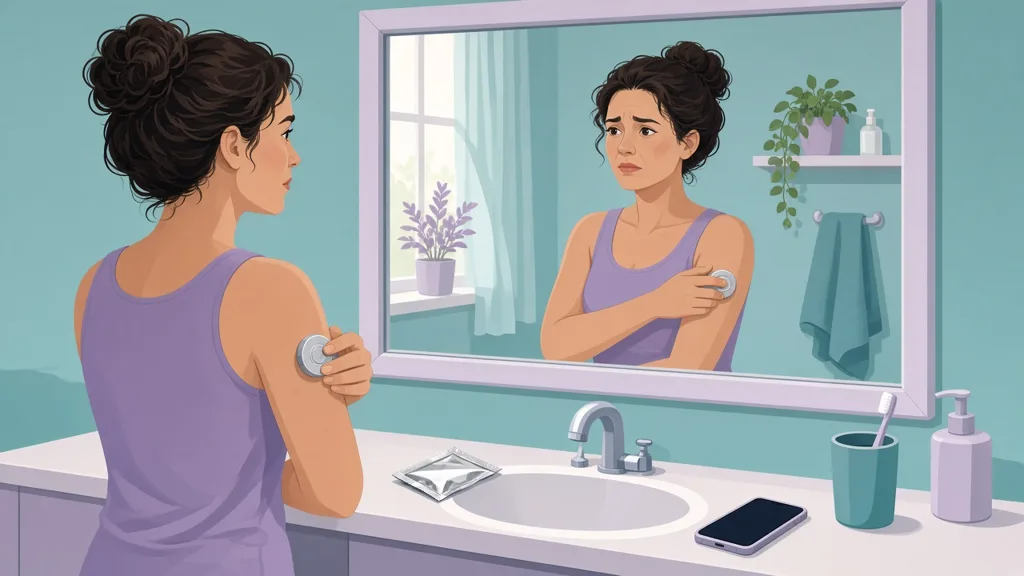
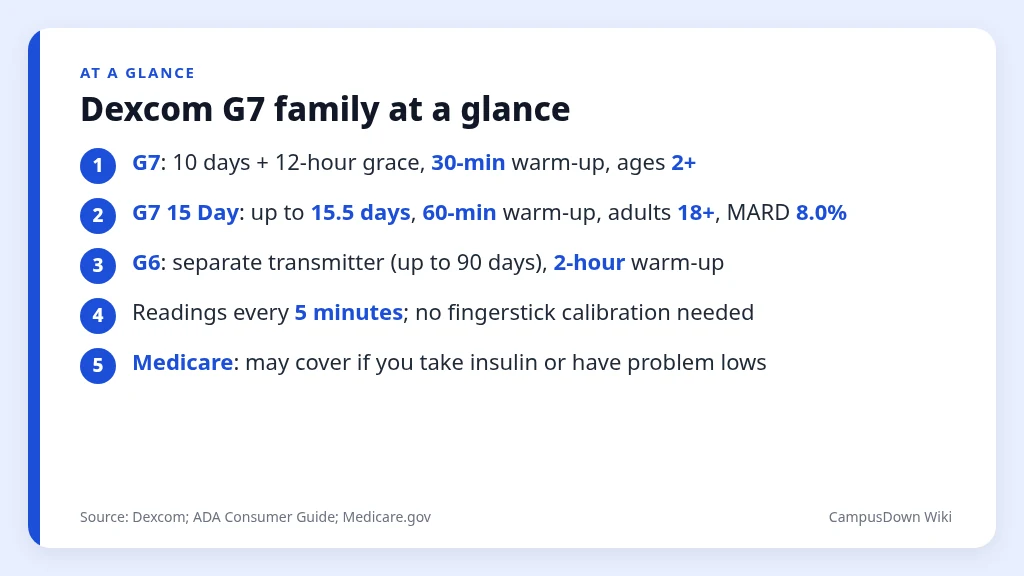
This guide explains the Dexcom G7 family with exact numbers from Dexcom and the American Diabetes Association (ADA) consumer guide: the original 10-day G7, the newer G7 15 Day, and how both differ from the older G6. If you are choosing between models or fighting with a sensor right now, take a closer look at the comparison card and the most-asked questions below.
What the Dexcom G7 is
The Dexcom G7 is a prescription continuous glucose monitor (CGM). A tiny wire under the skin measures glucose in the fluid between cells (interstitial fluid), and the all-in-one sensor and transmitter sends a reading to a phone app or receiver every five minutes, according to the ADA consumer guide. Key points from that guide:
- Wear time: 10 days, plus a 12-hour grace period to swap sensors
- Warm-up: 30 minutes
- Ages: 2 and older. The back of the arm is the site for ages 7 and up; children 2–6 can also use the upper buttocks
- Calibration: not required, and readings can be used for treatment decisions
- Water: the sensor can be submerged up to about 8 feet (2.4 m) for 24 hours
- Alerts: high, low and a predictive urgent low soon alert
- Pumps: the ADA lists compatibility with the iLet, Omnipod 5, Tandem Mobi and Tandem t:slim X2
Because interstitial glucose lags behind blood glucose, a CGM and a fingerstick can disagree when sugar is rising or falling fast. That is expected, not a defect.

G7 vs G7 15 Day vs G6
Dexcom announced FDA clearance of the Dexcom G7 15 Day on April 10, 2025, for adults 18 and older with diabetes. Dexcom lists:
- 15.5 days of wear (15 days plus a 12-hour grace period)
- An overall MARD of 8.0% (MARD is the average percent difference from a lab reference; lower is better)
- A 60-minute warm-up, which Dexcom says comes from a new algorithm that allows the extra five days
Dexcom's own footnote is worth reading in detail: in its sensor-life study, 73.9% of sensors lasted the full 15 days, so about one in four may not. At the time of the ADA's review, the G7 15 Day was listed as not yet pump compatible, so people using automated insulin delivery should confirm compatibility with their pump maker.
The older Dexcom G6 used a separate, reusable transmitter that lasts up to 90 days and a sensor with a 2-hour warm-up, according to Dexcom's training materials. The G7 combined the two parts into one disposable piece and shortened the warm-up.
These differences matter most at the moments things go wrong: a sensor that falls off, a reading that seems off, or a coverage denial. The story below shows how that can feel.
Example scenario: the alarm at 3 a.m.
- Who
- Maya, 34, a graphic designer with type 1 diabetes, switching from fingersticks to a Dexcom G7 for the first time.
- What happened
- On night two, her phone blared an urgent low alert at 3 a.m. The app showed 62 mg/dL, but she felt fine. She had fallen asleep lying on the arm with the sensor.
- How it felt
- She felt panicked, then embarrassed, then angry at the device. Her partner woke up scared, and she lay awake wondering whether she could trust any number it showed.
- What they did
- She did a fingerstick, which read 104 mg/dL. The next day her diabetes educator explained that pressure on a sensor during sleep can cause falsely low readings, and helped her pick a sensor spot she does not sleep on. She also learned to confirm with a meter whenever symptoms and numbers do not match.
- How it turned out
- By her second sensor, the night alarms were rare and believable. Maya kept her meter in her nightstand and said the G7 finally felt like a safety net instead of a smoke alarm.
This is an illustrative example, not a real patient or a review.
Maya's experience is common in the first weeks on any CGM. The fix is usually technique and expectations, not a new device, so check it for yourself with a fingerstick whenever a number does not match how you feel.
Most-asked questions about the Dexcom G7
Dexcom G7 vs FreeStyle Libre 3 Plus: which is better?
Both are prescription CGMs that need no fingerstick calibration. The Libre 3 Plus sends a reading every minute and lasts 15 days with a 60-minute warm-up; the 10-day G7 reads every five minutes with a 30-minute warm-up, and the G7 15 Day lasts 15.5 days. Pump compatibility and insurance coverage often decide it. See our side-by-side comparison and FreeStyle Libre 3 Plus.
Why people ask: "dexcom g7 vs libre 3 plus" is the #1 Google suggestion for "dexcom g7 vs," and "dexcom g7 15 day vs libre 3 plus" is #1 for "dexcom g7 15 day vs" (US autocomplete, November 2026).
Is the G7 15 Day worth switching to?
It means fewer sensor changes, but Dexcom's own data show about a quarter of sensors may not last the full 15 days, and the warm-up is 60 minutes instead of 30. If your pump needs the 10-day G7, stay with what your system supports.
Why people ask: On a 557,000-view YouTube CGM comparison, a comment with 73 likes reads, "I have the G7. I will NOT upgrade to the 15 day because of the constant failures." "dexcom g7 15 day vs 10 day" is #2 for "dexcom g7 15 day vs" (comments and autocomplete read November 2026).
How long is the Dexcom G7 warm-up?
30 minutes for the 10-day G7 and 60 minutes for the G7 15 Day, per the ADA consumer guide and Dexcom.
Why people ask: "dexcom g7 warm up time" is the #1 suggestion for "dexcom g7 warm up" (US, November 2026).
Does Medicare cover the Dexcom G7?
Medicare.gov says Part B may cover a CGM and supplies if you have diabetes, your provider orders it, you take insulin or have a history of problems with low blood sugar, and you or a caregiver are trained to use it. After the Part B deductible you usually pay 20% of the Medicare-approved amount. See CGM coverage under Medicare.
Why people ask: "dexcom g7 medicare coverage" is the #1 suggestion for "dexcom g7 medicare" (US, November 2026).
My sensor is falling off or reading wrong. What now?
Use the overpatch that comes in the box, choose a clean, dry site, and avoid sleeping on the sensor. If readings do not match symptoms, confirm with a fingerstick before treating, and report a failed sensor to Dexcom support. More tips are in CGM sensor fell off or inaccurate.
Why people ask: "dexcom g7 accuracy issues" is #2 for "dexcom g7 accuracy," and "dexcom g7 overpatch free" is #2 for "dexcom g7 overpatch" (US, November 2026).
Using a G7 safely
- Follow your clinician's plan for what to do at each alert level.
- Treat lows using the 15-15 approach your care team taught you, and recheck. See Hypoglycemia.
- Keep a meter and strips for times when readings and symptoms do not match.
- Ask your imaging team what to do with the sensor before an MRI or CT scan.
Get help now if
If you have signs of severe low blood sugar such as confusion, seizure or passing out, someone should give glucagon if prescribed and call 911.
Related on CampusDown
Compare the over-the-counter option in Dexcom Stelo, learn the basics of insulin, and if you are new to diabetes numbers, start with what an A1C result means.
Frequently asked questions
- Can you shower or swim with the Dexcom G7?
- Yes. The ADA consumer guide notes the sensor can be submerged up to about 8 feet for 24 hours.
- Does the Dexcom G7 need fingerstick calibration?
- No calibration is required, but a meter is still useful when symptoms and readings do not match.
- Where can you wear a Dexcom G7?
- The back of the upper arm for ages 7 and older; children 2–6 can also use the upper buttocks, per the ADA consumer guide.
- What does the 12-hour grace period mean?
- After a sensor session ends, you have 12 more hours of readings to replace it, which helps avoid gaps.
A CGM is only as helpful as your trust in it. Take time to learn more about how your sensor behaves, keep a meter close for the odd reading, and bring your questions about models and coverage to your next diabetes visit.
Browse more guides like this in the Home Medical Devices hub.
This article is for general education and does not replace advice from your own doctor, nurse or pharmacist.