
Your doctor's office calls about a blood test and says your potassium is high. You eat bananas, not much else comes to mind, and the word "heart" gets mentioned. What does that number actually mean?

This guide draws on MedlinePlus pages for the high potassium level, the potassium blood test and potassium in the diet. It is general education, not a diagnosis. Talk with your doctor or pharmacist before you change any food, supplement or medicine because of a lab result. To learn more about a related condition, see chronic kidney disease, and take a closer look at the sections below.
What "high potassium" means
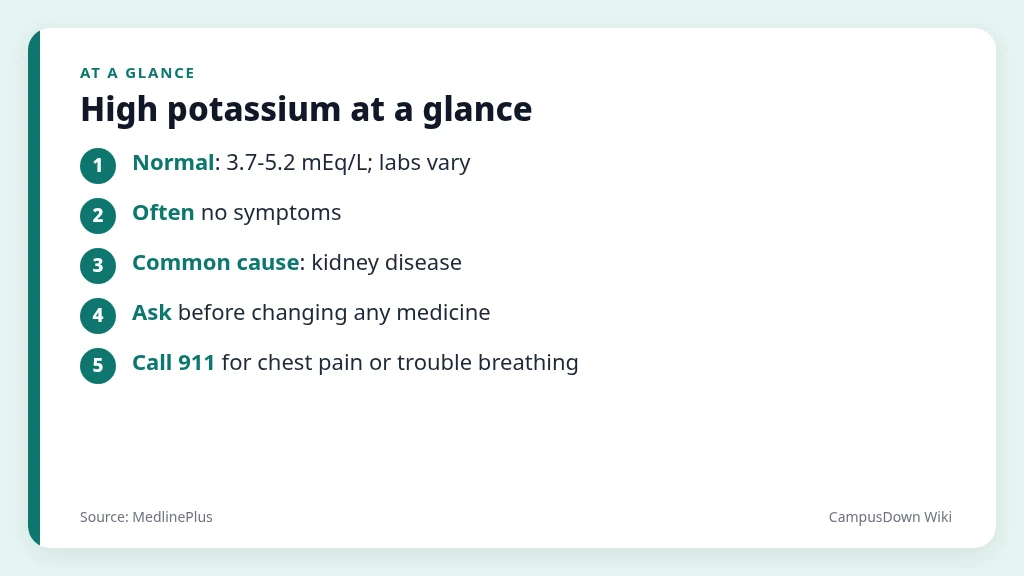
Potassium is a mineral your cells need to work. You get it from food, and your kidneys remove the extra in urine to keep the balance right. Hyperkalemia is the medical name for a potassium level in the blood that is higher than normal. MedlinePlus lists a normal range of 3.7 to 5.2 mEq/L (also written as 3.70 to 5.20 millimol/L) and adds that normal ranges vary slightly among laboratories, so your report's own range is the one that counts.
Why does it matter? MedlinePlus explains that small changes in potassium can have a big effect on the nerves and muscles, especially the heart, and that very high or very low levels can lead to life-threatening heart problems.

Common causes
MedlinePlus names kidney problems first: if your kidneys aren't working well, potassium can build up. Other causes on its list include:
- Addison disease, where the adrenal glands don't make enough hormones
- Burns over large areas of the body
- Certain blood pressure medicines, most often ACE inhibitors, ARBs and spironolactone-type drugs (mineralocorticoid receptor antagonists)
- Muscle or cell damage from crush injuries, falls, surgery, alcohol abuse, certain illicit drugs and some chemotherapies
- Red blood cells breaking open (hemolytic anemia)
- Severe bleeding from the stomach or intestines
- Extra potassium from salt substitutes or supplements
The potassium test page adds a point worth knowing: if it was hard to get the needle into your vein, injury to the red blood cells in the sample may release potassium and make the result look higher than it is. Your provider may repeat the test.
Symptoms
MedlinePlus says there are often no symptoms with a high potassium level. When symptoms do occur, they may include chest pain, trouble breathing, nausea or vomiting, palpitations, a slow, weak or irregular pulse, or sudden collapse when the heartbeat becomes too slow or stops. Because it can be silent, people who take certain medicines or who have kidney disease usually get regular blood tests. For a view of the lab side, see potassium normal range for nursing students.
How doctors check and treat it
Your provider will do a physical exam and may order a basic metabolic panel, a serum potassium level and an electrocardiogram (ECG). The ECG shows the heart's electrical rhythm; to see what rhythms look like, read ECG rhythms basics. Kidney tests such as eGFR are often part of the picture.
MedlinePlus says you need emergency treatment if the level is very high or if the ECG changes. That care may include calcium given into a vein to protect the heart and muscles, glucose and insulin given into a vein to lower potassium for a while, dialysis if kidney function is poor, medicines that help remove potassium from the intestines, sodium bicarbonate when acidosis is the cause, and certain diuretics. Treatment is chosen and monitored by clinicians, so it is not something to try at home.
Get help now if
Call 911 or go to the emergency room for chest pain, trouble breathing, a very slow or irregular pulse, severe weakness or fainting. Contact your provider right away if you have vomiting, palpitations or weakness, or if you take a potassium supplement and notice symptoms.
Food, salt substitutes and medicines
For a mild problem, diet changes can help prevent and treat high potassium. MedlinePlus says your provider may ask you to limit or avoid foods such as asparagus, avocados, potatoes, tomatoes and tomato sauce, winter squash, pumpkin and cooked spinach, plus fruits such as oranges and orange juice, nectarines, kiwifruit, raisins and other dried fruit, bananas, cantaloupe, honeydew and prunes. Salt substitutes are on the list too if you've been told to follow a low-salt diet, because many contain potassium.
Your provider may also reduce or stop potassium supplements or change medicines for heart disease and blood pressure. If you take lisinopril or losartan, don't stop either one on your own; ask your care team what to do. MedlinePlus advises following your provider's directions, taking medicines on time, and telling your provider about other medicines, vitamins and supplements you take.
Questions to take to your appointment
- What range does your lab use, and how far was my result outside it?
- Could any of my medicines or supplements be raising it?
- Do I use a salt substitute, and should I stop?
- Should my test be repeated, and how soon?
- How is my kidney function?
Example scenario: the salt substitute
- Who
- Abner, 67, a retired ferry captain in Bellingham, Washington, took a blood pressure pill and had mild kidney disease.
- What happened
- His doctor had told him to cut back on salt, so he started using a salt substitute on almost everything.
- How it felt
- A routine blood test showed a high potassium level, and he felt scared and a little foolish, because he had been trying to do the right thing.
- What they did
- He called the clinic that afternoon, stopped nothing on his own, and asked whether his salt substitute and his pills were part of the problem. His doctor repeated the test, reviewed his medicines and gave him a food list to follow.
- How it turned out
- Abner said he felt relieved to learn that the fix was a conversation and a plan, not a guess.
This is an illustrative example, not a real patient or a review.
Abner's story is an illustrative example. Test results and next steps are decided with your own doctor.
Most-asked questions about high potassium
What foods are high in potassium?
MedlinePlus lists examples such as potatoes, tomatoes, avocados, bananas and oranges; your provider will tell you which to limit.
Why people ask: "high potassium foods" is #1 for "high potassium" (US autocomplete, November 2026).
What are the symptoms of high potassium?
Often none; when present they can include palpitations, weakness, nausea and chest pain.
Why people ask: "high potassium symptoms" is #3 for "high potassium" (US autocomplete, November 2026).
What causes high potassium?
Kidney disease is the most common cause; medicines, supplements and salt substitutes can also raise it.
Why people ask: "high potassium causes" is #7 for "high potassium" (US autocomplete, November 2026).
How is hyperkalemia treated?
Treatment depends on how high the level is and what is causing it; severe cases need emergency care.
Why people ask: "hyperkalemia treatment" is #3 for "hyperkalemia" (US autocomplete, November 2026).
Does hyperkalemia show on an ECG?
An ECG is one of the tests providers use, and MedlinePlus says ECG changes are a danger sign.
Why people ask: "hyperkalemia ecg" is #4 for "hyperkalemia" (US autocomplete, November 2026).
Related on CampusDown
You can learn more about heart failure, and check it for yourself with the atrial fibrillation guide if your heart rhythm is a concern.
Frequently asked questions
- Is a high potassium result always an emergency?
- No. MedlinePlus says very high levels or ECG changes need emergency treatment; mild results are handled by your provider with a repeat test and a plan.
- Should I stop eating bananas?
- Don't change your diet based on a general list. Ask your provider which foods to limit based on your result and kidney function.
- Can my blood pressure pill cause high potassium?
- MedlinePlus says ACE inhibitors, ARBs and spironolactone-type medicines can. Don't stop them without talking to your provider.
- Why do salt substitutes matter?
- Many contain potassium, and MedlinePlus lists them as a source of extra potassium.
- Can a blood draw make potassium look high?
- MedlinePlus says injury to blood cells during a hard draw can release potassium, so a repeat test may be needed.
A high potassium result is a signal to check the cause, not a reason to panic. Ask about your medicines, your kidneys and your salt substitute, and get help fast if you have chest pain or trouble breathing.
Browse more guides like this in the U.S. Health Topics hub.
This article is for general education and does not replace advice from your own doctor, nurse or pharmacist.