
You're about to give a medication you've heard called "high-alert" and your hands feel a bit heavier. What makes a drug high-alert, and what are you supposed to do differently?
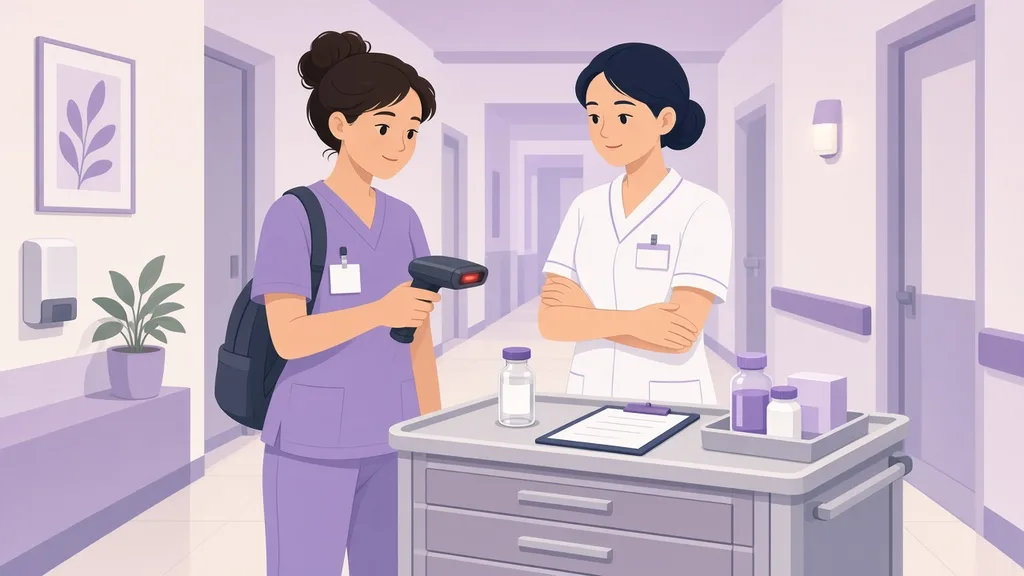
This guide is for nursing students and uses the Institute for Safe Medication Practices (ISMP) List of High-Alert Medications in Acute Care Settings (2024), ISMP's related newsletter and ECRI's page about the list. Follow your instructor's expectations and your facility's policies; they may add rules beyond what's here. To learn more about a related skill, see heparin drip calculation, and take a closer look at the lists below.
What "high-alert" means
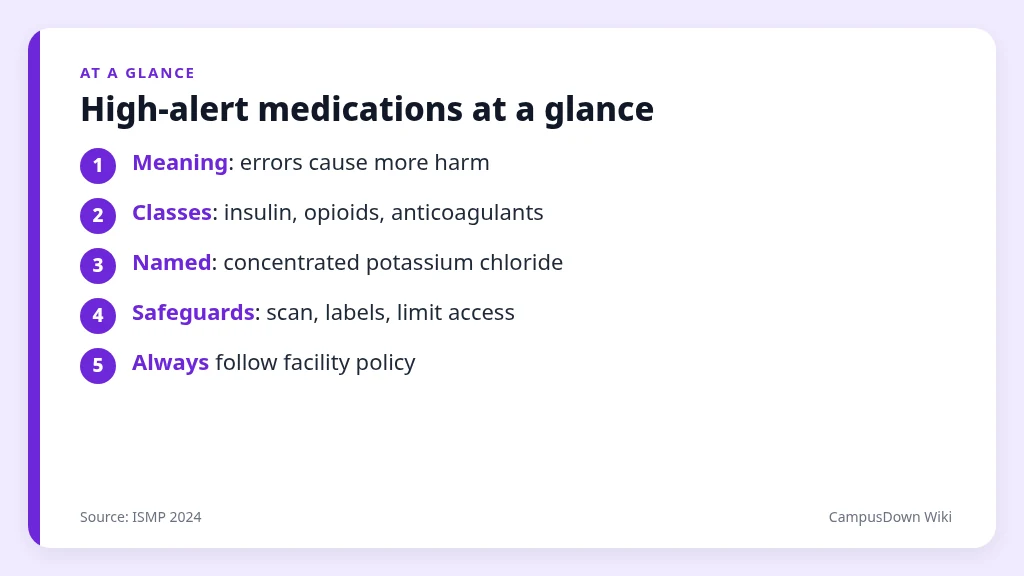
ISMP defines high-alert medications as drugs that bear a heightened risk of causing significant patient harm when they are used in error. It adds that mistakes may or may not be more common with these drugs, but the consequences of an error are clearly more devastating. The list is built from error reports to the ISMP National Medication Errors Reporting Program, harmful errors in the literature, studies of drugs involved in harmful errors and input from practitioners and safety experts. For 2024 ISMP also surveyed practitioners in September and October 2023.

Classes on the 2024 acute care list
Here is a selection of the classes ISMP lists, with a few of its examples:
- Antithrombotic agents: anticoagulants (warfarin, low molecular weight heparin, unfractionated heparin), direct oral anticoagulants and factor Xa inhibitors (rivaroxaban, fondaparinux), direct thrombin inhibitors, glycoprotein IIb/IIIa inhibitors and thrombolytics
- Insulin, subcutaneous and IV
- Opioids, all routes of administration (oral, sublingual, parenteral, transdermal)
- Adrenergic agonists, IV (epinephrine, phenylephrine, norepinephrine) and adrenergic antagonists, IV (propranolol, metoprolol, labetalol)
- Antiarrhythmics, IV (lidocaine, amiodarone) and inotropic medications, IV (digoxin, milrinone)
- Sedation agents: moderate sedation IV (dexmedetomidine, midazolam, lorazepam) and oral minimal and moderate sedation for children
- Neuromuscular blocking agents (succinylcholine, rocuronium, vecuronium)
- Chemotherapeutic agents, parenteral and oral
- Oral sulfonylurea hypoglycemics (glimepiride, glipizide, glyburide, tolbutamide)
- Other categories such as parenteral nutrition, dialysis solutions, epidural and intrathecal medications, hypertonic dextrose 20% or greater and hypertonic sodium chloride above 0.9%
Specific medications on the list
ISMP also names individual drugs: epinephrine IM and subcutaneous, epoprostenol IV, insulin U-500 (with special emphasis), magnesium sulfate injection, methotrexate oral for nononcologic use, nitroprusside, opium tincture, oxytocin IV, potassium chloride for injection concentrate, potassium phosphates injection, promethazine injection, tranexamic acid injection and vasopressin IV or intraosseous. You may meet several of these during clinical rotations. See potassium chloride and insulin types for background.
What the 2023 survey said
ISMP's newsletter reports that in 2023 more than 80% of respondents considered certain classes or drugs high-alert. U-500 insulin and potassium chloride for injection concentrate were each rated high-alert by 100%, and antithrombotic agents by 96%. The list is a living document; ISMP updates it periodically.
A close call worth knowing
The newsletter describes a hospital's close call: a bag of potassium chloride for injection concentrate (500 mEq/250 mL) was found in the bin for heparin 25,000 units/250 mL in an automated dispensing cabinet. Both products came in a similar bag with blue and red labeling. A nurse caught the error after removing the overwrap and scanning the barcode, before it reached the patient. ISMP's recommendations for the product include pharmacy-only purchase, storage and use, separating look-alike bags, auxiliary labels on cases and overwraps and scanning the barcode on the bag, and on all IV bags.
The lesson isn't to memorize one drug pair. It's that reading the label and scanning the barcode, every time, is what stopped an error.
Safeguards ISMP describes
ISMP says organizations may use strategies such as:
- standardizing ordering, storage, preparation and administration
- improving access to information about these drugs
- limiting access to high-alert medications
- auxiliary labels
- clinical decision support and automated alerts
- redundancies such as automated or independent double checks when necessary
ISMP also notes that manual independent double checks are not always the optimal strategy and may not be practical for every medication on the list. Your facility chooses the safeguards; your job is to know and follow them.
What students can do on clinical
- Learn your facility's high-alert list and policies before your first medication pass; ask your instructor where to find them.
- Read the full label, strength and form each time, and scan the barcode if your facility uses scanning.
- Never guess. If a drug looks unfamiliar, a bag looks wrong or an order seems odd, stop and ask your instructor or nurse.
- Use an independent double check when your policy requires one, and don't rubber-stamp it.
- Know the rights of medication administration; see the rights of medication administration.
- Practice with a safe tool; see drug suffixes for sorting drug names into classes.
Get help now if
If you suspect a medication error, tell your instructor or the nurse in charge right away and follow your facility's reporting process. Reporting protects the patient and helps the unit learn.
Example scenario: the look-alike bags
- Who
- Keziah, 24, a nursing student in Charlotte, North Carolina, was helping her preceptor gather an IV medication from a dispensing cabinet.
- What happened
- Two bags in the bin looked nearly identical, and she was tired near the end of a long clinical day.
- How it felt
- She felt pressure not to slow the team down, but she remembered her instructor saying that scanning is not optional.
- What they did
- She read the label aloud, scanned the barcode and asked her nurse to confirm the order, and the second bag turned out to be a different product.
- How it turned out
- Keziah said she felt proud, not embarrassed, that the extra thirty seconds had been part of the routine.
This is an illustrative example, not a real patient or a review.
Keziah's story is an illustrative example. Follow your facility's policies and your instructor's direction.
Most-asked questions about high-alert medications
What is the high alert medications list?
ISMP publishes a list for acute care settings, updated in 2024; your facility may adapt it.
Why people ask: "high alert medications list" is #2 for "high alert medications" (US autocomplete, November 2026).
What do high alert medications include?
Classes such as insulin, opioids and antithrombotic agents, and drugs such as concentrated potassium chloride.
Why people ask: "high alert medications include" is #3 for "high alert medications" (US autocomplete, November 2026).
What are examples of high alert medications?
Unfractionated heparin, warfarin, insulin, opioids (as a class), epinephrine and potassium chloride concentrate are among ISMP's listed examples.
Why people ask: "high alert medications examples" is #4 for "high alert medications" (US autocomplete, November 2026).
What is the definition of high alert medications?
Drugs that bear a heightened risk of significant harm when used in error, per ISMP.
Why people ask: "high alert medications definition" is #5 for "high alert medications" (US autocomplete, November 2026).
What is the ISMP list?
The Institute for Safe Medication Practices' List of High-Alert Medications in Acute Care Settings.
Why people ask: "high alert medications ismp" is #7 for "high alert medications" (US autocomplete, November 2026).
Related on CampusDown
You can learn more about heparin vs warfarin and check it for yourself in the guide to reading sliding scale insulin orders.
Frequently asked questions
- Are high-alert medications more likely to be given wrong?
- ISMP says errors may or may not be more common; the harm from an error is more severe.
- Is the ISMP list the same in every hospital?
- ISMP publishes a list, and each facility sets its own high-alert list and safeguards. Ask where to find yours.
- Does a double check always prevent errors?
- ISMP says manual independent double checks are not always the best strategy and may not be practical for every drug.
- Can students give high-alert medications?
- That depends on your school and facility. Ask your instructor before you give any medication.
High-alert doesn't mean "scary." It means a mistake costs more, so the checks matter more. Learn your facility's list, scan, read the label and ask before you act.
Browse more guides like this in the Nursing Student and NCLEX hub.
This article is for general education and does not replace advice from your own doctor, nurse or pharmacist.