
Your doctor started a water pill and added a potassium tablet that looks as big as a vitamin. It's hard to swallow. Can you cut it, crush it or take it with just a sip?

Potassium chloride is one of those medicines where how you take it matters as much as what you take. This guide is based on MedlinePlus's potassium drug information (revised June 2024) and a DailyMed potassium chloride extended-release tablet label. It does not give doses; follow your own prescription label and talk to your doctor or pharmacist. To learn more about where potassium sits on a lab report, take a closer look at the potassium range guide.
What potassium is for
MedlinePlus says potassium is essential for the proper functioning of the heart, kidneys, muscles, nerves and digestive system. Food usually supplies enough, but certain diseases, such as kidney disease and gastrointestinal disease with vomiting and diarrhea, and certain drugs, especially diuretics ("water pills"), can remove potassium from the body. Supplements are taken to replace the lost potassium or to prevent it from dropping. The DailyMed label describes use for the treatment and prevention of low potassium (hypokalemia). A common example is a furosemide user whose care team monitors potassium.
MedlinePlus lists oral liquid, powder, granules, effervescent tablets, regular tablets and extended-release tablets and capsules. Which form you get depends on your prescription.

Swallow extended-release tablets whole
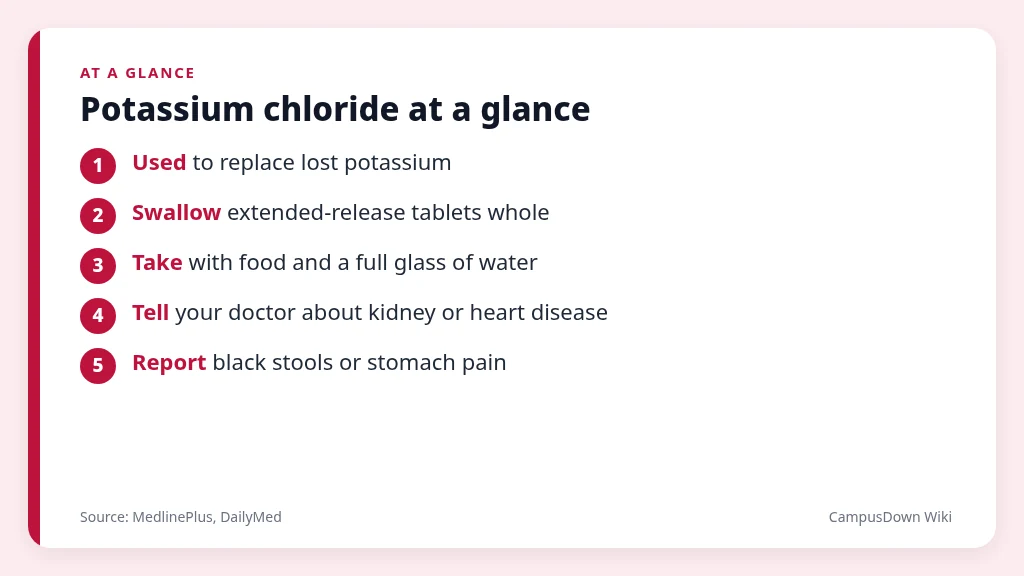
MedlinePlus says to swallow extended-release tablets and capsules whole, not to chew them or dissolve them in your mouth. The DailyMed label says to swallow tablets whole without crushing, chewing or sucking on them. The reason is that these products are designed to release slowly, and breaking them can change how they act.
If a tablet is too large or hard to swallow, don't crush or cut it unless your prescriber or pharmacist says that's okay for your specific product. Ask whether another form, such as an oral liquid or powder, would work. The label specifically notes that a liquid form may be considered for patients who have difficulty swallowing the tablets.
With food and a full glass of water
MedlinePlus says to take all forms of potassium with a full glass of water or fruit juice and, typically, with or right after meals. The DailyMed label says to take with meals and a glass of water and not on an empty stomach. For liquids and powders, MedlinePlus says to dissolve them in cold water or juice as directed and to mix well just before drinking.
Stomach and swallowing warnings
The label warns that potassium chloride solid oral forms can cause ulcerative or stenotic (narrowing) lesions in the stomach and intestines, and suggests considering a liquid form for people with dysphagia, swallowing disorders or severe gastrointestinal motility disorders. MedlinePlus tells people to call the doctor right away for stomach pain, unusual stomach bulging or black stools. Milder upset stomach, vomiting or diarrhea should be reported if severe or persistent.
Get help now if
Call your doctor right away for black stools, stomach pain, unusual stomach bulging, mental confusion, tingling or burning in the arms or legs, heaviness or weakness of the legs, or cold, pale gray skin, as MedlinePlus advises. Get emergency help for trouble breathing, a fainting spell or chest symptoms.
What to tell your doctor and pharmacist
- Heart, kidney or Addison (adrenal) disease, which MedlinePlus lists
- All medicines, since MedlinePlus says some should not be taken with potassium and others need monitoring; the DailyMed label lists triamterene and amiloride (potassium-sparing diuretics) as contraindicated with potassium chloride. Mention drugs like lisinopril too, so your team can decide what to monitor.
- Salt substitutes, since MedlinePlus says many contain potassium
- Pregnancy or breastfeeding
- Any upcoming surgery, including dental
For related safety checks, see high-alert medications and the rights of medication administration.
Don't self-prescribe
Potassium matters for the heart and muscles, so the level is checked. The DailyMed label directs that serum potassium be monitored, and treatment depends on your lab results. Don't start, stop or adjust potassium on your own, and don't use extra supplements or salt substitutes unless your doctor knows. If you take a water pill, ask whether lab checks are planned.
Missed dose
MedlinePlus says to take the missed dose as soon as you remember it and take any remaining doses for that day at evenly spaced intervals, and not to double up. For longer gaps, call the pharmacist.
Questions to ask your pharmacist
- Is my tablet extended-release, and can it be split or crushed?
- What if I have trouble swallowing it? Is there a liquid or powder form?
- Should I take it with a specific meal, and with how much water?
- Which of my other medicines or salt substitutes could interact?
- When will my potassium be rechecked?
- What symptoms mean I should call right away?
Example scenario: the large tablet
- Who
- Pearl, 76, a retired seamstress in Asheville, North Carolina, took a potassium tablet with her water pill but struggled to swallow it and sometimes sipped only a little water.
- What happened
- She considered cutting it, but wasn't sure that was allowed.
- How it felt
- She felt embarrassed about asking, afraid of seeming difficult.
- What they did
- She called her pharmacist, who confirmed what her tablet type was and talked with her prescriber about whether another form would suit her. Pearl made sure to take it with a meal and a full glass of water in the meantime and didn't cut it.
- How it turned out
- Pearl said she wished she'd called weeks sooner.
This is an illustrative example, not a real patient or a review.
Pearl's story is an illustrative example. Which form suits you is decided with your own prescriber and pharmacist.
Most-asked questions about potassium chloride
What is potassium chloride 20 mEq over the counter?
Ask your pharmacist what is available and appropriate; don't treat potassium as a casual supplement, and talk to a doctor first.
Why people ask: "potassium chloride 20 meq over the counter" is #2 for "potassium chloride 20 meq" (US autocomplete, November 2026).
What are the side effects of potassium chloride 20 mEq?
Upset stomach, vomiting and diarrhea; urgent signs include black stools, stomach pain, confusion and tingling or weakness.
Why people ask: "potassium chloride 20 meq side effects" is #3 for "potassium chloride 20 meq" (US autocomplete, November 2026).
What is a potassium chloride extended-release tablet?
A tablet that releases potassium slowly; swallow it whole.
Why people ask: "potassium chloride 20 meq extended release tablet" is #9 for "potassium chloride 20 meq" (US autocomplete, November 2026).
What is potassium chloride used for?
To treat or prevent low potassium, including losses from diuretics, vomiting and diarrhea.
Why people ask: "potassium chloride uses" is #5 for "potassium chloride" (US autocomplete, November 2026).
What are nursing considerations for potassium chloride?
Check the form, give with food and water, avoid crushing extended-release tablets and monitor potassium and the patient's symptoms per policy.
Why people ask: "potassium chloride nursing considerations" is #9 for "potassium chloride" (US autocomplete, November 2026).
Related on CampusDown
You can learn more about medicines and check it for yourself in the potassium range guide. For water pill context in detail, see furosemide.
Frequently asked questions
- Can I crush or chew potassium chloride tablets?
- No, not if they are extended release. MedlinePlus and the label say to swallow them whole.
- What if I can't swallow the tablet?
- Call your pharmacist or prescriber; a liquid form may be an option, per the label.
- Should I take it on an empty stomach?
- No. The label says to take it with meals and a glass of water.
- Do salt substitutes matter?
- Yes. MedlinePlus says many contain potassium, so tell your doctor.
- What stomach signs are urgent?
- Black stools, stomach pain and unusual bulging, per MedlinePlus; call your doctor right away.
Potassium chloride works best when taken the way the label says: with food, with plenty of water and swallowed whole if extended release. When in doubt, call your pharmacist.
Browse more guides like this in the Medicines hub.
This article is for general education and does not replace advice from your own doctor, nurse or pharmacist.