
A lab result pops up on your patient's chart with a flag next to potassium, and your mind goes blank. Is 3.4 bad? Is 5.3 an emergency? And who do you tell first?

This guide is for nursing students and uses MedlinePlus's potassium test, low blood potassium, high potassium level and potassium blood test pages. It is for learning; follow your instructor's expectations and your facility's policies, and never act on a lab value alone. To learn more about related labs, take a closer look at the lab values cheat sheet.
Why you will see more than one "normal"
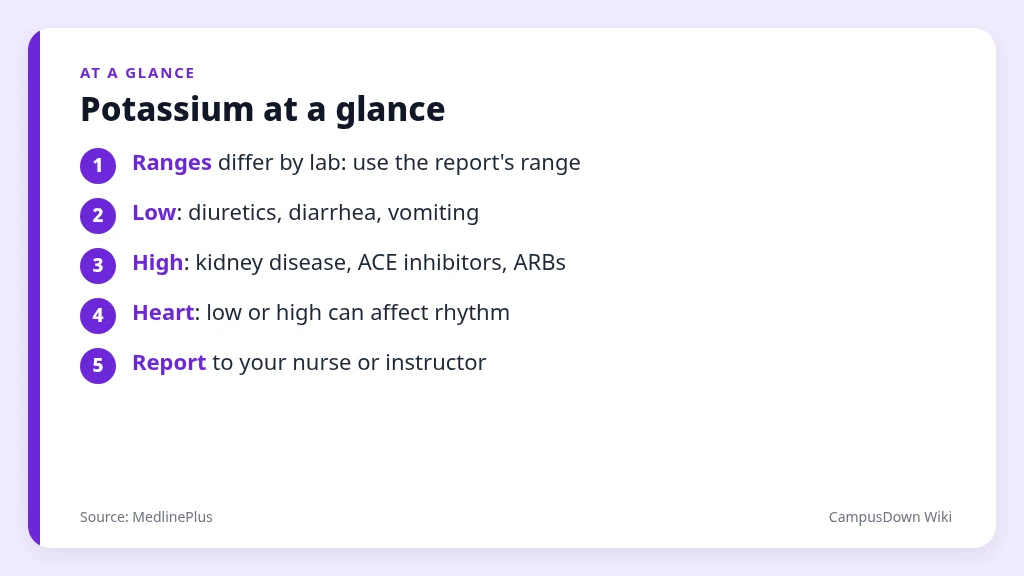
MedlinePlus is a good example of why textbook numbers don't match. Its potassium test article says the normal range is 3.7 to 5.2 mEq/L, while its low blood potassium article says 3.5 to 5.1 mEq/L (or mmol/L). Both pages add that normal ranges vary slightly among laboratories.
So the number to use on clinical is the reference range printed on your facility's lab report. A study guide range is for learning the pattern; the report is for the patient in front of you. Units matter too: mEq/L and mmol/L are the same number for potassium, but always check the unit on the report.

Why potassium matters so much
MedlinePlus says potassium helps nerves and muscles communicate and moves nutrients into cells and waste out. It stresses that small changes in potassium can have a big effect on nerves and muscles, especially the heart: low levels can lead to an irregular heartbeat or other electrical malfunction, high levels cause decreased heart muscle activity, and either can lead to life-threatening heart problems.
That is why potassium shows up so often in nursing exams. For rhythms, see ECG rhythms basics; for a deeper look at the high side, see high potassium on a blood test.
Low potassium (hypokalemia): causes and signs
MedlinePlus lists common causes: diuretics (water pills), diarrhea or vomiting, laxative overuse, eating disorders, low magnesium, sweating, chronic kidney disease, hormone problems such as Cushing syndrome or hyperaldosteronism, and some antibiotics at toxic levels. The test pages also mention heavy sweating and alcohol use disorder.
Symptoms of a small drop may be absent or mild: constipation, palpitations, fatigue, muscle weakness or spasms, and tingling or numbness. A large drop may lead to abnormal heart rhythms, especially in people with heart disease, which can cause lightheadedness or fainting. MedlinePlus says treatment depends on severity; mild cases are often managed with supplements and severe ones with potassium through a vein, ordered by the provider. A common diuretic is furosemide.
High potassium (hyperkalemia): causes and signs
MedlinePlus says kidneys remove extra potassium, so kidney disease is the most common cause of a high level. Other causes include Addison disease, large burns, injuries that damage muscle, severe bleeding in the stomach or intestines, and taking extra potassium such as salt substitutes or supplements. Certain blood pressure medicines, most often ACE inhibitors, ARBs and mineralocorticoid receptor antagonists such as spironolactone, can raise potassium.
There are often no symptoms. When they occur, they may include chest pain, difficulty breathing, nausea or vomiting, palpitations, and a slow, weak or irregular pulse. MedlinePlus says providers may order a basic metabolic panel, an ECG and a serum potassium level, and that a very high level or ECG changes need emergency treatment. See chronic kidney disease for why those patients are watched closely.
Get help now if
If a patient has chest pain, trouble breathing, a slow or irregular pulse or collapses, call for help right away according to your facility's emergency process. Do not wait for a lab to confirm.
What a student can assess and ask
These are learning prompts, not orders. Your instructor and facility policy decide what you do.
- Look at the trend: is this the first abnormal value, or is it moving? A single result can be affected by how the blood was drawn.
- Look at the medicines: diuretics, ACE inhibitors, ARBs, spironolactone, potassium supplements and salt substitutes all appear in the sources above.
- Look at the cause: vomiting, diarrhea, poor intake, kidney disease or a recent injury.
- Check the patient: pulse rate and regularity, muscle strength, palpitations, nausea, constipation or tingling, depending on whether the value is low or high.
- Ask about kidney tests and an ECG: MedlinePlus lists them as part of the work-up.
- Report with context using a structured format such as the one in SBAR.
MedlinePlus's potassium blood test page notes that repeatedly clenching and relaxing a fist just before or during the draw may temporarily raise potassium and give an incorrect result, and that natural black licorice eaten in the two weeks before a test may lower levels. That's one reason providers look at the whole picture.
Potassium given by IV is high-alert
ISMP lists potassium chloride for injection concentrate among its high-alert medications. Read the label every time, use scanning, and never give a concentrated potassium product unless your policy and your instructor say you may. See potassium chloride and high-alert medications.
Example scenario: the flagged result
- Who
- Ximena, 23, a second-year nursing student in Tucson, Arizona, was assigned to an older patient who took a water pill and a blood pressure medicine for heart failure.
- What happened
- When she checked the morning labs, the potassium had a flag beside it, but she wasn't sure which direction counted as worse or whether it was her place to speak up.
- How it felt
- She felt nervous about bothering the nurse and worried about getting the range wrong.
- What they did
- She looked at the reference range printed on the report, noted the patient's medicines and told the nurse what she saw. The nurse confirmed the value, checked the patient and called the provider following unit policy.
- How it turned out
- Ximena said she learned that saying "I saw this, what should I do?" is part of the job, not a mistake.
This is an illustrative example, not a real patient or a review.
Ximena's story is an illustrative example. Follow your instructor's direction and your facility's policies.
Most-asked questions about the potassium range
What is the potassium normal range in mmol/L?
For potassium, mEq/L and mmol/L are the same number. MedlinePlus reports 3.7 to 5.2 in one article and 3.5 to 5.1 in another; use your lab's range.
Why people ask: "potassium normal range mmol/l" is #8 for "potassium normal range" (US autocomplete, November 2026).
Does the normal potassium range differ for women and men?
MedlinePlus gives one adult range and says ranges vary slightly by laboratory; check the report.
Why people ask: "potassium normal range female" is #2 for "potassium normal range" (US autocomplete, November 2026).
What is the normal range of potassium in blood?
Serum potassium is usually reported in mEq/L or mmol/L; ranges vary slightly among labs.
Why people ask: "potassium normal range in blood" is #3 for "potassium normal range" (US autocomplete, November 2026).
Is there a normal potassium range by age?
The MedlinePlus pages here give adult ranges only. Ask your instructor or the lab for age-specific values.
Why people ask: "potassium normal range by age" is #5 for "potassium normal range" (US autocomplete, November 2026).
What potassium level is low?
Below your lab's lower limit. MedlinePlus describes low potassium (hypokalemia) as lower than normal.
Why people ask: "potassium normal range low" is #6 for "potassium normal range" (US autocomplete, November 2026).
Related on CampusDown
You can learn more about the companion lab in sodium normal range and nursing priorities and check it for yourself in the nursing student hub. For fluid balance in detail, see fluid volume excess and deficit.
Frequently asked questions
- Why do textbooks list different potassium ranges?
- Labs use slightly different reference ranges, and even MedlinePlus lists 3.5 to 5.1 on one page and 3.7 to 5.2 on another.
- Is a slightly abnormal potassium always an emergency?
- Not necessarily. MedlinePlus says a result outside the range doesn't always mean a condition that needs treatment, but it should be reported and reviewed.
- Which medicines can raise potassium?
- MedlinePlus lists ACE inhibitors, ARBs, mineralocorticoid receptor antagonists such as spironolactone, and potassium supplements or salt substitutes.
- Which medicines can lower potassium?
- Diuretics are the most common example in the MedlinePlus pages.
- Should students give potassium?
- Only when your instructor and facility policy allow it. Concentrated potassium chloride for injection is on ISMP's high-alert list.
Learn the pattern, then use the range on your own lab report. Potassium affects the heart, so report abnormal values and follow your facility's process.
Browse more guides like this in the Nursing Student and NCLEX hub.
This article is for general education and does not replace advice from your own doctor, nurse or pharmacist.