
Your instructor asks you to recite the rights of medication administration, and you say five. Another student says seven. A third says ten. Who's right, and which version will you actually be tested on?

This guide is for nursing students. It uses OpenStax's Pharmacology for Nurses, section 2.1 (Drug Administration and the Nursing Process) and MedlinePlus's Medicine safety during your hospital stay. Follow your school's list and your facility's policies; they may differ from the lists below. To learn more about related safety topics, take a closer look at high-alert medications.
Why you hear different numbers
The rights are a checklist that has grown over time. OpenStax says nursing practice has expanded the original five rights of medication administration to seven. MedlinePlus's patient-facing page lists eight, adding right response. Some schools and exam prep materials list more or group them differently.
So treat any list as a thinking tool. The goal is the same in every version: the right person gets the right drug in the right way, and the care is recorded accurately. Ask your instructor which version your program uses and learn that one.

The seven rights, in plain words
Based on OpenStax:
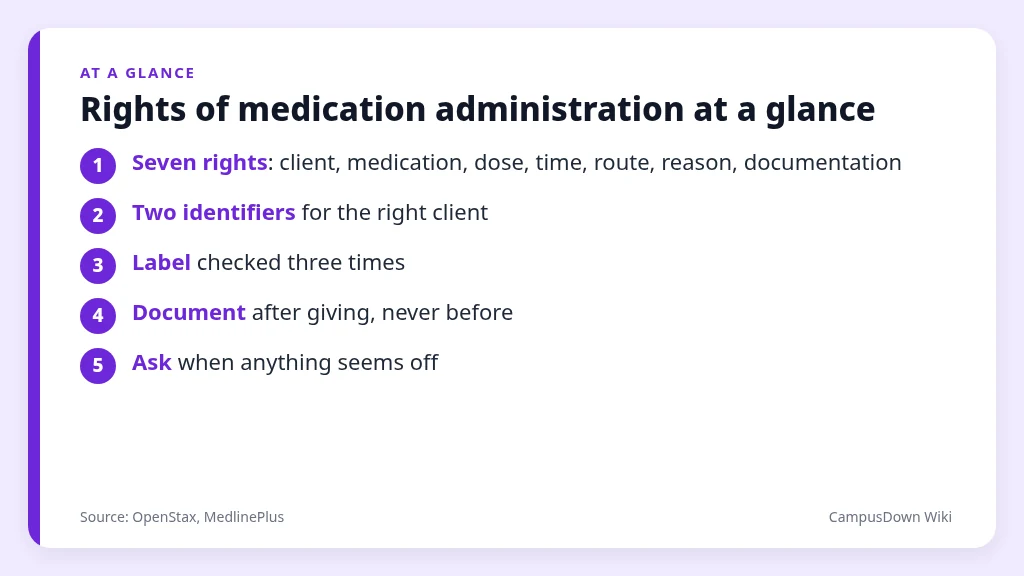
- Right client. Use at least two identifiers. OpenStax says The Joint Commission recommends this, and that name, date of birth and/or medical record number are standard. When possible, ask the client to state their name and date of birth and compare it to the wristband and chart.
2. Right medication. Compare the label to the order. OpenStax says to compare the label or container three separate times: when obtaining the medication, when preparing it and at the bedside. Check the expiration date, how it was stored and any allergies. 3. Right dose. Validate the dose and any calculations. OpenStax says you can ask another nurse to validate doses of high-alert drugs such as heparin or insulin, and to question doses that seem unsafe. 4. Right time. Each facility has a policy for acceptable timing. OpenStax says most institutions allow 30 to 60 minutes before or after the scheduled dose; check your own policy. 5. Right route. Confirm the route is correct and safe for this client; never assume the route. If it was left off the order, confirm with the provider. 6. Right indication (reason). Know why the client has the medication, which also helps you assess whether it's working. Clarify orders that don't seem to fit. 7. Right documentation. Document after giving; record variances, refusals and held medications and the reasons.
MedlinePlus's version adds right response: is the medicine producing the desired effect? For example, after a blood pressure medicine, does the blood pressure stay in the desired range? This links to the nursing process, where evaluation closes the loop.
The "three checks"
OpenStax says most institutions require nurses to review the rights at least three times before administering. The label check has its own three moments: when you obtain the medication, when you prepare it and at the bedside. The medication should stay in its original container until you are at the bedside, ready to give it.
OpenStax gives an example of why every right matters: a nurse can have the right drug, dose, route, time and reason, but if she walks into the wrong room and doesn't identify the client, an error still happens.
Scanning helps, but doesn't replace thinking
OpenStax describes barcode scanning: you scan your badge, the client's wristband and the drug, and the system compares them with the order and warns you if they don't match. It cites a review reporting that barcode technology significantly decreases medication errors when proper scanning occurs before administration.
Scanning is a safety net, not a substitute for knowing why the drug is ordered. If an alert pops up, stop and find out why. For a close look at how two similar products can be mixed up, read mixing insulin and drug suffixes.
Get help now if
Never document a medication as given before you give it. OpenStax says to complete documentation after the drug is administered. If you notice a mistake, tell your instructor or nurse right away and follow the facility's reporting process.
Teaching and the client's role
OpenStax encourages clients to question the nurse about their medicines, and MedlinePlus gives patients tips such as asking what each medicine is for, knowing the names and times, and speaking up if something seems wrong or a container has no label. ISMP's 2024 high-alert list for acute care includes insulin and antithrombotic agents, which is one reason facilities add extra safeguards for them. A client who asks "what is this?" is part of your safety system, not a threat to your confidence. MedlinePlus also notes that high-alert medicines, including blood thinners, insulin and narcotic pain medicines, may have extra safety steps.
Learning the rights without memorizing in a panic
- Write the list on a card and use it at the bedside during practice.
- Say each right out loud during skills lab, until it feels natural.
- Tie each right to a question: Who? What? How much? When? How? Why? Did I record it? Did it work?
- Practice clinical judgment, not just recall; see the Tanner clinical judgment model.
- Use your lists in your charting practice too.
Starting your first job? See your first year as a new grad nurse.
Example scenario: the wrong name on the cup
- Who
- Jovita, 22, a nursing student in Albuquerque, New Mexico, was preparing to give a scheduled medication to a patient who was drowsy and nodding when she said his name.
- What happened
- His wristband matched the order, but she remembered her instructor saying a nod isn't an identifier.
- How it felt
- She felt rushed and a little silly asking again, worried it would seem like she doubted herself.
- What they did
- She asked him to say his full name and date of birth, compared his answer to the wristband and the order, and scanned the wristband and the drug. Her instructor watched and then talked through why the second identifier mattered.
- How it turned out
- Jovita said asking again took ten seconds and that she'd never skip it.
This is an illustrative example, not a real patient or a review.
Jovita's story is an illustrative example. Follow your instructor's direction and your facility's policies.
Most-asked questions about the rights
What are the rights of medication administration in nursing?
OpenStax lists seven: client, medication, dose, time, route, indication and documentation. MedlinePlus lists eight.
Why people ask: "rights of medication administration nursing" is #2 for "rights of medication administration" (US autocomplete, November 2026).
Are there new rights of medication administration in 2026?
Lists vary by source and school; OpenStax says practice expanded from five to seven. Use the version your program teaches.
Why people ask: "rights of medication administration 2026" is #3 for "rights of medication administration" (US autocomplete, November 2026).
What are the 10 rights of medication administration?
Some sources list more than seven, and MedlinePlus lists eight with right response. Ask your instructor which list your program uses.
Why people ask: "rights of medication administration 10" is #5 for "rights of medication administration" (US autocomplete, November 2026).
Is there a rights of medication administration PDF?
Many schools provide one. OpenStax's chapter is free online and MedlinePlus lists the rights on a patient page.
Why people ask: "rights of medication administration pdf" is #6 for "rights of medication administration" (US autocomplete, November 2026).
What are the rights in order?
OpenStax lists client, medication, dose, time, route, indication and documentation, but the order is a memory aid; do all of them every time.
Why people ask: "rights of medication administration in order" is #8 for "rights of medication administration" (US autocomplete, November 2026).
Related on CampusDown
You can learn more about the nursing student hub and check it for yourself in the nursing process guide. For checks on a risky class in detail, see high-alert medications.
Frequently asked questions
- Why are there different numbers of rights?
- The checklist expanded over time; OpenStax says five became seven, MedlinePlus lists eight, and schools vary.
- How many identifiers should I use?
- OpenStax says The Joint Commission recommends at least two, such as name and date of birth, and to compare them to the wristband and chart.
- How many times do I check the label?
- OpenStax says three separate times: when obtaining, when preparing and at the bedside. Follow your facility's policy.
- When do I document?
- After giving the medication, never before, per OpenStax. Also document refusals, holds and variances with reasons.
- How close to the scheduled time do I have to be?
- OpenStax says most institutions allow 30 to 60 minutes before or after, but each facility sets its own policy.
The rights are a habit, not a list to recite. Check the person, the drug, the order and the record every time, and ask when anything looks off.
Browse more guides like this in the Nursing Student and NCLEX hub.
This article is for general education and does not replace advice from your own doctor, nurse or pharmacist.