
Your instructor says, "Clear before cloudy," and you nod like you understand. But why clear first, which insulins does it apply to, and what happens when you meet one that shouldn't be mixed at all?

This guide is for nursing students. It is based on the FDA-approved prescribing information for Humulin R, Humulin N, Humalog and NovoLog (insulin aspart). It explains the idea behind the rule; it does not teach dosing. Follow your instructor's procedure and your facility's policy, and always read the product label. To learn more about the insulin families, take a closer look at the insulin types chart.
The rule, and where it comes from
"Clear before cloudy" is a memory aid, and it matches what the labels say for common pairs:
- Humulin R (regular human insulin) is a clear and colorless solution. Its label says: *do not mix Humulin R with insulin preparations other than Humulin N; to mix Humulin R and Humulin N, draw Humulin R into the syringe first and inject immediately after mixing.*
- Humulin N (NPH) is a white and cloudy suspension. Its label says: if mixed with Humulin R, draw Humulin R first; if mixed with Humalog, draw Humalog first; inject immediately after mixing.
- Humalog (insulin lispro) is clear and colorless. The U-100 label says it may be mixed with NPH insulin preparations only; if mixed, draw Humalog into the syringe first and inject immediately after mixing.
- NovoLog (insulin aspart) is clear and colorless. Its label says that if mixed with NPH insulin, withdraw NovoLog first and inject immediately after mixing.
So in each case the clear, short- or rapid-acting insulin goes in first and the cloudy NPH goes second. The rule is a shortcut to those label instructions, not a replacement for them.

What "clear" and "cloudy" mean
The labels describe how each product should look:
- Humulin R, Humalog and NovoLog should appear clear and colorless; the labels say not to use them if particulate matter or coloration is seen.
- Humulin N should be uniformly cloudy after mixing (resuspending the vial or pen) and should not contain particulate matter.
If the appearance doesn't match the label, don't use it; tell your instructor or nurse. If you want to compare insulin groups in detail, see insulin types chart and rapid-acting insulin timing.
Not everything can be mixed
Memorizing "clear first" can create a false sense that any clear insulin can go with any cloudy one. The labels say otherwise:
- Humulin R: do not mix with preparations other than Humulin N.
- Humalog U-100: NPH preparations only; do not mix Humalog U-200 with any other insulin; and do not mix with other insulins in a continuous subcutaneous infusion (pump).
- NovoLog: do not mix with other insulins in a pump, and NPH is the only insulin the label allows to be mixed with it for injection.
For any other product, such as a long-acting insulin, don't assume it can be mixed. Ask the pharmacist or check the label for that specific product. The long-acting group is covered in insulin glargine.
Get help now if
Never guess at insulin. If you are not sure whether two insulins can be mixed, stop and ask your instructor, nurse or pharmacist before drawing anything up.
Why this matters: insulin is high-alert
ISMP lists insulin on its high-alert medication list, and the labels reinforce the same point. The Humalog and Humulin R labels say that accidental mix-ups between insulin products have been reported and tell patients to always check the insulin label before each injection. Low blood sugar is the most common adverse reaction to insulins; see hypoglycemia and high-alert medications.
A calm checklist for skills lab and clinical
This is a learning outline. Your school's skills procedure is the one to follow.
- Read the order and confirm the insulin names, the order and the patient. See the rights of medication administration.
2. Check each label (name, strength, expiration) and look at the product. 3. Confirm the mix is allowed by the label or facility policy. 4. Follow your facility's independent double-check when it is required for insulin. 5. Draw up in the order the label gives: the clear insulin first, then the NPH, and give the injection right after mixing, as the labels say. 6. Document after giving, not before.
For sliding scale orders, see sliding scale insulin.
Example scenario: the skills check-off
- Who
- Roscoe, 28, a nursing student in Spokane, Washington, was nervous before his insulin skills check-off.
- What happened
- He had memorized "clear before cloudy" but froze when his instructor asked, "Does that apply to every insulin?"
- How it felt
- He felt his face get hot, worried he'd fail, and embarrassed that he hadn't opened the label.
- What they did
- He took a breath, picked up the labels and read what each product said about mixing, then explained that he would confirm the order, check the label and ask if he wasn't sure. His instructor walked him through the steps and noted the label as the final authority.
- How it turned out
- Roscoe said he passed, and that reading the label first became his habit.
This is an illustrative example, not a real patient or a review.
Roscoe's story is an illustrative example. Follow your instructor's direction and your facility's policies.
Most-asked questions about clear to cloudy insulin
What is the clear to cloudy insulin rule?
A memory aid: when a label allows mixing, the clear insulin is drawn first and the cloudy NPH second.
Why people ask: "clear to cloudy insulin rule" is #2 for "clear to cloudy insulin" (US autocomplete, November 2026).
How do you mix clear and cloudy insulin?
Only if the label allows it; for Humulin R and Humulin N the label says to draw Humulin R first and inject immediately.
Why people ask: "clear to cloudy insulin mixing" is #3 for "clear to cloudy insulin" (US autocomplete, November 2026).
What are the steps for mixing insulin?
Follow your school's skills procedure and facility policy; the labels give the draw order and say to inject right after mixing.
Why people ask: "clear to cloudy insulin steps" is #4 for "clear to cloudy insulin" (US autocomplete, November 2026).
Which insulin do you draw first?
The clear one (Humulin R, Humalog or NovoLog) is drawn before NPH, per the labels.
Why people ask: "clear to cloudy insulin draw" is #5 for "clear to cloudy insulin" (US autocomplete, November 2026).
Do you draw clear before cloudy insulin?
Yes for the labeled combinations with NPH; always confirm with the label for the specific products.
Why people ask: "clear before cloudy insulin" is #8 for "clear to cloudy insulin" (US autocomplete, November 2026).
Related on CampusDown
You can learn more about insulin types and check it for yourself in the nursing student hub. For ordering in detail, see sliding scale insulin.
Frequently asked questions
- Why is the clear insulin drawn first?
- The labels for the common NPH mixes say to draw the clear insulin first and inject right after mixing. Follow the label and your facility's procedure.
- Can I mix long-acting insulin with clear insulin?
- Don't assume so. Check the label for that product and ask a pharmacist or your instructor.
- Is it OK to mix insulin in a pump?
- The Humalog and NovoLog labels say not to mix them with other insulins in a continuous subcutaneous infusion pump.
- What should NPH look like?
- The Humulin N label says it should appear uniformly cloudy after mixing and not contain particles.
- What if the mix isn't allowed on the label?
- Don't mix. Ask your instructor, nurse or pharmacist.
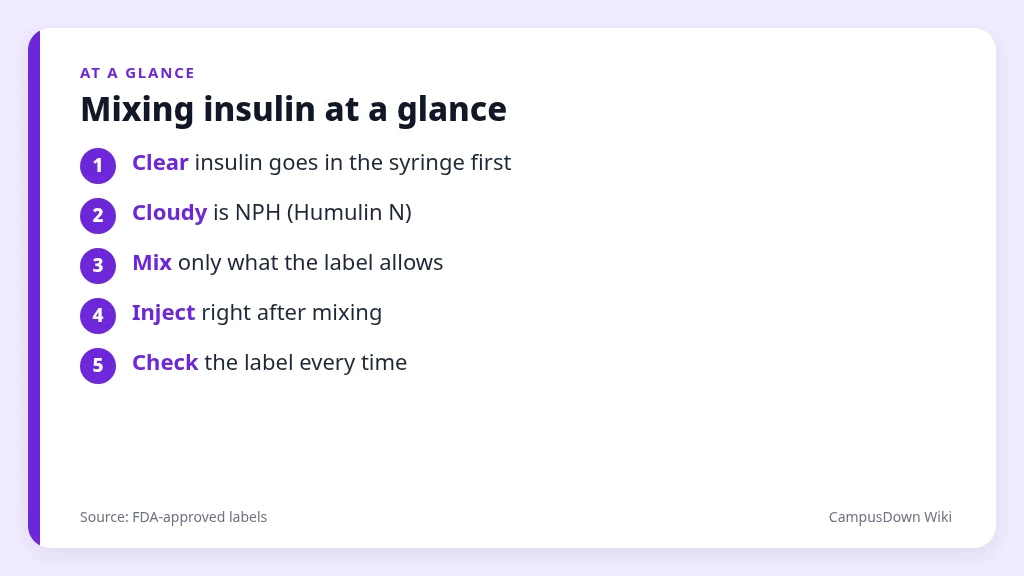
"Clear before cloudy" is a handy cue, but the label is the rule. Check it every time, mix only what it allows and ask when anything is unclear.
Browse more guides like this in the Nursing Student and NCLEX hub.
This article is for general education and does not replace advice from your own doctor, nurse or pharmacist.