
Your pharmacist hands you a pen that says Lantus, and then mentions Basaglar and Toujeo as if you should know the difference. What is insulin glargine, and what are the rules that apply to all of these?

This guide is a plain-language overview. It is based on the FDA-approved Lantus prescribing information (revised June 2023; FDA notes posted labels may not be the latest) and MedlinePlus's insulin glargine page. It is general education, not a dosing guide. Don't start, stop or change any insulin without your prescriber. To learn more about insulin groups, take a closer look at the insulin types chart.
What insulin glargine is
MedlinePlus says insulin glargine is used to treat type 1 and type 2 diabetes and is in a class called long-acting insulin. It works by replacing insulin the body would normally make, helping move sugar from the blood into body tissues and stopping the liver from producing more sugar. The Lantus label describes it as a long-acting human insulin analog indicated to improve glycemic control in adults and children with diabetes, and says it is not recommended for diabetic ketoacidosis.
MedlinePlus lists several products that contain insulin glargine: Basaglar, Lantus, Rezvoglar, Semglee and Toujeo, plus a combination product with another medicine. It explains that some are biosimilar to insulin glargine, meaning they work as well and are as safe to use. Strengths and devices differ between products, so ask your pharmacist which one you have.

Basal vs mealtime insulin
Long-acting insulin is generally used for the background, or basal, part of a regimen, while rapid-acting insulins such as Humalog and NovoLog are used around meals. The Lantus label says people with type 1 diabetes must use it together with short-acting insulin. It describes a flat time profile over 24 hours without a pronounced peak compared with NPH insulin. Your care team decides which combination suits you.
Timing: same time every day
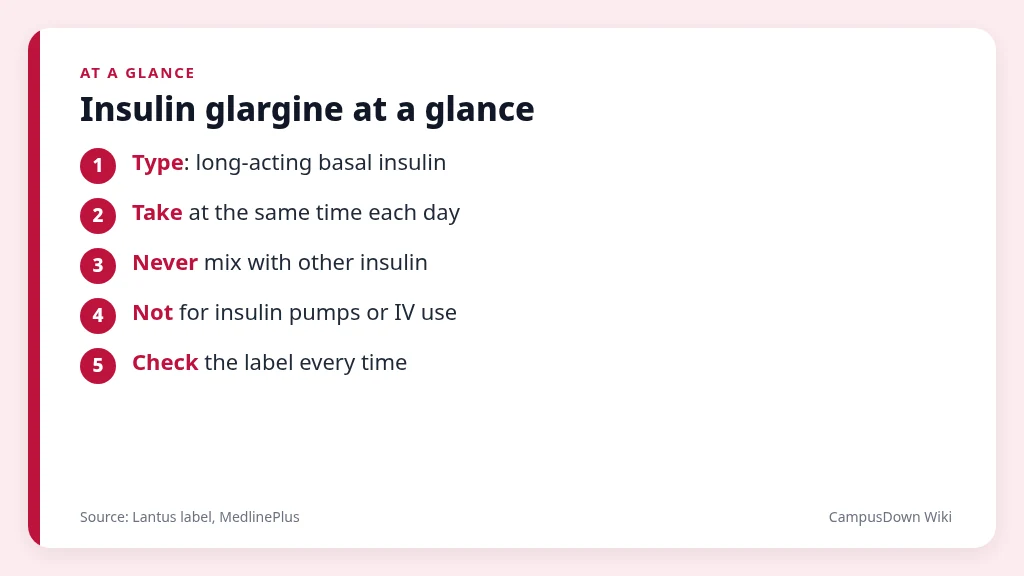
The label says to give Lantus subcutaneously once daily at any time of day, but at the same time every day. MedlinePlus says to use it at the same time every day, exactly as directed, and never more or less than prescribed. If you miss a dose or want to move the timing, call your care team rather than guessing.
Label rules worth remembering
- Never mix or dilute: the label says do not dilute or mix Lantus with any other insulin or solution, and MedlinePlus says the same for insulin glargine. Compare this with insulins that can be mixed with NPH in the mixing guide.
- Not for pumps or IV: the label says do not administer intravenously or via an insulin pump, and MedlinePlus says never to inject it into a vein or muscle or use it in an external pump. For pump options, see insulin pump vs injections.
- Look at it: it should be clear and colorless with no particles; MedlinePlus says not to use it if it is colored, cloudy or has solid particles, or if it is expired.
- Rotate sites: inject in the abdomen, thigh or deltoid (upper arm) and rotate within the region to reduce the risk of lipodystrophy and cutaneous amyloidosis. MedlinePlus says to avoid skin that is thick, lumpy, tender, bruised or scarred.
- Never share: MedlinePlus says never to reuse or share needles, syringes or pens. Dispose of sharps in a puncture-resistant container.
- Pens: the label says to use the SoloStar pen with caution if you have visual impairment and rely on audible clicks.
Low blood sugar
The label says hypoglycemia is the most common adverse reaction to insulins and that severe hypoglycemia can cause seizures and be life-threatening. It can also impair concentration and reaction time, which matters for driving. The label asks for more frequent glucose checks when insulin dosage, other medicines, meals or activity change, and for people with kidney or liver problems or hypoglycemia unawareness. MedlinePlus says to know the symptoms of low and high blood sugar and the plan for them. See hypoglycemia.
Get help now if
Call 911 for severe low blood sugar symptoms such as passing out, seizure or being unable to swallow, and follow the emergency plan your care team gave you.
Other side effects and warnings
MedlinePlus lists injection-site redness, swelling, pain or itching, skin thickening or small dents in the skin, and signs of infection among side effects to report. Serious signs include rash or hives all over the body, wheezing, trouble breathing or swallowing, fast pulse, weakness, muscle cramps, abnormal heartbeat, sudden weight gain, swelling of the ankles or feet, shortness of breath and vision changes. The label also warns about low potassium (hypokalemia) and about fluid retention and heart failure when used with certain medicines (PPAR-gamma agonists). Tell your doctor about nerve damage from diabetes, heart failure, low potassium, vision problems and heart, liver or kidney disease.
Alcohol, illness and routines
MedlinePlus says alcohol may cause low blood sugar, and to ask your doctor how to handle illness, unusual stress or changes in diet, exercise or activity, since those can change your insulin needs. Older adults and those with several medicines may need extra planning; see diabetes in older adults.
Check the label, and ask before switching
The label says accidental mix-ups between insulin products can occur and tells patients to check insulin labels before each injection. MedlinePlus says not to switch to another brand or type of insulin, or change the dose of any insulin, without talking to your doctor, and to check the label to be sure the pharmacy gave you the right type. If a product changes, ask the pharmacist what differs and tell your prescriber.
Questions to bring to your appointment
- Which insulin glargine product am I using, and what time should I take it?
- What should I do if I miss a dose or travel across time zones?
- What are my low blood sugar symptoms and my plan?
- How should I check my sugar when I change meals or activity?
- Is my regimen meant to include mealtime insulin as well?
- What if my insurance or pharmacy changes my product?
Example scenario: the evening alarm
- Who
- Hiram, 58, a long-haul bus driver in Fort Worth, Texas, took his long-acting insulin at varying times because of his changing route schedule.
- What happened
- He wasn't sure how much it mattered, and he sometimes took it late when he got home.
- How it felt
- He felt guilty and a little defensive, afraid his doctor would scold him for not being perfect.
- What they did
- He brought his logbook to the clinic and asked how to handle a schedule that changed. His care team went over a plan for consistent timing, what to do if he was off schedule and how to check his sugar on long days. They also reviewed his low blood sugar symptoms and driving.
- How it turned out
- Hiram said having a plan for the messy days was more useful than a lecture.
This is an illustrative example, not a real patient or a review.
Hiram's story is an illustrative example. Your insulin schedule and plan are decided with your own care team.
Most-asked questions about Lantus and insulin glargine
What is Lantus SoloStar?
SoloStar is the Lantus prefilled pen; the label notes the pen dials in 1-unit increments and to use caution with visual impairment. Your prescriber and pharmacist explain your pen.
Why people ask: "lantus solostar" is #3 for "lantus" (US autocomplete, November 2026).
What is the generic name for Lantus?
Insulin glargine. MedlinePlus lists several products that contain it.
Why people ask: "lantus generic name" is #5 for "lantus" (US autocomplete, November 2026).
What are the side effects of Lantus?
Low blood sugar is the most common; others include injection-site reactions, skin changes, allergic reactions and low potassium.
Why people ask: "lantus insulin side effects" is #4 for "lantus insulin" (US autocomplete, November 2026).
How much does Lantus insulin cost?
Prices vary by product, plan and pharmacy; ask your pharmacist and insurer about covered options.
Why people ask: "lantus insulin price" is #3 for "lantus insulin" (US autocomplete, November 2026).
Is Lantus the same as insulin glargine?
Yes, Lantus contains insulin glargine. Other glargine products exist; don't switch without your prescriber.
Why people ask: "lantus insulin glargine" is #8 for "lantus insulin" (US autocomplete, November 2026).
Related on CampusDown
You can learn more about insulin types and check it for yourself in the medicines hub. For mealtime insulin in detail, see rapid-acting insulin timing.
Frequently asked questions
- Can I mix Lantus with another insulin?
- No. The label says not to dilute or mix it with any other insulin or solution.
- Can I use Lantus in an insulin pump?
- No. The label and MedlinePlus say not to use it in an insulin pump or give it intravenously.
- When should I take it?
- Once daily at the same time every day, per the label. Ask your care team about your schedule.
- What is the main risk?
- Hypoglycemia, the most common adverse reaction listed for insulins.
- Can my pharmacy switch me to another glargine product?
- Ask the pharmacist what differs and tell your prescriber; MedlinePlus says not to switch brand or type of insulin without your doctor.
Insulin glargine provides background insulin, with a few firm rules: same time daily, no mixing, no pumps and always check the label. Keep your care team in the loop on any change.
Browse more guides like this in the Medicines hub.
This article is for general education and does not replace advice from your own doctor, nurse or pharmacist.