
You've been on injections for years, and someone in a support group says her pump changed her life. Another person says he went back to shots and never regretted it. Which one is right?

Neither answer is universal. This guide lays out what NIDDK and the FDA say about the options and gives you questions to discuss with your diabetes team. It is not a recommendation for a device and doesn't give settings or doses. To learn more about the insulins themselves, take a closer look at the insulin types chart.
How people take insulin
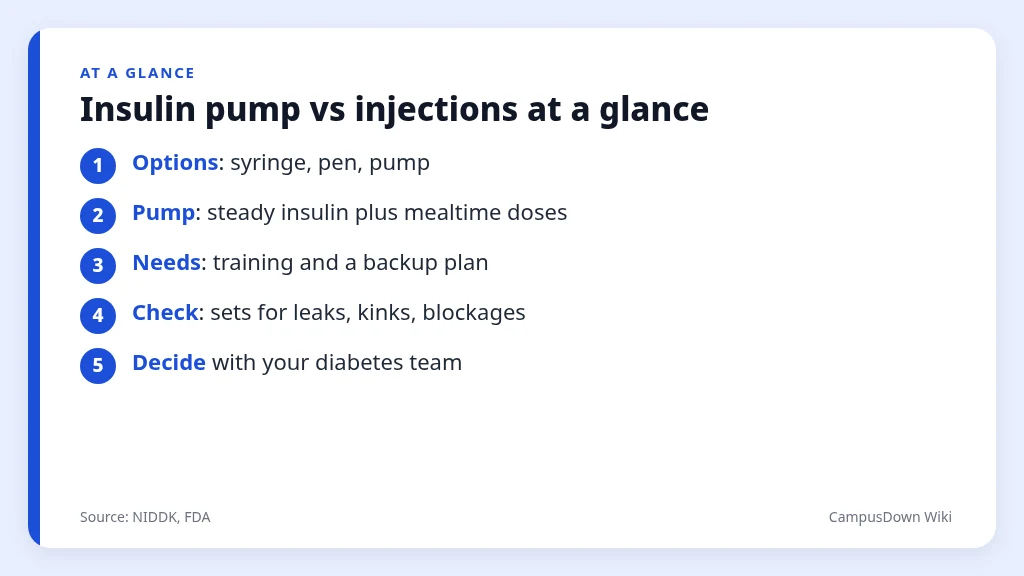
NIDDK says most people with diabetes take insulin using a needle and syringe, an insulin pen or an insulin pump, and that inhalers and jet injectors are less common. It adds that the way you take insulin may depend on your lifestyle, insurance plan and preferences, and to talk with your doctor about the options.
Multiple daily injections means several shots a day, commonly a long-acting insulin for background needs plus rapid-acting insulin at meals. See insulin glargine for a long-acting example. A pump replaces those with one device that gives both parts.

What a pump is
NIDDK says an insulin pump is a small machine that gives steady doses of insulin throughout the day and can be programmed to give more or less based on needs, with extra doses at mealtimes. One type is worn outside the body and connects to a plastic tube inserted under the skin that stays in for several days; another type has no tubing and attaches to the skin with a self-adhesive pad and is controlled by a handheld device. The FDA describes a pump as delivering insulin under the skin through a small plastic tube (catheter), continuously, on demand before meals, or to correct high glucose.
Pens and syringes
NIDDK says a pen looks like a writing pen with a needle, and that many people find pens easier to use but they cost more than needles and syringes. With a vial and syringe you draw up the insulin yourself. NIDDK says to alternate injection spots, since repeated injections in one spot can cause the tissue to harden.
Pump and CGM systems
NIDDK explains that an artificial pancreas (automated insulin delivery) links a continuous glucose monitor (CGM), an insulin pump and a program that calculates insulin. It says these systems are FDA-approved, mainly described for type 1 diabetes, and that most require you to count and enter carbohydrates at meals. For monitoring options, see glucose meter vs CGM.
What the FDA says about using a pump safely
The FDA's home-use guidance says:
- Complete training on safe use, and consider inviting family or care partners to practice with you.
- Work with your provider to develop a back-up plan, including supplies, for resuming your insulin regimen if the pump fails.
- Regularly monitor glucose with a CGM or meter.
- Check the pump and tubing for leaks, kinks, air bubbles or blockages. Most pumps can detect blockages and sound an alert, but not always right away, and in general pumps cannot detect leaks.
- Know the signs of high and low blood sugar; ask your provider before changing pump settings.
- Don't follow another person's treatment plan; your insulin needs are unique.
- Report problems to your provider, pump supplier and FDA MedWatch.
That means choosing a pump involves skill-building and supplies, not just a new gadget. Ask whether you'd also keep injection supplies at home.
Considerations to weigh
These are discussion points, not rules:
- Daily routine: some people prefer the flexibility of programmed or on-demand doses; others prefer not to wear a device all day.
- Skills: pumps need training and troubleshooting; injections need accurate dose calculation and site rotation.
- Comfort: think about tubing or adhesive pads on your skin, sleep, exercise and clothing.
- Cost and coverage: NIDDK notes pens cost more than syringes; pump supplies and CGMs add costs. Ask your insurer what is covered and what you pay for supplies.
- Safety plan: know your plan for low sugar and for pump problems; see hypoglycemia.
- Age and health: vision, dexterity and support matter; see diabetes in older adults.
Questions to bring to your appointment
- Does my diabetes type and history make a pump a reasonable option?
- How would training work, and who would I call after hours?
- What is the backup plan if my pump stops working?
- Would I need a CGM, and is a CGM-linked system an option?
- What would it cost me, including supplies?
- If I try a pump and don't like it, can I go back to injections?
Example scenario: the support group debate
- Who
- Kiera, 34, a graduate student in Madison, Wisconsin, had used insulin pens for years and kept hearing in an online group that she should switch to a pump.
- What happened
- She felt torn, since she liked her routine but worried she was missing out.
- How it felt
- She felt pressure and a little defensive.
- What they did
- She wrote down what she liked and disliked about her current routine, then took the list and a handful of questions to her diabetes team. They talked through training, backup supplies and costs, and she decided to try a pump trial class before choosing.
- How it turned out
- Kiera said the visit helped her stop treating it like a contest.
This is an illustrative example, not a real patient or a review.
Kiera's story is an illustrative example. Your own decision is made with your diabetes team.
Most-asked questions about pumps vs injections
What do people say about insulin pumps vs injections on forums?
Opinions differ, and forum posts aren't medical advice. NIDDK says the choice depends on lifestyle, insurance and preferences. Bring your questions to your diabetes team.
Why people ask: "insulin pump vs injections reddit" is #2 for "insulin pump vs injections" (US autocomplete, November 2026).
Should I use an insulin pump or injections?
There's no single answer. Your diabetes team can discuss training, cost, skills and safety with you.
Why people ask: "insulin pump or injections" is #3 for "insulin pump vs injections" (US autocomplete, November 2026).
What's the difference between an insulin pump and shots?
A pump gives steady insulin through a small tube under the skin; shots are given with a syringe or pen.
Why people ask: "insulin pump vs shots" is #4 for "insulin pump vs injections" (US autocomplete, November 2026).
What are the benefits of an insulin pump vs injections?
Sources describe steady delivery with programmable mealtime doses; it also requires training and backup planning.
Why people ask: "benefits of insulin pump vs injections" is #7 for "insulin pump vs injections" (US autocomplete, November 2026).
What is the difference between a pump and multiple daily injections?
A pump replaces several daily shots with one device that gives background and mealtime insulin; injections use pens or syringes.
Why people ask: "insulin pump vs multiple daily injections" is #8 for "insulin pump vs injections" (US autocomplete, November 2026).
How much does an insulin pump cost compared with injections?
Costs depend on your plan and supplies; ask your insurer. NIDDK notes pens cost more than syringes.
Why people ask: "cost of insulin pump vs injections" is #9 for "insulin pump vs injections" (US autocomplete, November 2026).
Related on CampusDown
You can learn more about home medical devices and check it for yourself in the insulin types chart. For meal-related insulin in detail, see the sliding scale guide.
Frequently asked questions
- Is a pump better than injections?
- Neither is universally better. NIDDK says the choice depends on lifestyle, insurance and preferences; decide with your diabetes team.
- What if my pump fails?
- The FDA advises having a backup plan and supplies for resuming your insulin regimen; ask your team what yours is.
- Can a pump detect leaks?
- The FDA says most pumps can detect blockages but may not do so right away, and in general pumps cannot detect leaks.
- Do I need a CGM with a pump?
- Not always, but the FDA says to monitor glucose regularly with a CGM or meter, and automated systems link a CGM and pump.
- Can I use any insulin in a pump?
- No. The FDA says to check your pump's user guide for compatible insulin; for example, the Lantus label says not to use it in a pump.
A pump and daily injections can both work. The better choice is the one that fits your health, skills, budget and support, so bring your questions to your diabetes team.
Browse more guides like this in the Home Medical Devices hub.
This article is for general education and does not replace advice from your own doctor, nurse or pharmacist.