
You've seen "sliding scale" written on a chart and it sounds simple: check a number, give insulin. Why do so many guidelines warn about it, and what does a safe order look like?

This guide is written for nursing students. It draws on the American Diabetes Association (ADA) Standards of Care in Diabetes-2026, section 16 (Diabetes Care in the Hospital), the 2023 American Geriatrics Society (AGS) Beers Criteria and ISMP's high-alert list. It deliberately has no dosing chart: the right scale depends on the patient, the order and your facility's protocol, and people searching for a chart should use their own orders. Always follow the written order, your facility's protocol and your instructor. To learn more about the drug class, see insulin types, and take a closer look at the sections below.
What the term means
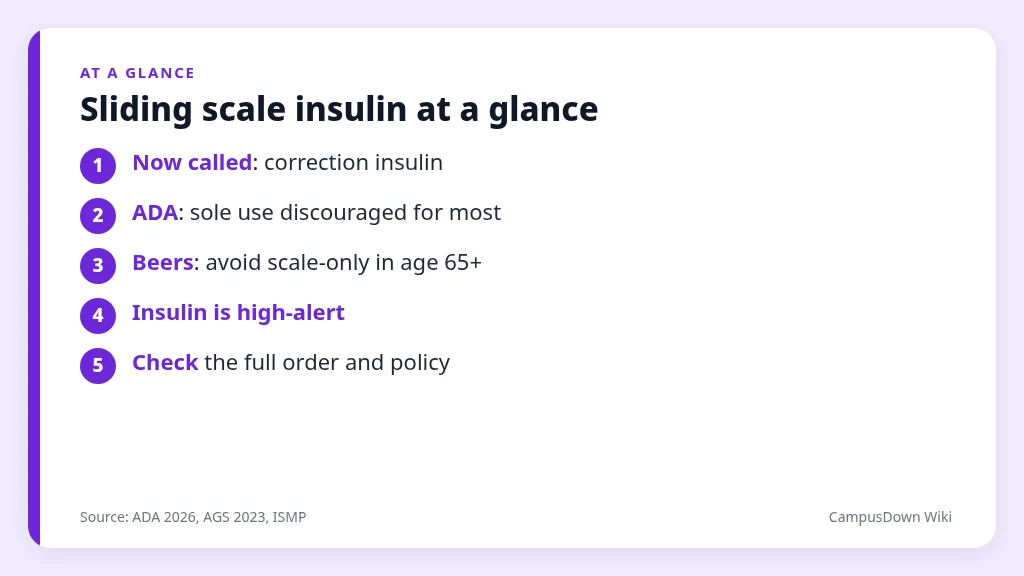
"Sliding scale" has meant short- or rapid-acting insulin given in an amount based on the current blood glucose, often without a scheduled long-acting (basal) insulin. The ADA now says the sole use of correction or supplemental insulin without basal insulin was "formerly referred to as a sliding scale." You'll still hear the old name on units, so know both.
Correction insulin itself isn't the problem. The ADA 2026 text says rapid- or short-acting correctional insulin before meals, or every 4 to 6 hours if the person isn't eating or is on continuous tube or parenteral feeding, is indicated to correct or prevent high glucose. The concern is using it alone.

What current guidance prefers
The ADA 2026 recommendations for hospitalized adults include:
- Critically ill: continuous intravenous insulin infusion for reaching goals and avoiding hypoglycemia (16.8a)
- Noncritically ill with poor or no oral intake: basal insulin, or a basal plus correction plan (16.8b)
- Noncritically ill with adequate nutrition: a plan with basal, prandial and correction components (16.9)
- Most individuals: sole use of correction insulin without basal insulin is discouraged (16.10)
The ADA adds that a randomized trial found a basal plus bolus plan improved glucose outcomes and reduced hospital complications compared with correction-only insulin for people with type 2 diabetes admitted for general surgery. It says prolonged correction-only use is strongly discouraged, except for people with type 2 diabetes in noncritical care with mild or stress hyperglycemia who stay under 180 mg/dL. For people with type 1 diabetes, the ADA says correction insulin alone is contraindicated, because dosing based only on pre-meal glucose doesn't account for basal needs or food intake and raises the risk of both hypoglycemia and hyperglycemia. The ADA also recommends that institutions use written or computerized order sets that allow a personalized approach (16.2).
Older adults and Beers
The 2023 AGS Beers Criteria list "insulin, sliding scale" as a drug to avoid in adults 65 and older, defined as regimens with only short- or rapid-acting insulin dosed by current glucose without basal or long-acting insulin. The rationale: higher risk of hypoglycemia without improvement in hyperglycemia management, regardless of care setting. The recommendation doesn't apply to regimens that contain basal insulin. AGS says the criteria should support, not replace, shared clinical decision-making. For more, see diabetes in older adults and hypoglycemia in older adults.
The parts of a modern insulin order
Use this as a reading guide, not a dosing guide. Orders vary by facility and patient.
- Basal: scheduled insulin that covers the body's background need.
2. Prandial (nutritional): insulin tied to meals or feedings. 3. Correction: extra insulin if glucose is above the target, often matched to how much insulin the person needs overall. The ADA describes low, medium and high correction scales relative to total daily insulin. 4. The timing: before meals, at bedtime or every 4 to 6 hours with continuous feeding, as ordered.
Safety checks before you act
- Read the whole order. Confirm the insulin product, route, timing, whether it's basal, prandial or correction, and the scale or parameters.
- Check the glucose, the timing and the food. Confirm the reading is current and that the patient is eating or not as the order expects.
- Know the high-alert status. Insulin, subcutaneous and IV, is on ISMP's acute care list, with U-500 singled out for special emphasis. See high-alert medications.
- Use the process. If your facility uses barcode scanning or independent double checks, use them; the ADA notes that pen use in hospitals is safe when protocols such as nursing education and barcode scanning ensure single-person use.
- Watch for low glucose. The ADA defines hypoglycemia as below 70 mg/dL, with level 2 below 54 mg/dL. Know your facility's low-glucose protocol; see hypoglycemia.
- Never hold or skip basal insulin on your own. The ADA stresses that basal insulin should not be held for people with type 1 diabetes; ask the nurse or provider if anything seems off.
- Ask. If an order seems unclear, unusually large or doesn't fit the patient, stop and ask your instructor, nurse or the prescriber.
Get help now if
Don't use this article to calculate or give a dose. Confirm any insulin order with your instructor or nurse. For a patient who is shaky, sweaty, confused or hard to wake, follow your facility's low-glucose and emergency protocol and get help immediately.
Example scenario: the order that didn't add up
- Who
- Norbert, 29, a nursing student in Albuquerque, New Mexico, was shadowing on a medical unit and reviewing a patient's orders.
- What happened
- He noticed that an older patient with type 2 diabetes had only a correction scale ordered and no basal insulin, and the patient had been eating poorly.
- How it felt
- He felt nervous about questioning an order, but he remembered his instructor saying that asking is part of safety.
- What they did
- He told his preceptor what he saw and asked whether the team wanted to review the plan, and the preceptor called the prescriber to discuss it.
- How it turned out
- Norbert said he felt grateful that his question was welcomed, and relieved to learn that the decision was the team's, not his.
This is an illustrative example, not a real patient or a review.
Norbert's story is an illustrative example. Orders and decisions belong to the prescriber and care team.
Most-asked questions about sliding scale insulin
Is there a sliding scale insulin chart?
Scales differ by facility, patient and order, so this guide doesn't publish one. Use the written order and your facility's protocol.
Why people ask: "sliding scale insulin chart dosage" is #2 for "sliding scale insulin" (US autocomplete, November 2026).
Is there a sliding scale insulin formula?
Orders are written by prescribers using protocols; students don't make up formulas. Ask your instructor how your facility's protocol works.
Why people ask: "sliding scale insulin formula" is #5 for "sliding scale insulin" (US autocomplete, November 2026).
What does sliding scale insulin mean?
Short- or rapid-acting insulin dosed by the current glucose; the ADA now calls it correction or supplemental insulin.
Why people ask: "sliding scale insulin meaning" is #6 for "sliding scale insulin" (US autocomplete, November 2026).
What is sliding scale insulin dosing?
It's decided by the prescriber and protocol; ADA 2026 discourages correction-only insulin for most hospitalized people.
Why people ask: "sliding scale insulin dosing" is #7 for "sliding scale insulin" (US autocomplete, November 2026).
What is a sliding scale insulin protocol?
A written facility protocol or order set; the ADA recommends order sets that allow a personalized approach.
Why people ask: "sliding scale insulin protocol" is #8 for "sliding scale insulin" (US autocomplete, November 2026).
Related on CampusDown
You can learn more about rapid-acting insulin lispro and aspart and check it for yourself in mixing insulin: clear to cloudy.
Frequently asked questions
- Why do guidelines discourage sliding scale alone?
- The ADA says basal, prandial and correction insulin is preferred for most hospitalized people, and AGS Beers says scale-only regimens carry higher hypoglycemia risk in older adults without better control.
- Is correction insulin the same as sliding scale?
- The ADA uses "correction or supplemental insulin" for what used to be called sliding scale.
- Can I use a chart I found online?
- No. Use the order written for your patient and your facility's protocol.
- Who decides the insulin plan?
- The prescriber and care team, using protocols; nurses and students check, give and report as directed.
Sliding scale insulin has a new name and a cautious reputation. Read the whole order, know why basal insulin matters and check anything unclear with your preceptor before you give it.
Browse more guides like this in the Nursing Student and NCLEX hub.
This article is for general education and does not replace advice from your own doctor, nurse or pharmacist.