
Did you buy a pair of Sony hearing aids, only to see "Item no longer available" on Sony's website and wonder whether they are about to stop working? You are not the only one. "Sony hearing aids discontinued" now shows up in U.S. search suggestions.
This guide explains what the Sony CRE-E10 is, using Sony's own user guide and support pages. It also covers the 2026 end of the partnership behind it, what that means for owners, and how to compare replacements.
What the CRE-E10 is
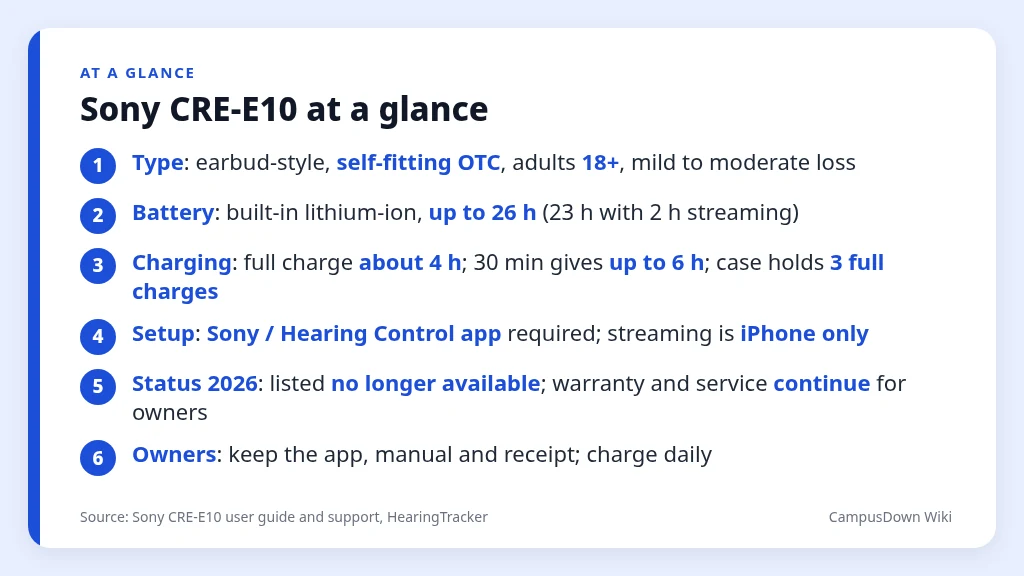
The CRE-E10 is an earbud-style, rechargeable, self-fitting over-the-counter (OTC) hearing aid. Sony developed it with WS Audiology, the company behind the Widex and Signia brands. Sony's user guide lists its intended use:
- It amplifies sound for people 18 or older with perceived mild to moderate hearing impairment.
- The user adjusts it through software tools. No hearing professional is required.
- The Sony | Hearing Control app is required to set it up.
- The left and right aids are meant to be worn together as a set.
Sony's product page described four sizes of soft ear tips, automatic sound adjustment for different settings, and Bluetooth audio streaming from iPhone. Streaming was iOS only, although the app itself ran on iOS and Android.

Battery and charging, from Sony
This is where owners most often have questions, so take a closer look:
| Item | Sony's figure |
|---|---|
| Battery type | Built-in lithium-ion, not removable |
| Run time without streaming | Up to 26 hours |
| Run time with 2 hours of streaming | Up to 23 hours |
| Full charge | About 4 hours |
| Quick charge | 30 minutes gives up to 6 hours |
| Charging case | Holds 3 full charges for the aids |
| Charging | Qi-compatible wireless case |
Sony's guide says the aids are meant to be charged daily, even if not empty, and suggests charging overnight. They switch off on their own when the battery runs out. Sony also notes that battery capacity drops with age, and the guide lists an expected service life of five years. Our batteries vs rechargeable guide explains in detail what an aging built-in battery means day to day.
CRE-E10 vs CRE-C10 and CRE-C20
Sony sold three OTC models in the U.S. HearingTracker reported Sony's prices as:
- CRE-C10: about $700. Completely-in-canal (CIC), disposable batteries, no wireless.
- CRE-E10: about $900. Earbud style, rechargeable, iPhone streaming.
- CRE-C20: about $1,000. CIC, rechargeable, no wireless.
HearingTracker reported that all three were pre-set models with four to six programs controlled by the app. It also noted the independent lab HearAdvisor ranked the CRE-E10 first among 60 OTC devices it had tested.
What changed in 2026
HearingTracker noticed that all three Sony models had been listed as "Item no longer available" on Sony's U.S. website for several months. A WS Audiology spokesperson then confirmed that Sony and WSA had mutually agreed not to renew their 2022 agreement. According to that report:
- Sony OTC hearing aids would remain available for a few more months through some WSA channels.
- Existing customers would continue to receive warranty and service support.
- WSA planned to stay in the OTC market, but not under the Sony name.
A JAMA commentary in 2026 described the exits of Sony and other early OTC brands as a sign that legal access alone has not guaranteed long-term consumer support.
Key point
A discontinued model is not a broken one. The aids keep amplifying with their saved settings. The risk is long-term: app updates, replacement parts and battery wear. Plan for those now rather than after something fails.
Example scenario: the "no longer available" scare
- Who
- Clifford, 71, a retired high school band teacher in Raleigh, bought CRE-E10s in early 2024 after his wife kept turning the TV down on him. He liked them for the golf course and for FaceTime with his grandkids.
- What happened
- In 2026 he went to order extra ear tips and saw "Item no longer available." He then read an online post claiming Sony hearing aids would "stop working soon."
- How it felt
- He felt a jolt of panic. He had spent real money, and he had finally stopped dreading conversations at the clubhouse. He worried he would be back to nodding along without understanding.
- What they did
- His daughter helped him check the facts. They found the WS Audiology statement that warranty and service would continue, wrote down his purchase date and serial numbers, downloaded the user guide PDF, and made sure the Hearing Control app was updated. He kept a spare set of ear tips.
- How it turned out
- Two months later the aids worked the same as ever. Clifford made a plan: keep using them while they serve him well, and get a full hearing test before choosing his next pair, so he would know whether OTC was still right for him.
This is an illustrative example, not a real patient or a review.
Clifford is an illustrative example, not a real patient. Check your own warranty terms with the seller.
What owners should do now
- Keep the app updated and installed on the phone you use with the aids.
2. Save the user guide PDF from Sony's support site. 3. Write down your purchase date, seller and serial numbers. Keep the receipt. 4. Charge daily as Sony recommends, and keep the case charged. 5. Stock up on ear tips while they are easy to find. 6. Contact Sony or WSA support for warranty questions rather than relying on forum posts.
If the aids start sounding weaker, check for earwax on the tips first; see our earwax guide.
Choosing a replacement later
When the time comes, check it for yourself against the FDA's OTC rules. OTC aids are only for adults with perceived mild to moderate loss. Options in 2026 include:
- AirPods Pro 2 and Pro 3 with Apple's FDA-authorized Hearing Aid feature
- Jabra Enhance Select models with remote audiology support
- A prescription hearing aid fitted by an audiologist, especially if your hearing has changed
Before buying, read our OTC vs prescription guide. Brand stability now matters too. Owners of Lexie and Eargo aids faced an even bigger change in 2026, when their parent company wound down U.S. operations.
Most-asked questions about the Sony CRE-E10
What did the Sony CRE-E10 cost?
HearingTracker reported about $900 a pair on Sony's site, compared with about $700 for the CRE-C10 and $1,000 for the CRE-C20.
Why people ask: "sony cre-e10 price" is #2 for "sony cre-e10" (US autocomplete, November 2026).
Are Sony hearing aids discontinued?
Sony's U.S. site lists all three OTC models as no longer available, and WS Audiology confirmed the partnership ended. Warranty and service support continue for existing customers.
Why people ask: "sony hearing aids discontinued" is #10 for "sony hearing aids" (US, November 2026).
Sony CRE-E10 vs CRE-C20: what is the difference?
The E10 is a rechargeable earbud style with iPhone streaming. The C20 is a rechargeable completely-in-canal aid without wireless streaming.
Why people ask: "sony cre-e10 vs cre-c20" is #8 for "sony cre-e10" (US, November 2026).
Do I need the Sony app?
Yes for setup. Sony's guide says the Sony / Hearing Control app is necessary to set up the device and to fine-tune it.
Why people ask: "sony hearing aids app" is #7 for "sony hearing aids" (US, November 2026).
How do I reach Sony hearing aid customer service?
Use the contacts in your user guide or Sony's support site, and keep your purchase details ready. WS Audiology said service support continues.
Why people ask: "sony hearing aids customer service" is #8 for "sony hearing aids" (US, November 2026).
Related on CampusDown
If ringing in your ears is part of what brought you to hearing aids, see tinnitus. If you want to learn more about how OTC options differ, start with OTC vs prescription hearing aids.
Frequently asked questions
- Will my Sony CRE-E10 stop working?
- No announcement says so. The aids keep working on their own settings, and WS Audiology said warranty and service support continue.
- Can I still buy a CRE-E10?
- Sony's U.S. site lists it as no longer available. Some stock may remain at other sellers for a while; confirm warranty terms first.
- Can I replace the CRE-E10 battery myself?
- No. Sony's guide says the lithium-ion cell is permanently built in.
- Can Android phones stream to the CRE-E10?
- Sony lists Bluetooth audio streaming for iPhone only. The app works on iOS and Android.
The Sony CRE-E10 was one of the best-reviewed OTC hearing aids, and owners can keep using it with confidence while support continues. Keep the app, manual and receipt handy, charge daily, and talk to your doctor or an audiologist if your hearing seems to change.
Browse more guides like this in the Home Medical Devices hub.
This article is for general education and does not replace advice from your own doctor, nurse or pharmacist.
References
- Sony: CRE-E10 user guide (rechargeable self-fitting OTC hearing aids)
- Sony support: How often will I need to charge the CRE-E10?
- Sony Electronics: CRE-E10 product page
- HearingTracker: Sales of Sony hearing aids discontinued; WSA eyes next steps
- JAMA: Over-the-counter hearing aids 4 years later (2026)
- FDA: OTC hearing aids, what you should know