
Your pharmacy fills a different brand of mealtime insulin than last month, and now you're wondering: is Humalog the same as NovoLog? When do I take it relative to my meal? And is it okay to swap?

This guide explains rapid-acting insulin in plain language. It draws on the Humalog (insulin lispro) and NovoLog (insulin aspart) prescribing information and MedlinePlus's insulin lispro and insulin aspart pages. It is general education; it doesn't give doses and can't tell you which product is right for you. Never switch insulin brands, types or doses without your prescriber. To learn more about the insulin families, take a closer look at the insulin types chart.
Two names for the same job
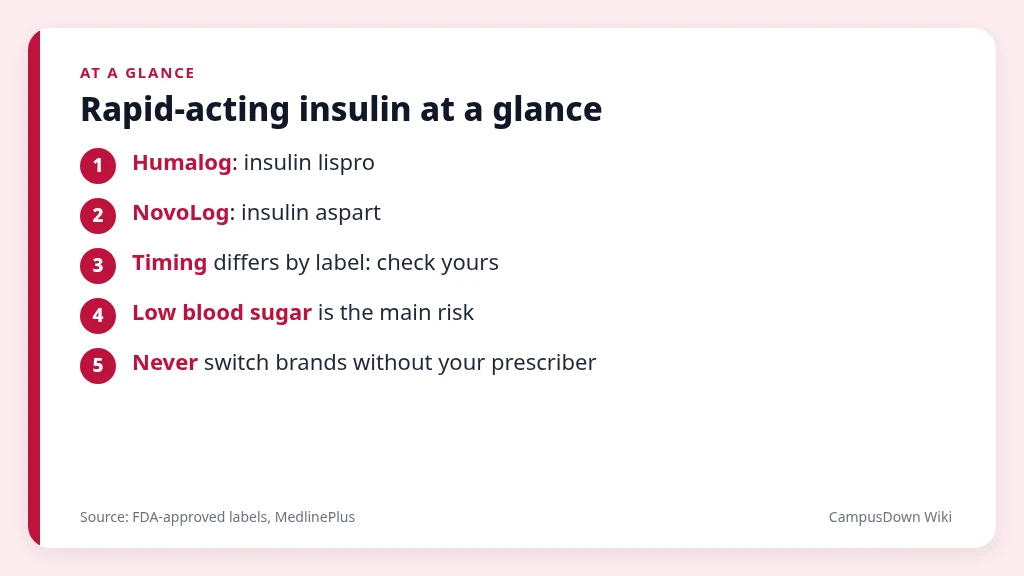
Humalog contains insulin lispro and NovoLog contains insulin aspart. Both are rapid-acting insulin analogs used to improve blood sugar control in people with diabetes, and MedlinePlus lists several other products in each family (for lispro: Admelog, Humalog and Lyumjev; for aspart: Fiasp and NovoLog, plus other aspart products). MedlinePlus says insulin lispro is used in type 1 and type 2 diabetes and explains that several lispro products are biosimilar, which MedlinePlus describes as working as well and being as safe to use as insulin lispro.
Rapid-acting insulins are used around meals, and the labels say they are generally used together with an intermediate- or long-acting insulin in many regimens. For the long-acting group, see insulin glargine.

Timing around meals: what the labels say
This is where the details differ, and where mistakes can happen.
- Humalog label: give the dose within fifteen minutes before a meal or immediately after a meal.
- NovoLog label: inject within 5 to 10 minutes before a meal; the patient information says you should eat a meal within 5 to 10 minutes after you take it.
- Regular human insulin (Humulin R), a different, short-acting insulin, is labeled for injection approximately 30 minutes before meals, which shows why you shouldn't treat all mealtime insulins the same.
MedlinePlus's general pages are written to cover several products, and its insulin lispro page says injection is typically 15 to 30 minutes before meals, which differs from the Humalog label's wording. That's a good example of why the label and instructions for your exact product, plus your prescriber's directions, come first. MedlinePlus also says to inject it shortly before or after a meal depending on the product, and that if you remember your dose before or shortly after a meal, you inject it right away, while if more time has passed you follow your doctor's instructions; never inject a double dose.
Meals, skipped meals and low blood sugar
MedlinePlus says to eat a healthy diet with about the same amounts of the same kinds of food at about the same times each day, because skipping or delaying meals can cause problems with blood sugar. Both labels say hypoglycemia is the most common adverse reaction to insulin, and the Humalog label adds that severe low blood sugar can cause seizures and can be life-threatening. MedlinePlus says never to use insulin when you have symptoms of low blood sugar or when your meter shows a low reading, and it describes symptoms such as shakiness, nervousness, sweating, chills, irritability, confusion and fast heartbeat.
Get help now if
Low blood sugar can be an emergency. Follow the plan your care team gave you, and call 911 for severe symptoms such as passing out, seizures or being unable to swallow. Learn more about the signs in hypoglycemia.
The Humalog label notes that awareness of low blood sugar may be less noticeable in people with long-standing diabetes, nerve disease, recurrent low blood sugar or those taking medicines that block the sympathetic nervous system, such as beta-blockers. If you're older or take several medicines, see diabetes in older adults.
Mixing, pens and pumps
- Mixing: the Humalog U-100 and NovoLog labels say they may be mixed with NPH insulin only, with the rapid-acting insulin drawn into the syringe first and injected immediately. The Humalog U-200 label says do not mix with any other insulin. See mixing insulin: clear before cloudy.
- Pumps: both labels say not to mix the insulin with other insulins in a continuous subcutaneous infusion pump. For the pump question, see insulin pump vs injections.
- Pens: the Humalog label says never to share a prefilled pen, cartridge or reusable pen, and not to transfer Humalog U-200 from a prefilled pen into a syringe, because syringe markings won't measure the dose correctly and can cause overdose and severe low blood sugar.
- Appearance: the solutions should be clear and colorless; MedlinePlus says not to use insulin that is colored, cloudy or has particles.
- Sites: the labels say to rotate injection sites within the same region to reduce the risk of lipodystrophy and cutaneous amyloidosis.
Check the label every time
The Humalog label says accidental mix-ups between insulin products have been reported and tells patients to always check the insulin label before each injection. Insulin is on the ISMP high-alert list in hospitals for similar reasons; see high-alert medications. At home, a few habits help: keep products in separate places, read the name each time and ask your pharmacist when something looks different.
Switching brands or types
MedlinePlus's insulin aspart page says not to switch to another brand or type of insulin, or change the dose of any insulin, without talking to your doctor. If your pharmacy substitutes a product, ask the pharmacist to explain the difference and tell your prescriber, because timing, strength and pen devices can differ.
Sliding scale and mealtime orders
In hospitals, rapid-acting insulin is often given by an order tied to blood glucose checks; see sliding scale insulin for how those orders are read. Your own home plan comes from your care team.
Questions to bring to your appointment
- Which insulin am I using, and when exactly should I take it relative to meals?
- What should I do if I skip, delay or eat less at a meal?
- What are my low blood sugar symptoms and what is my plan?
- Can I mix any insulins, and which ones?
- What if my pharmacy substitutes a different product?
- Do my other medicines change low blood sugar warning signs?
Example scenario: the new pen
- Who
- Maxine, 47, a bookkeeper in Omaha, Nebraska, picked up her mealtime insulin and noticed the pen looked different from her usual one.
- What happened
- She wasn't sure whether the timing was the same, and she had a lunch meeting in an hour.
- How it felt
- She felt flustered and worried about getting it wrong, and she nearly just copied her old routine.
- What they did
- She stopped, read the label on the new pen, called the pharmacy and asked the pharmacist to confirm the product and instructions, then left a message for her prescriber's office. The pharmacist walked her through the pen and the timing printed on her label.
- How it turned out
- Maxine said she kept the pharmacist's number in her phone after that.
This is an illustrative example, not a real patient or a review.
Maxine's story is an illustrative example. Insulin products, timing and doses are decided with your own care team.
Most-asked questions about Humalog and NovoLog
Can you tell me about Humalog vs NovoLog dosing?
This page doesn't give doses. Both labels say doses are individualized and depend on blood glucose monitoring; your prescriber decides.
Why people ask: "humalog vs novolog dosing" is #2 for "humalog vs novolog" (US autocomplete, November 2026).
How do Humalog and NovoLog compare with Lantus?
Humalog and NovoLog are rapid-acting mealtime insulins; Lantus is a long-acting insulin used differently. Ask your care team about your regimen.
Why people ask: "humalog vs novolog vs lantus" is #4 for "humalog vs novolog" (US autocomplete, November 2026).
Can I convert from Humalog to NovoLog?
Don't switch on your own. MedlinePlus says not to switch brand or type of insulin without talking to your doctor.
Why people ask: "humalog vs novolog conversion" is #5 for "humalog vs novolog" (US autocomplete, November 2026).
Does Humalog cost more than NovoLog?
Prices change and depend on your plan; ask your pharmacist and insurer about covered products.
Why people ask: "humalog vs novolog price" is #6 for "humalog vs novolog" (US autocomplete, November 2026).
What are the side effects of Humalog and NovoLog?
Low blood sugar is the most common; the labels also list allergic reactions, injection site reactions, lipodystrophy and low potassium.
Why people ask: "humalog vs novolog side effects" is #8 for "humalog vs novolog" (US autocomplete, November 2026).
Related on CampusDown
You can learn more about insulin types and check it for yourself in the medicines hub. For a different delivery method in detail, see insulin pump vs injections.
Frequently asked questions
- Is Humalog the same as NovoLog?
- They are different rapid-acting insulins (lispro and aspart) with different labels and timing instructions. Ask your prescriber before switching.
- When should I inject rapid-acting insulin?
- Follow your product's label and your prescriber: the Humalog label says within fifteen minutes before a meal or immediately after; the NovoLog label says within 5 to 10 minutes before a meal.
- Can I mix it with long-acting insulin?
- The labels say mixing is allowed only with NPH insulin. Don't mix with long-acting products unless your prescriber and label allow it.
- What is the main side effect?
- Hypoglycemia (low blood sugar) is the most common adverse reaction listed on both labels.
- Can I share a pen with someone else?
- No. The Humalog label says never to share prefilled pens, cartridges or reusable pens, even if the needle is changed.
Humalog and NovoLog do a similar job but have different labels. Read yours every time, plan meals and insulin together, and talk with your prescriber before any change.
Browse more guides like this in the Medicines hub.
This article is for general education and does not replace advice from your own doctor, nurse or pharmacist.