
When is a patient most likely to go low after an insulin dose? If you can answer that for any insulin on the med list, you understand insulin types. The answer is usually "around the peak," and that single idea is behind most insulin questions on nursing exams and most of the advice patients get about meals and snacks.

This guide lays out the NIDDK's onset, peak and duration table, adds common generic and brand names, and answers the questions people search most. Whether you are a nursing student or someone starting insulin, take a closer look at the peak column; it is where lows tend to happen.
The insulin types chart
The NIDDK groups insulin by timing. These are typical values; each product's label and each person's body can differ.
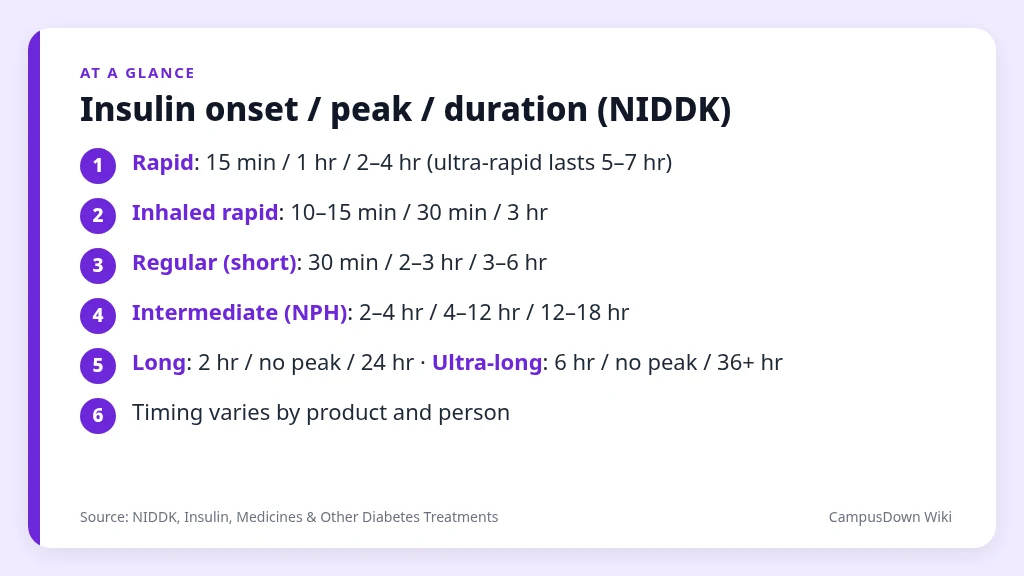
- Rapid-acting / ultra rapid-acting: onset about 15 minutes, peak about 1 hour, duration 2 to 4 hours (rapid) or 5 to 7 hours (ultra rapid). Examples: insulin lispro (Humalog, Admelog), insulin aspart (NovoLog), insulin glulisine (Apidra); ultra rapid-acting faster aspart (Fiasp) and lispro-aabc (Lyumjev).
- Rapid-acting, inhaled: onset 10 to 15 minutes, peak 30 minutes, duration 3 hours. Example: Afrezza.
- Regular (short-acting): onset 30 minutes, peak 2 to 3 hours, duration 3 to 6 hours. Examples: Humulin R, Novolin R.
- Intermediate-acting (NPH): onset 2 to 4 hours, peak 4 to 12 hours, duration 12 to 18 hours. Examples: Humulin N, Novolin N. NPH is cloudy.
- Long-acting: onset about 2 hours, no peak, duration about 24 hours. Examples: insulin glargine (Lantus, Basaglar, Semglee).
- Ultra long-acting: onset about 6 hours, no peak, duration 36 hours or longer. Example: insulin degludec (Tresiba).
The NIDDK adds that premixed insulins combine two types, start working in 15 to 60 minutes and last 10 to 16 hours, with a peak that depends on the mix. The ADA uses slightly different ranges for some types (for example, a 1–2 hour peak for rapid-acting and a 1.5–4 hour onset for long-acting), which is a good reminder that charts are approximate.

Basal vs bolus
The ADA explains that bolus insulin covers rising glucose, usually from meals, while basal (background) insulin works through the day and night. Long-acting and ultra long-acting insulins are basal; rapid-acting and regular insulins are usually bolus. In a pump, rapid-acting insulin delivered steadily serves as basal.
A chart is easy to memorize and harder to apply at 2 a.m. on a busy unit. The story below shows why.
Example scenario: the NPH peak on night shift
- Who
- Jasmine, 24, a senior nursing student on a medical-surgical rotation, caring for Mr. Delgado, 71, who received NPH insulin at 5 p.m. with a light dinner.
- What happened
- Around 11 p.m. she found him sweaty and mumbling; she froze for a second, flooded with fear that she had missed something.
- How it felt
- She felt her heart pound and her hands shake, and she worried she was overreacting. Then she remembered her instructor's line: "NPH peaks 4 to 12 hours later."
- What they did
- She checked his glucose, which was 61 mg/dL, called her nurse, and followed the unit's hypoglycemia protocol while the nurse notified the provider.
- How it turned out
- Mr. Delgado's glucose was back in range within half an hour, and the team adjusted his evening plan. Jasmine wrote "dose time + peak = watch window" on her pocket card, and the timeline finally made sense.
This is an illustrative example, not a real patient or a review.
Jasmine's story is an illustration, not a real case. Always follow your facility's protocol and the provider's orders; this article is for learning, not for choosing doses.
Most-asked questions about insulin types
What are the onset, peak and duration of each insulin?
See the chart above. In short: rapid 15 min / 1 hr / 2–4 hr, regular 30 min / 2–3 hr / 3–6 hr, NPH 2–4 hr / 4–12 hr / 12–18 hr, long-acting 2 hr / none / 24 hr, ultra long 6 hr / none / 36+ hr, per the NIDDK.
Why people ask: "insulin types and onset peak duration" is #4 for "insulin types," and "insulin onset peak duration chart" is #2 for "insulin onset peak duration" (US autocomplete, November 2026).
What are the names of long-acting insulins?
Insulin glargine (Lantus, Basaglar, Semglee) is long-acting, and insulin degludec (Tresiba) is ultra long-acting. See our insulin glargine guide.
Why people ask: "long acting insulin names" is #2 and "long acting insulin brands" is #3 for "long acting insulin" (US, November 2026).
Insulin glargine vs Lantus: are they the same?
Lantus is a brand of insulin glargine. In July 2021, the FDA approved Semglee (insulin glargine-yfgn) as the first interchangeable biosimilar to Lantus, meaning it can be substituted at the pharmacy without a new prescription, subject to state law.
Why people ask: "insulin glargine vs lantus" is #1 for "insulin glargine vs," and "insulin glargine vs insulin glargine-yfgn" is #4 (US, November 2026).
What are rapid-acting insulin names?
Insulin lispro (Humalog, Admelog), insulin aspart (NovoLog) and insulin glulisine (Apidra), plus the ultra rapid-acting Fiasp and Lyumjev. See lispro vs aspart.
Why people ask: "rapid acting insulin names" is #2 for "rapid acting insulin" (US, November 2026).
Why do nursing exams focus on peak times?
Because low blood sugar is most likely around the peak, nurses time glucose checks and meals around it. Long-acting insulins without a peak have a lower risk pattern, but lows can still happen.
Why people ask: "insulin chart nursing" is #2 and "insulin chart nclex" is #6 for "insulin chart"; "insulin onset peak duration nclex" is #5 for "insulin onset peak duration" (US, November 2026).
Studying for an exam? You can check it for yourself by covering the chart and writing each insulin's peak from memory, then add a dose time and work out the watch window.
Cost and coverage
Medicare.gov says people with Medicare pay no more than $35 for a one-month supply of each Part D- or Part B-covered insulin product, with no deductible for insulin. Private plans differ; ask your pharmacist about lower-cost biosimilars.
Related on CampusDown
Read the technique in detail in mixing insulin clear to cloudy, dosing logic in sliding-scale insulin, and what to do about lows in low blood sugar in older adults. For background, see Insulin and Diabetes.
Frequently asked questions
- Which insulin is cloudy?
- NPH (intermediate-acting) insulin is cloudy; most other insulins are clear. Premixed insulins containing NPH are also cloudy.
- Which insulins have no peak?
- Long-acting and ultra long-acting insulins, such as glargine and degludec, are described by the NIDDK as not peaking.
- How long does rapid-acting insulin last?
- About 2 to 4 hours per the NIDDK; ultra rapid-acting forms last about 5 to 7 hours.
- Is inhaled insulin real?
- Yes. The NIDDK lists rapid-acting inhaled insulin, with onset in 10 to 15 minutes and a 3-hour duration.
Every insulin has a shape: when it starts, when it is strongest and when it fades. Learn more about your own insulin's label with your pharmacist, and let the peak tell you when to watch for lows.
Browse more guides like this in the Nursing Student and NCLEX hub.
This article is for general education and does not replace advice from your own doctor, nurse or pharmacist.