
Why would a patient with a new blood clot get two blood thinners at the same time? It sounds like a medication error the first time you see it on a MAR. It is actually one of the most tested ideas in anticoagulation, and it makes sense once you compare how heparin and warfarin work.
This guide compares the two drugs using their FDA labels on DailyMed (Hospira heparin sodium and Jantoven warfarin) and MedlinePlus. It is written for nursing students. If you have an exam soon, take a closer look at the comparison table and the priority section.
How each one works
- Heparin (unfractionated) works with antithrombin in the blood to block clotting factors quickly. It is made from porcine intestinal mucosa.
- Warfarin is a vitamin K antagonist. It reduces the liver's production of vitamin K-dependent clotting factors (II, VII, IX and X) and proteins C and S. Because existing factors take time to clear, the label says the peak effect may be delayed 72 to 96 hours.
Neither drug dissolves a clot that has already formed. Both stop new clots and stop existing ones from growing.

Side-by-side comparison
| Feature | Heparin | Warfarin |
|---|---|---|
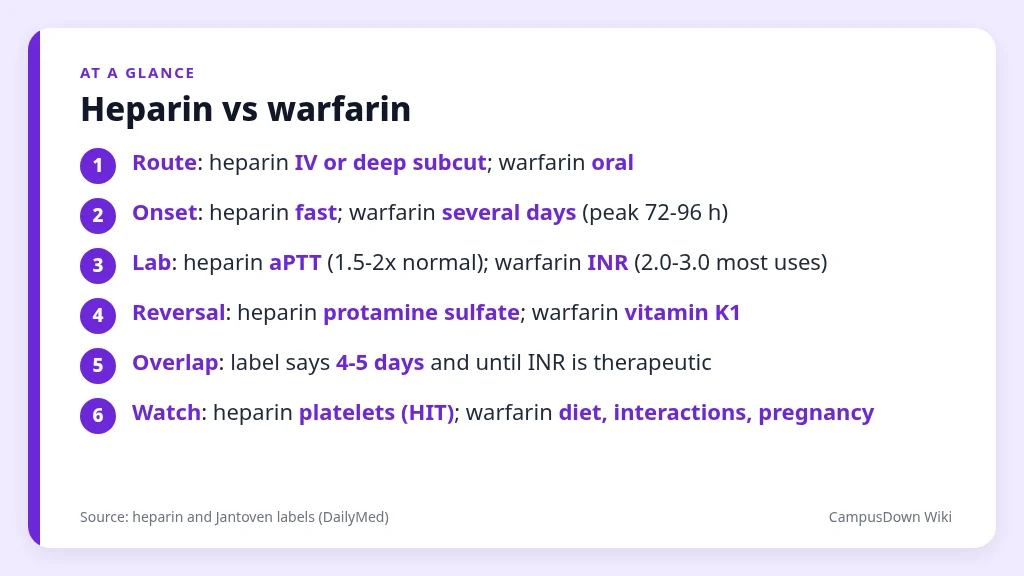
| Route | IV (bolus or continuous) or deep subcutaneous; never IM | Oral tablet |
| Onset | Fast | Several days; peak 72-96 hours |
| Monitoring lab | aPTT | PT/INR |
| Usual goal | aPTT 1.5-2x normal (label) | INR 2.0-3.0 for AFib, DVT/PE (label) |
| Reversal | Protamine sulfate | Vitamin K1; hospitals may also use clotting factor products |
| Key risk | Bleeding; HIT | Bleeding; many interactions; contraindicated in most pregnancies |
| Where used | Hospital start of therapy, procedures, dialysis | Long-term at home |
Why they overlap
The warfarin label says that because the full effect of warfarin takes several days, heparin is preferred for rapid initial anticoagulation. It then says to continue full-dose heparin and overlap warfarin for 4 to 5 days, and until the INR shows the desired response, before stopping heparin. The label also notes heparin can increase the INR, so INR is followed closely during overlap.
Heparin safety points from the label
- Fatal medication errors: heparin comes in many strengths. The label says to carefully check the container before giving it and not to use a premixed bag as a catheter lock flush. Heparin is a classic high-alert medication.
- Heparin-induced thrombocytopenia (HIT): an immune reaction that can cause clots in veins and arteries. The label says to monitor platelet counts and stop all heparin if HIT is suspected; HIT can appear up to several weeks after heparin is stopped.
- Monitoring: periodic platelet counts, hematocrit and stool occult blood tests are recommended during therapy.
- Protamine: the label says each mg of protamine sulfate neutralizes about 100 USP units of heparin, given slowly, and protamine itself can cause severe low blood pressure and allergic-type reactions.
- After andexanet alfa: the label warns heparin may not work after andexanet alfa was used to reverse apixaban or rivaroxaban.
For drip math, see heparin drip calculations.
Warfarin safety points from the label
- Bleeding is the boxed warning.
- Diet and interactions: keep vitamin K intake consistent; many drugs and supplements change the INR.
- Pregnancy: contraindicated except in pregnant women with mechanical heart valves at high risk of clots.
- HIT: the label warns that starting warfarin alone during acute HIT has led to amputation and death; it may be considered once the platelet count has normalized.
- Skin necrosis and calciphylaxis are rare but serious.
See our warfarin guide and INR and PTT explained.
Where enoxaparin and DOACs fit
Enoxaparin (Lovenox) is a low-molecular-weight heparin given by subcutaneous injection, often used for clot prevention or as a bridge. The newer pills apixaban (Eliquis) and rivaroxaban (Xarelto) are factor Xa inhibitors that do not use routine INR monitoring. Know the suffix patterns in drug suffixes ("-xaban" = factor Xa inhibitor).
Example scenario: the double order
- Who
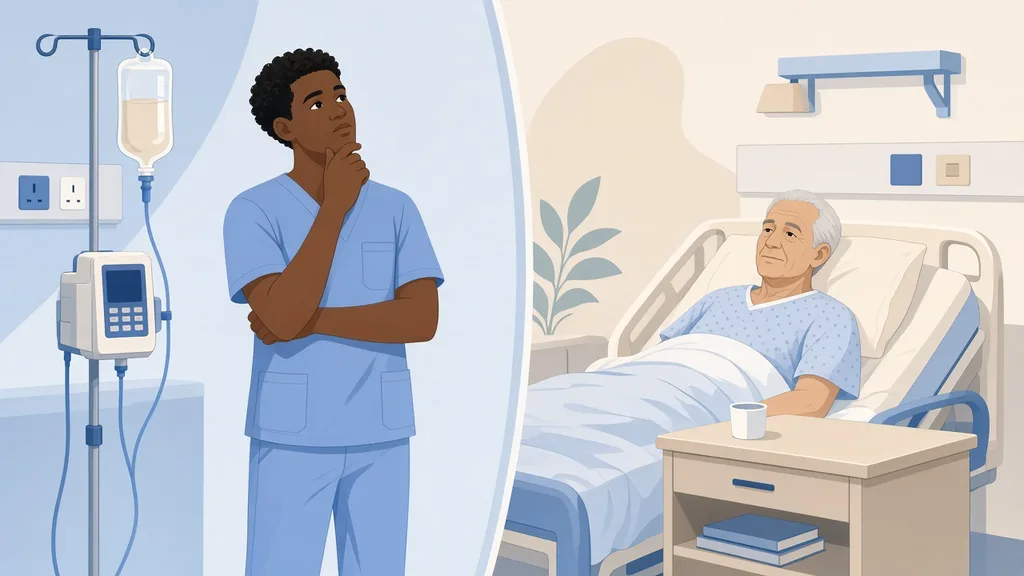
- Jamal, 26, a second-career accelerated BSN student in Georgia, was caring for a 64-year-old man admitted with a DVT on a heparin infusion.
- What happened
- On day 2 the provider ordered warfarin 5 mg by mouth. Jamal froze: two anticoagulants felt like an error, and he worried about the patient bleeding.
- How it felt
- He was torn between speaking up and looking like he did not know the basics, and he remembered a classmate who was told to "always question duplicates."
- What they did
- He paused before giving the dose, checked the warfarin label's conversion section with his preceptor, confirmed the aPTT and baseline INR, and asked the pharmacist to confirm the overlap plan.
- How it turned out
- The pharmacist explained the 4-to-5-day overlap until the INR is therapeutic. Jamal gave the warfarin, taught the patient about bleeding signs and vitamin K foods, and his preceptor told him that asking was the right instinct. He now calls it "the bridge, not the duplicate."
This is an illustrative example, not a real patient or a review.
Jamal is an illustrative example, not a real patient or event. Always follow your facility's policy and ask when an order looks unusual.
NCLEX priority pearls
- Heparin with a high aPTT, or warfarin with a high INR: assess for bleeding first, then hold as ordered and notify.
- New drop in platelets on heparin: think HIT; stop heparin per protocol and notify.
- Antidotes: protamine for heparin, vitamin K for warfarin.
- Teach warfarin patients: consistent vitamin K, report new medicines, keep INR appointments.
Get help now if
For patients: on any blood thinner, call 911 for a severe headache, sudden weakness, vomiting blood, or black stools. Never stop or change an anticoagulant without your provider.
Most-asked questions about heparin vs warfarin
Heparin vs warfarin: which labs are monitored?
Heparin is monitored with the aPTT; the label calls the dose adequate at 1.5 to 2 times normal. Warfarin is monitored with the INR, usually aiming for 2.0 to 3.0.
Why people ask: "heparin vs warfarin labs" is #4 for "heparin vs warfarin" (US autocomplete, November 2026).
What are the antidotes for heparin and warfarin?
Protamine sulfate for heparin; vitamin K1 for warfarin, with clotting factor products used in some emergencies.
Why people ask: "heparin vs warfarin antidote" is #5 for "heparin vs warfarin," and "heparin antidote" is #3 for "heparin" (US, November 2026).
How do heparin and warfarin work differently?
Heparin works with antithrombin to block clotting factors quickly; warfarin blocks vitamin K-dependent factor production in the liver, so it takes days to work.
Why people ask: "heparin vs warfarin moa" is #2 and "heparin vs warfarin mechanism of action" is #3 for "heparin vs warfarin" (US, November 2026).
What is heparin-induced thrombocytopenia?
An immune reaction to heparin that lowers platelets and can cause dangerous clots. The label says to monitor platelets and stop all heparin if HIT is suspected.
Why people ask: "heparin induced thrombocytopenia" is #4 for "heparin" (US, November 2026).
Heparin vs warfarin vs Lovenox: what is the difference?
Lovenox (enoxaparin) is a low-molecular-weight heparin given under the skin; unfractionated heparin is given IV or subcutaneously; warfarin is an oral pill monitored with INR.
Why people ask: "heparin vs warfarin vs lovenox" is #6 for "heparin vs warfarin" (US, November 2026).
You can check it for yourself at clinical: look at a patient's MAR during warfarin initiation and see whether heparin or enoxaparin overlaps it.
Frequently asked questions
- Can heparin be given IM?
- No. MedlinePlus says heparin should not be injected into a muscle.
- Why does warfarin take days to work?
- Existing clotting factors have to clear first; the label lists half-lives up to about 60 hours for factor II.
- Is heparin safe in pregnancy?
- Heparin is used in some pregnancies under specialist care; warfarin is generally contraindicated. Ask the prescriber.
- Does heparin interfere with INR?
- Yes, the warfarin label says heparin can increase the INR.
Heparin is the fast bridge, warfarin is the slow road home, and the overlap connects them. Learn more by reading both labels in detail, and ask your instructor or pharmacist whenever an anticoagulant order surprises you.
Browse more guides like this in the Nursing Student and NCLEX hub.
This article is for general education and does not replace advice from your own doctor, nurse or pharmacist.