
You have a heparin order, a patient's weight and a bag on the pump. Do you know which number goes into the pump, and why? Heparin math is one of the first calculations that makes new nursing students' palms sweat, and for good reason.

This guide explains the arithmetic structure behind a heparin drip using the FDA label on DailyMed and ISMP's high-alert medication guidance. It is for learning. It does not give a dose, and you must never calculate or set a real infusion from this page. Use the provider's order, your facility's protocol and a second nurse's check. If you have a quiz soon, take a closer look at the dimensional analysis section.
Why heparin gets extra attention
ISMP describes high-alert medications as drugs with a heightened risk of causing significant patient harm when used in error, and recommends safeguards such as standardizing ordering and administration, limiting access, using auxiliary labels and alerts, and employing redundancies. Heparin is a classic example; see high-alert medications.
The FDA label for premixed heparin says it is supplied in various strengths and warns that fatal hemorrhages have occurred due to medication errors. It tells you to carefully examine all heparin products to confirm the correct container choice before giving it.

The two numbers you need
- The patient's weight in kilograms. If the chart shows pounds, convert using your facility's approved method (the label itself pairs 150 lb with 68 kg). Use the weight your order and protocol specify.
2. The concentration of the bag in units per mL. The label lists premixed bags of 25,000 units/250 mL (100 units/mL), 12,500 units/250 mL (50 units/mL) and 25,000 units/500 mL (50 units/mL). Read the bag in front of you.
The structure of the calculation
Heparin math is dimensional analysis: arrange the units so they cancel and leave the unit you want.
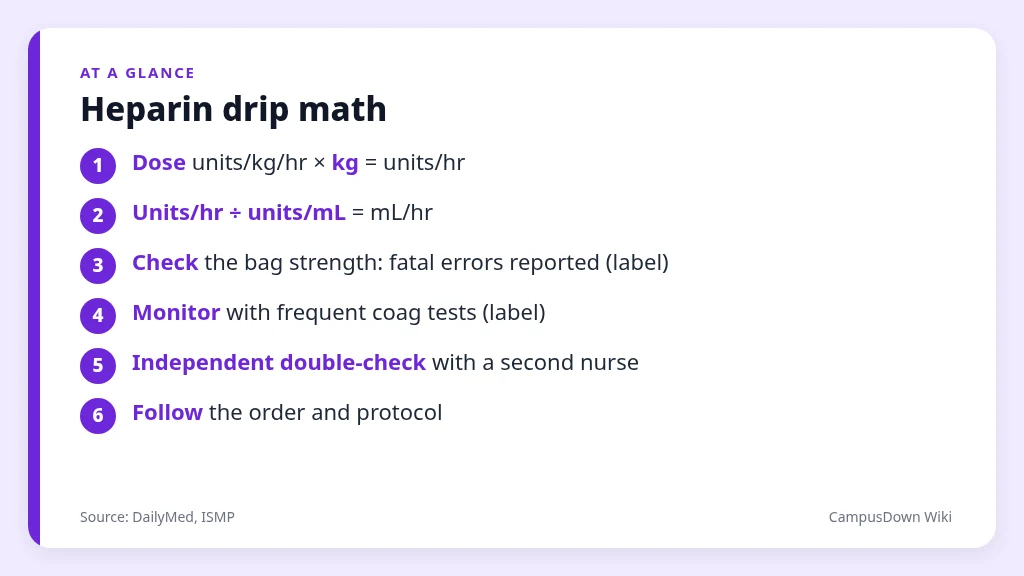
Step 1 - dose per hour: (ordered units per kg per hour) × (weight in kg) = units per hour
Step 2 - pump rate: (units per hour) ÷ (units per mL) = mL per hour
Bolus (if ordered): (units per kg) × (kg) = units; then units ÷ (units per mL) = mL
The units tell you if you set it up right: "units/kg/hr × kg" cancels "kg" and leaves "units/hr"; dividing by "units/mL" cancels "units" and leaves "mL/hr". If your units don't cancel to mL/hr, stop and recheck.
What the label says about monitoring
The label says that when heparin is given in therapeutic amounts, its dosage should be monitored by frequent blood coagulation tests, and if the test is unduly prolonged or hemorrhage occurs, heparin should be discontinued promptly (per the prescriber and protocol). It also recommends periodic platelet counts, hematocrits and stool occult blood tests during the course of therapy. Your facility's protocol sets which test, how often, and how rates change; see aPTT and INR explained and the lab values cheat sheet.
Weight-based vs fixed dosing
The label's adult guideline table is written for a 150 lb (68 kg) patient and uses a fixed initial dose and a daily range. Many hospitals instead use weight-based protocols with nomograms. The label's pediatric section is separate; pediatric heparin math follows pediatric orders and protocols.
Safety checklist before you start
- Verify the order (drug, units/kg/hr, route, any bolus) with the provider if anything is unclear.
- Read the bag concentration and compare it with the order and the pharmacy label.
- Confirm the patient's current weight and which unit (kg or lb) was used.
- Do an independent double-check with another nurse, and compare pump settings to the order.
- Know your baseline labs, such as platelets, and see heparin vs warfarin for HIT and reversal.
- Know your facility's rules about rounding and pump programming.
Get help now if
This page teaches how to read a calculation. It is not a dosing tool. Real heparin infusions must follow a provider's order and your facility's protocol, with an independent double-check.
Example scenario: the number that didn't look right
- Who
- Zachary, 25, a BSN student in Columbus, Ohio, was practicing heparin math with his nurse preceptor on a patient who had a new clot.
- What happened
- He set up the calculation correctly, but when he read the bag label he realized it had a different strength than the one he used in his notes.
- How it felt
- He felt his stomach drop and wanted to hide the mistake, because he had been confident a minute earlier.
- What they did
- He stopped, told his preceptor, and they re-ran the math together with the label in front of them and had a second nurse do an independent check before anything was programmed.
- How it turned out
- Zachary said catching it felt scarier than being wrong on a test, and it taught him to read the bag first, every single time.
This is an illustrative example, not a real patient or a review.
Zachary's story is an illustrative example, not a real person or event.
Most-asked questions about heparin drip calculations
How do you do a heparin drip calculation?
Multiply the ordered units/kg/hr by the patient's kg, then divide by the bag's units/mL to get mL/hr.
Why people ask: "heparin drip calculation" is #1 for "heparin drip calculation" (US autocomplete, November 2026).
What is the heparin drip calculation for units/kg/hr?
It converts a weight-based dose into units per hour; see the formula above.
Why people ask: "heparin drip calculation units/kg/hr" is #2 for "heparin drip calculation" (US autocomplete, November 2026).
What is the heparin drip calculation formula?
Dose (units/kg/hr) × weight (kg) ÷ concentration (units/mL) = mL/hr.
Why people ask: "heparin drip calculation formula" is #3 for "heparin drip calculation" (US autocomplete, November 2026).
How do you calculate heparin mL/hr?
Use the two-step formula above and confirm with a second nurse.
Why people ask: "heparin drip calculation ml/hr" is #4 for "heparin drip calculation" (US autocomplete, November 2026).
Are there heparin drip calculation examples or worksheets?
Your course's practice problems are the right place; this page shows the structure only.
Why people ask: "heparin drip calculation worksheet" is #6 for "heparin drip calculation" (US autocomplete, November 2026).
How do I calculate the heparin infusion rate?
The same way: units per hour divided by units per mL.
Why people ask: "how to calculate heparin infusion rate" is #4 for "heparin drip calculation units/kg/hr" (US autocomplete, November 2026).
What is a heparin drip protocol?
A facility-specific, usually weight-based, protocol for starting and adjusting heparin using coag tests.
Why people ask: "heparin drip protocol" is #1 for "heparin drip protocol" (US autocomplete, November 2026).
Related on CampusDown
You can learn more about MAP calculation and check it for yourself with your school's pharmacology drug-suffix guide.
Frequently asked questions
- Which bag strengths exist for premixed heparin?
- The FDA label lists 100 units/mL and 50 units/mL premixes.
- Should I use a calculator?
- Follow your school's and facility's rules; always verify by dimensional analysis and a second nurse.
- Can heparin be used as a catheter lock flush from a premixed bag?
- The label says not to use this product as a catheter lock flush.
- How is heparin monitored?
- The label says frequent blood coagulation tests; protocols specify which test and how often.
A correct number starts with a correct bag, a correct weight and a second pair of eyes. Learn the structure, then let the order and protocol set the actual numbers.
Browse more guides like this in the Nursing Student and NCLEX hub.
This article is for general education and does not replace advice from your own doctor, nurse or pharmacist.