
Do you freeze when an exam question gives you an INR of 4.2 and asks what the nurse should do first? Or are you a patient who just got a lab result and has no idea whether 2.6 is good or bad? INR and PTT are two of the most-searched lab tests in the U.S., and they become simple once you link each test to its drug.

This guide uses MedlinePlus lab pages and FDA labels for warfarin (Jantoven) and heparin on DailyMed. It is written for nursing students and useful for patients. Always use your own lab's reference range and your provider's goal. If you are studying for the NCLEX, take a closer look at the priority section.
The one-line rule
- PT/INR monitors warfarin.
- PTT (aPTT) monitors unfractionated heparin.
A study trick many students use: pair the drug with the longer route story (heparin, often an IV drip in the hospital) with the longer test name (PTT), and the home pill (warfarin) with the shorter one (PT/INR).

PT/INR: what it measures
MedlinePlus explains that the PT test measures how many seconds it takes a clot to form in a blood sample. Because results vary between labs, the result is converted to the INR so providers can compare results across labs.
Normal values (MedlinePlus Medical Encyclopedia), if you are not taking a blood thinner:
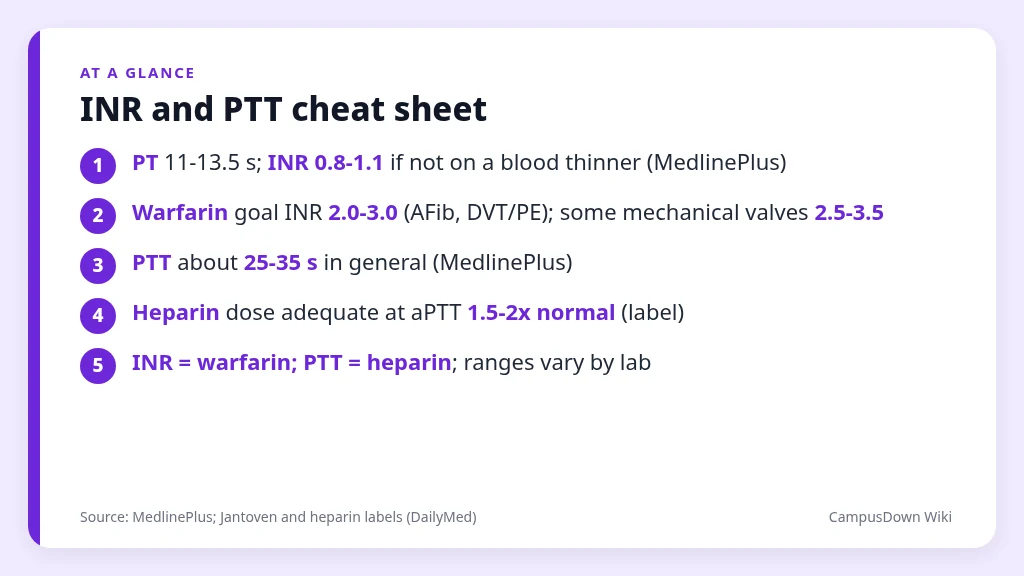
- PT: 11 to 13.5 seconds
- INR: 0.8 to 1.1
Therapeutic values on warfarin (Jantoven label):
- AFib and DVT/PE: target INR 2.5, range 2.0 to 3.0
- some mechanical mitral valves and older caged-ball valves: target 3.0, range 2.5 to 3.5
- the label says an INR above 4.0 gives no added benefit in most patients and raises bleeding risk
MedlinePlus adds that an INR that is too low means clotting risk, and too high means bleeding risk. Results can be affected by vitamin K-rich foods, alcohol and other medicines. See our warfarin guide.
PTT: what it measures
MedlinePlus says the PTT test measures the seconds it takes blood to clot, looking at different clotting factors than the PT. It is used to monitor heparin, to look for bleeding disorders such as hemophilia, and to check for problems such as lupus anticoagulant.
- General normal PTT: 25 to 35 seconds (MedlinePlus); ranges vary by lab
- Heparin goal: the heparin label says full-dose therapy is adequate when the aPTT is 1.5 to 2 times normal, checked before each dose early in treatment and at intervals after
A long PTT can also come from liver disease, vitamin K deficiency, hemophilia or too much heparin. Weight-based heparin drips are covered in heparin drip calculations.
What about Eliquis and Xarelto?
The DOAC pills apixaban (Eliquis) and rivaroxaban (Xarelto) are not monitored with routine INR. Their labels rely on kidney function, age and weight for dosing. A patient on Eliquis with a "normal" INR is not unprotected. See Eliquis and Xarelto.
Example scenario: the INR of 4.6
- Who
- Sofia, 22, a junior BSN student in Arizona, was assigned an 80-year-old patient on warfarin admitted for pneumonia and started on an antibiotic.
- What happened
- At 0700 the morning INR came back at 4.6. Her patient's gums were oozing slightly after brushing. Sofia's hands went cold: she had learned the numbers in class but had never seen a high one in a real chart.
- How it felt
- She felt the familiar panic of "what do I do first?" and the fear of looking unprepared in front of her instructor and the patient's daughter.
- What they did
- She took a breath, assessed for bleeding (vital signs, stool, urine, neuro checks, gums, IV sites), held the scheduled warfarin per the unit's protocol with her preceptor, and called the provider with an SBAR that included the antibiotic start date.
- How it turned out
- The provider adjusted the plan and ordered a recheck. Her instructor praised that she assessed the patient before reaching for the phone and linked the antibiotic to the INR rise. Sofia wrote "assess, hold, notify" on the inside of her badge holder.
This is an illustrative example, not a real patient or a review.
Sofia's day is an illustrative example, not a real patient or clinical event. Always follow your facility's protocol and your instructor's direction.
NCLEX-style priorities
- High INR on warfarin: assess for bleeding first, hold warfarin as ordered, notify the provider. The label lists vitamin K1 for reversal when needed.
- High aPTT on heparin: assess for bleeding, follow the heparin protocol (often hold or reduce the rate), notify. The label lists protamine sulfate as the heparin reversal agent.
- Watch platelets on heparin: the heparin label recommends periodic platelet counts because of heparin-induced thrombocytopenia (HIT).
- Bleeding signs: black stools, blood in urine, gum bleeding, bruising, sudden severe headache or neuro changes.
Get help now if
For patients: call 911 for a severe headache, confusion, weakness, vomiting blood, or black stools while on any blood thinner. Do not change your dose because of one lab result; your clinic or provider decides.
Most-asked questions about INR and PTT
What is the normal INR range?
For people not on a blood thinner, MedlinePlus lists an INR of 0.8 to 1.1. For most people on warfarin for AFib or DVT/PE, the label's target range is 2.0 to 3.0. Your lab and provider set your goal.
Why people ask: "inr normal range" is the #1 Google suggestion for "inr normal range," with "warfarin" at #2 and "nclex" at #10 (US autocomplete, November 2026).
What is the INR normal range for warfarin patients?
The label lists 2.0 to 3.0 for AFib and DVT/PE, and 2.5 to 3.5 for some mechanical valves.
Why people ask: "inr normal range for warfarin patients" is #5 and "inr normal range on blood thinners" is #7 (US, November 2026).
Can you test INR at home?
Yes. Home INR meters with test strips are used by some warfarin patients with a prescription and training. Ask your anticoagulation clinic whether you qualify and how results are reported.
Why people ask: "inr testing at home" is #5, "inr test strips" is #4 and "inr tester for home use" is #9 for "inr test" (US, November 2026).
What INR is needed before surgery?
There is no single number for everyone. The warfarin label says the INR should be checked right before dental or surgical procedures, and the surgeon and prescriber decide on any change.
Why people ask: "inr normal range for surgery" is #3 for "inr normal range" (US, November 2026).
You can check it for yourself on your next clinical day: find one patient on warfarin and one on heparin, and look at which lab is trended for each.
Related on CampusDown
You can learn more with our NCLEX lab values cheat sheet, DVT and PE nursing care and NCLEX priority (ABC) questions.
Frequently asked questions
- Is a higher INR "thinner" blood?
- Yes, in simple terms a higher INR means blood takes longer to clot.
- Is PTT the same as aPTT?
- They are closely related; many labs report the activated PTT (aPTT), and the heparin label uses aPTT.
- Why is my lab range different from the textbook?
- MedlinePlus notes normal ranges vary slightly between labs; use your lab's range.
- Does heparin affect INR?
- The warfarin label says heparin can increase the INR, which matters during overlap.
INR goes with warfarin, PTT goes with heparin, and every result is read alongside the patient in front of you. Learn more about your own lab's ranges, and ask your instructor, doctor or pharmacist when a number does not make sense.
Browse more guides like this in the Nursing Student and NCLEX hub.
This article is for general education and does not replace advice from your own doctor, nurse or pharmacist.
References
- MedlinePlus Medical Encyclopedia: Prothrombin time (PT)
- MedlinePlus Medical Encyclopedia: Partial thromboplastin time (PTT)
- MedlinePlus: Prothrombin Time Test and INR (PT/INR)
- DailyMed: Jantoven (warfarin sodium) prescribing information
- DailyMed: Heparin Sodium in Sodium Chloride Injection (Hospira) prescribing information