
You're 68, you got "the regular" flu shot every year, and this fall the pharmacy asks, "High-dose or regular?" Is the stronger one for you, and does it hurt more?

This guide uses CDC's "Flu and People 65 Years and Older" page (updated September 4, 2026) and CDC's "Different Types of Flu Vaccines" (updated September 1, 2026) and "Flu Vaccine Safety" pages. It is general information, not medical advice; your clinician or pharmacist can say which vaccine is right for you. If you want to learn more about another vaccine for older adults, take a closer look at shingles.
What CDC recommends at 65 and older
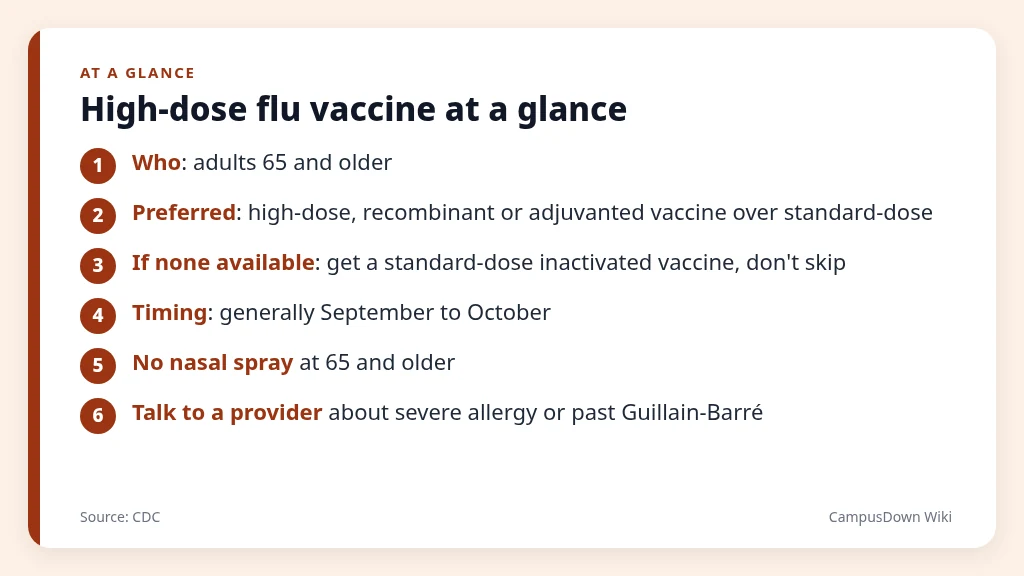
CDC says adults 65 and older are at higher risk of serious flu complications, and that between 70 and 85 percent of seasonal flu-related deaths and between 50 and 70 percent of flu-related hospitalizations occur in people 65 and older. For this group CDC and ACIP preferentially recommend higher-dose inactivated or recombinant vaccines or an adjuvanted inactivated vaccine over standard-dose unadjuvanted vaccines, because studies suggest these are potentially more effective. If none of these is available, get a standard-dose unadjuvanted inactivated vaccine rather than going without.

The three preferred options
CDC's vaccine-types page describes:
- Fluzone High-Dose: an inactivated flu vaccine that contains four times the antigen of a regular inactivated flu shot to create a stronger immune response, approved for people 65 and older.
- Flublok: a recombinant vaccine that doesn't contain viruses, only the influenza antigen, with three times the antigen of standard-dose inactivated vaccines, approved for ages 9 and older.
- Fluad: an adjuvanted inactivated vaccine containing an ingredient called an adjuvant to help create a stronger immune response, approved for people 65 and older.
CDC says the preference is based on studies suggesting these vaccines are potentially more effective in this age group, and that there are other flu vaccines approved for people 65 and older. CDC's page also says all flu vaccines in the United States are trivalent. Ask which your clinic stocks this season, since products change.
What is not recommended
People 65 and older should not get the nasal spray flu vaccine, per CDC. CDC describes Fluzone High-Dose as an inactivated flu vaccine, not an mRNA vaccine.
Timing
CDC says vaccination is generally best in September and October, and that most adults 65 and older should generally not be vaccinated early (July or August) because protection may decrease. CDC also stresses pneumococcal vaccination for older adults and says to call a provider right away if you get flu symptoms, because antiviral medicines are recommended for people at high risk. See sepsis and COPD flare signs for complications to watch for.
Side effects
CDC's flu vaccine safety page (August 2023) says common side effects of the flu shot are soreness, redness or swelling where the shot was given, headache, fever, nausea and muscle aches, which are generally mild and go away within a few days; injections can occasionally cause fainting. Some studies found a possible small association with Guillain-Barré syndrome, estimated at fewer than 1 or 2 cases per million people vaccinated, while others found none. People with severe, life-threatening allergies to a flu vaccine or its ingredients can't get it, and CDC says to talk with your doctor first if you've had Guillain-Barré syndrome, a severe allergy to eggs or an ingredient, or aren't feeling well. CDC doesn't compare side effects across the specific products on that page, so ask your clinician what to expect from yours.
Get help now if
Call 911 for trouble breathing, swelling of the face or throat, hives all over or fast heartbeat soon after a vaccine. Call your clinician for a fever that doesn't go away, new weakness or tingling in your legs, or flu symptoms such as fever with cough and body aches.
Questions for your clinician or pharmacist
- Which flu vaccine do you offer for my age, and is it high-dose, recombinant or adjuvanted?
- If those are out of stock, should I get a standard-dose now or wait?
- Do my allergies or health conditions change my choice?
- Should I also have pneumococcal or other vaccines?
- What should I do if I get flu symptoms?
Example scenario: waiting for the strong one
- Who
- Tobiah, 71, a retired high school coach in Omaha, Nebraska, was offered a standard-dose flu shot at his clinic in October, but wanted to wait for the high-dose.
- What happened
- He worried about a sore arm and about getting sick in the meantime.
- How it felt
- He felt torn.
- What they did
- He asked his pharmacist, who said the preferred options for his age are high-dose, recombinant or adjuvanted, and that if none is available, a standard-dose vaccine is better than none. The pharmacy found a high-dose supply two days later, and Tobiah asked about sore-arm tips and what symptoms to call about.
- How it turned out
- Tobiah said a quick call and a clear plan beat guessing.
This is an illustrative example, not a real patient or a review.
Tobiah's story is an illustrative example. Your clinician can say which vaccine suits you and when.
Most-asked questions about the high-dose flu vaccine
What are the side effects of the high-dose flu vaccine?
Common effects are soreness, redness or swelling at the site, headache, fever, nausea and muscle aches, usually mild and short-lived.
Why people ask: "high dose flu vaccine side effects" is #2 for "high dose flu vaccine" (US autocomplete, November 2026).
Is the high-dose flu vaccine for seniors?
Yes; CDC and ACIP preferentially recommend higher-dose, recombinant or adjuvanted vaccines for people 65 and older.
Why people ask: "high dose flu vaccine for seniors" is #3 for "high dose flu vaccine" (US autocomplete, November 2026).
What age is the high-dose flu vaccine for?
CDC says Fluzone High-Dose is approved for people 65 and older.
Why people ask: "high dose flu vaccine age" is #4 for "high dose flu vaccine" (US autocomplete, November 2026).
What about the high-dose flu vaccine in 2026?
CDC's page updated September 4, 2026 still prefers higher-dose, recombinant or adjuvanted vaccines at 65 and older; ask your clinic which products it has this season.
Why people ask: "high dose flu vaccine 2026" is #5 for "high dose flu vaccine" (US autocomplete, November 2026).
How does the high-dose flu vaccine compare with the regular one?
High-dose contains four times the antigen of standard-dose inactivated vaccines and is preferred at 65 and older, and CDC says such vaccines are potentially more effective.
Why people ask: "high dose flu vaccine vs regular" is #6 for "high dose flu vaccine" (US autocomplete, November 2026).
What are the indications for the high-dose flu vaccine?
Adults 65 and older; talk to a provider about severe allergy to an ingredient or a history of Guillain-Barré syndrome.
Why people ask: "high dose flu vaccine indications" is #7 for "high dose flu vaccine" (US autocomplete, November 2026).
What is the name of the high-dose flu vaccine?
CDC names Fluzone High-Dose as the high-dose vaccine; Flublok (recombinant) and Fluad (adjuvanted) are the other preferred options.
Why people ask: "high dose flu vaccine name" is #9 for "high dose flu vaccine" (US autocomplete, November 2026).
Who should get the high-dose flu vaccine at 65 and older?
CDC says adults 65 and older, with a standard-dose inactivated vaccine if none of the preferred types is available.
Why people ask: "high dose flu vaccine for 65 and older" is #10 for "high dose flu vaccine" (US autocomplete, November 2026).
What is the Fluzone High-Dose vaccine?
An inactivated flu vaccine with four times the antigen of a regular shot, approved for people 65 and older.
Why people ask: "fluzone high dose vaccine" is #2 for "fluzone high dose" (US autocomplete, November 2026).
What are Fluzone High-Dose side effects?
Soreness, redness or swelling at the site, headache, fever, nausea and muscle aches are common; ask your clinician what to expect.
Why people ask: "fluzone high dose side effects" is #3 for "fluzone high dose" (US autocomplete, November 2026).
Is Fluzone High-Dose an mRNA vaccine?
No; CDC describes it as an inactivated flu vaccine.
Why people ask: "fluzone high dose mrna" is #5 for "fluzone high dose" (US autocomplete, November 2026).
Who makes Fluzone High-Dose?
The CDC pages used here don't name manufacturers; check the package insert or ask your pharmacist.
Why people ask: "fluzone high dose manufacturer" is #6 for "fluzone high dose" (US autocomplete, November 2026).
How does Fluzone High-Dose compare with Fluad?
Both are preferred at 65 and older; Fluad contains an adjuvant and Fluzone High-Dose has four times the antigen. CDC doesn't rank one above the other here.
Why people ask: "fluzone high dose vs fluad" is #7 for "fluzone high dose" (US autocomplete, November 2026).
Related on CampusDown
You can learn more about the senior health hub and check it for yourself in polypharmacy and the Beers Criteria. For vaccine-preventable illness in detail, see shingles, and for infections that can turn serious see sepsis.
Frequently asked questions
- Who should get the high-dose flu vaccine?
- Adults 65 and older are the group it is approved for, and CDC prefers higher-dose, recombinant or adjuvanted vaccines for them.
- What if the high-dose isn't available?
- CDC says get a standard-dose unadjuvanted inactivated vaccine instead.
- When should I get it?
- Generally September or October; most adults 65 and older should not be vaccinated in July or August.
- Can I have the nasal spray?
- No; CDC says people 65 and older should not.
- What are common side effects?
- Soreness, redness, swelling, headache, fever, nausea and muscle aches, usually mild.
For adults 65 and older, CDC and ACIP prefer high-dose, recombinant or adjuvanted flu vaccines, but any appropriate flu vaccine beats none. Get it around September or October, skip the nasal spray, know the common side effects, and ask a provider about allergies or past Guillain-Barré syndrome.
Browse more guides like this in the Senior Health and Medicare hub.
This article is for general education and does not replace advice from your own doctor, nurse or pharmacist.