
Your lab report says eGFR 58, and the word "low" is flagged next to it. Does that mean kidney disease? Maybe, maybe not. One number from one day isn't a diagnosis, and it isn't the whole story.

This guide is based on the National Kidney Foundation (NKF), which explains the stages, and the National Institute of Diabetes and Digestive and Kidney Diseases (NIDDK), which describes how clinicians use eGFR. We explain in detail what the number is and isn't. Only your doctor can interpret your results in light of your health and medicines.
What eGFR is
The NKF explains that eGFR is calculated from a blood creatinine test, plus your age and sex. Creatinine is a waste product made by muscles, and healthy kidneys keep it at a steady level. The result estimates how much blood your kidneys filter each minute. NIDDK adds that eGFR is calculated with equations that may not always be precise, and that its calculator uses the race-free CKD-EPI equations for adults 18 and older. NIDDK also supports using both creatinine and cystatin C when more accuracy matters, for example when a decision depends on a close number.

The stages
The NKF's stage table (for chronic kidney disease, CKD):
| Stage | Kidney function | eGFR |
|---|---|---|
| 1 | Kidney damage, normal function | 90 or above |
| 2 | Mild loss | 60-89 |
| 3a | Mild to moderate loss | 45-59 |
| 3b | Moderate to severe loss | 30-44 |
| 4 | Severe loss | 15-29 |
| 5 | Kidney failure | Less than 15 |
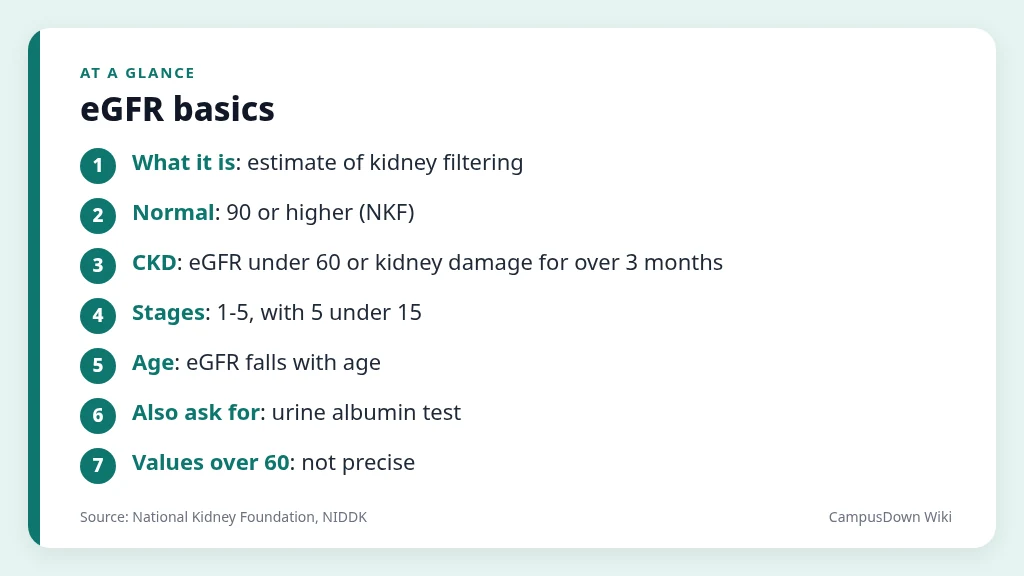
The NKF says that normal in adults is more than 90, and that an eGFR of 60-89 may not mean kidney disease if there's no sign of kidney damage, such as protein in the urine.
What an eGFR of 60 means
NIDDK says CKD is generally diagnosed when there's evidence, for more than 3 months, of kidney damage (usually urine albumin above 30 mg/g creatinine) and/or decreased kidney function (eGFR below 60). The NKF says an eGFR below 60 for more than three months usually means kidney disease and may lead to a referral to a nephrologist (kidney doctor). So a single result of 58 or 60 calls for a repeat test and a closer look, not a conclusion.
Age matters
The NKF says eGFR gets lower with age even in people without kidney disease, and that the calculation accounts for age. NIDDK adds that many people with age-related decline may not progress to kidney failure, and that the outlook for a 75-year-old with an eGFR of 55 may differ from a 45-year-old with the same number. Don't compare your number to a younger person's, and ask your doctor what's expected for you.
Why the number can mislead
NIDDK notes that eGFR isn't reliable with rapidly changing creatinine, extreme muscle mass or body size, or unusual diets, and that exact values above 60 aren't reliable, so some labs report ">60". The staging system based only on eGFR also doesn't reliably identify who's at greatest risk, which is why urine albumin testing is recommended as a second key marker, especially with diabetes or high blood pressure.
Medicines and kidneys
The NKF says people with a mildly low eGFR may be asked to avoid medicines that can damage the kidneys (such as ibuprofen) or have the dose of some medicines adjusted. Bring every medicine, including over-the-counter pain relievers, to a brown bag review. If you take diabetes medicines, see metformin and glipizide for how kidney function enters those decisions. If you have heart failure and take water pills, your team may check kidney numbers; see daily weights for heart failure.
Who should be checked
NIDDK says to screen people at risk, including those with diabetes, high blood pressure, heart disease or a family history of kidney failure, using eGFR and a urine albumin test. Ask whether your annual wellness visit is a good time to review labs. Blood pressure goals are in blood pressure targets for older adults, and diabetes care is in diabetes in older adults.
Questions for your doctor
- Is my eGFR a one-time result or a trend?
- Should we repeat it, and add a urine albumin test or cystatin C?
- Do any of my medicines need checking for kidney safety?
- What should I avoid, and when should I call you?
Get help now if
Call your doctor promptly if you notice much less urine, swelling in the legs or face, shortness of breath or confusion. Call 911 for severe symptoms.
Example scenario: the number that came back lower
- Who
- Anselm, 73, a retired high school chemistry teacher in Madison, Wisconsin, saw an eGFR of 57 in his patient portal before his doctor called. His wife, Eulalia, 71, a retired librarian, looked it up and found the stage chart.
- What happened
- He'd taken ibuprofen for his knees nearly every day for years, and he hadn't had a urine test in a long time.
- How it felt
- Anselm felt a jolt of fear, and Eulalia worried they'd waited too long.
- What they did
- At the visit, his doctor explained that one result isn't a diagnosis, ordered a repeat test and a urine albumin test, and asked about his medicines. The doctor discussed switching his knee pain plan and told him what to avoid. Eulalia kept a folder of the lab reports.
- How it turned out
- Anselm said he felt better once he understood the number was the start of a conversation. Eulalia said the folder turned out to be the most useful thing they had.
This is an illustrative example, not a real patient or a review.
Anselm's story is an illustrative example. Only a clinician can interpret your results.
Most-asked questions about eGFR
What does eGFR tell you about kidney function?
It estimates how well your kidneys filter blood, based on creatinine, age and sex. A clinician reads it with your other tests.
Why people ask: "egfr kidney function" is #1 for "egfr kidney function" (US autocomplete, November 2026).
What are the eGFR kidney function stages?
Stages 1 to 5 run from 90 or above down to under 15, per the National Kidney Foundation. Staging also considers kidney damage and time.
Why people ask: "egfr kidney function stages" is #4 for "egfr kidney function" (US autocomplete, November 2026).
What's the normal range for an eGFR kidney function test?
The NKF says normal in adults is more than 90, but eGFR falls with age, so ask what's expected for you.
Why people ask: "egfr kidney function test normal range" is #3 for "egfr kidney function" (US autocomplete, November 2026).
What is normal GFR by age?
eGFR gets lower with age even without kidney disease. NIDDK says a 75-year-old with an eGFR of 55 may have a different outlook than a 45-year-old with the same number.
Why people ask: "normal gfr by age" is #1 for "what is a normal egfr for age" (US autocomplete, November 2026).
What is normal GFR for age 65?
There's no single cutoff; ask your doctor. NKF says eGFR below 60 for three months or more indicates kidney disease at any age.
Why people ask: "what is normal gfr for age 65" is #2 for "what is a normal egfr for age" (US autocomplete, November 2026).
What does an eGFR of 60 mean?
It sits at the line CKD is judged by: an eGFR below 60 for more than 3 months, or kidney damage such as protein in the urine, can indicate CKD. A repeat test and a urine test help.
Why people ask: "egfr 60 meaning" is #2 for "egfr 60" (US autocomplete, November 2026).
What CKD stage is an eGFR of 60?
The NKF puts 60-89 in stage 2 (with kidney damage) and 45-59 in stage 3a. Stage depends on damage and duration too.
Why people ask: "egfr 60 ckd stage" is #4 for "egfr 60" (US autocomplete, November 2026).
Related on CampusDown
You can learn more about diabetes in older adults and check it for yourself in blood pressure targets.
Frequently asked questions
- Can eGFR go up again?
- It can change with hydration, illness and medicines. Your doctor looks at trends.
- Is eGFR the same as kidney percentage?
- The NKF's table lists it alongside "kidney function" percentages, but it's an estimate, not an exact percent.
- Do I need a urine test too?
- NIDDK recommends urine albumin as a second key marker of kidney disease.
- Does a low eGFR always mean dialysis?
- No. The NKF says dialysis or a transplant is needed with kidney failure (below 15), and NIDDK says many people with age-related decline may not progress to kidney failure.
An eGFR is a starting point. Repeat it, add the urine test, review your medicines and ask what the number means for you.
Browse more guides like this in the U.S. Health Topics hub.
This article is for general education and does not replace advice from your own doctor, nurse or pharmacist.