
Your instructor holds up three bags and asks which one you would hang for a dehydrated patient, and which one could swell the brain if you got it wrong. Where do you start?

You start with tonicity: how the fluid's particle concentration compares with blood. This guide follows OpenStax's Clinical Nursing Skills (chapters 13 and 19). It is a study aid. Real orders, drug references and your facility policy decide what you hang and at what rate, and your instructor or nurse supervises you. To learn more about the assessment side, take a closer look at fluid volume excess vs deficit.
The idea in one paragraph
OpenStax says IV fluids restore volume to the intravascular compartment, and some also use osmosis to shift water between compartments. There are three types: isotonic, hypotonic and hypertonic. The "tonicity" compares the IV fluid with the patient's blood.

Isotonic
An isotonic fluid has a similar concentration of particles as blood, so it stays in the intravascular space and doesn't shift water into or out of cells. OpenStax gives 0.9% normal saline (0.9% NaCl) as the example and lists lactated Ringer's, Ringer's solution and D5LR as isotonic solutions in its infusion chapter.
- Used for: raising blood pressure in fluid volume deficit and replacing losses.
- Normal saline: fluid resuscitation for hemorrhage, severe vomiting or diarrhea, GI suction losses, wound drainage, mild low sodium and blood transfusions.
- Lactated Ringer's (LR): fluid resuscitation, GI losses, burns, trauma or metabolic acidosis, often during surgery.
- Watch for: too much isotonic fluid can cause fluid volume excess. Monitor closely for overload, especially in heart failure or kidney failure. OpenStax says LR should not be used if serum pH is over 7.5 because it can worsen alkalosis, and may raise potassium in kidney failure.
Hypotonic
A hypotonic fluid has a lower concentration of solutes than blood, so water moves from the blood vessels into cells. OpenStax gives 0.45% normal saline as the example (the infusion chapter also lists 0.225%, 0.33% and D2.5W).
- Used for: cellular dehydration, to provide free water for the kidneys to excrete solutes and in conditions like hypernatremia. The infusion chapter also mentions diabetic ketoacidosis and hyperosmolar states.
- Watch for: if too much fluid moves into cells, cerebral edema can occur, and hypovolemia and hypotension can worsen. OpenStax says to monitor for hypotension and confusion and to avoid or be cautious in patients with liver disease, trauma, burns or increased intracranial pressure.
Hypertonic
A hypertonic fluid has a higher concentration than blood, so water moves out of cells into the vessels. OpenStax gives 3% sodium chloride as the example, plus 5% NaCl, D10W, D20W and D50W in the infusion chapter.
- Used for: severe hyponatremia and cerebral edema (3% NaCl).
- Watch for: signs of hypervolemia such as breathing difficulty and elevated blood pressure, and closely monitor serum sodium if the fluid contains sodium. OpenStax says hypertonic solutions are usually given in acute care settings because they need close monitoring and, because they are vesicants (irritating to tissue), should be given through a central line.
D5W: the one that changes
OpenStax lists 5% dextrose in water (D5W) as starting out isotonic and then becoming hypotonic once the dextrose is metabolized. It provides free water and some dextrose, but should not be used for fluid resuscitation, because after the dextrose is used it becomes hypotonic and leaves the vascular space, which can cause brain swelling. This is a favorite exam topic.
Quick comparison
| Type | Example | Effect on cells | Main watch-for |
|---|---|---|---|
| Isotonic | 0.9% NaCl, LR | No shift; expands vessels | Fluid overload |
| Hypotonic | 0.45% NaCl | Water moves into cells | Cerebral edema, low BP |
| Hypertonic | 3% NaCl | Water moves out of cells | Overload, sodium changes |
Monitoring while a fluid runs
Use the assessment skills in the fluid guide: blood pressure, heart rate, lung sounds, edema, urine output, daily weights and mental status. For lab context, see the sodium range guide and the potassium range guide, since fluids and electrolytes move together.
Checking the IV site
OpenStax says to check that the catheter is placed correctly and works, compare the insertion site with the opposite side and look for redness, swelling and warmth, and assess for phlebitis at least once per shift and whenever the catheter is used. Key complications include:
- Phlebitis: redness, pain, heat, swelling, possibly a palpable cord
- Infiltration: swelling, pain, coolness, tight skin and leaking at the site; stop the infusion and follow policy
- Extravasation: infiltration of an irritating solution with burning, blistering or tissue damage; follow the specific policy
Safety habits
- Verify the order, the fluid, the rate and the patient identity every time; see the rights of medication administration.
- Know which additives raise the stakes; see high-alert medications (for example, concentrated potassium).
- Report changes in breathing, blood pressure, mental status or urine output promptly.
- Never change a rate or fluid without an order and your instructor's guidance.
Study tips
- Draw a cell and arrows for each type and say the direction of water out loud.
- Make a three-row table with example, effect and watch-for.
- Memorize the D5W exception.
- Practice linking each fluid to a patient scenario, such as dehydration, hyponatremia or burns, and to the risks.
Questions for your instructor
- Which fluids does our unit stock, and which need a pump or a central line?
- How often do we assess patients on each type?
- Which findings do we report immediately?
- How does our facility handle infiltration and extravasation?
- What does the exam expect for D5W?
Example scenario: the bag that looked fine
- Who
- Amias, 24, a nursing student in Albuquerque, New Mexico, saw a patient with dehydration and assumed that D5W was a reasonable choice because the bag looked like a normal "fluid."
- What happened
- He wasn't sure why his instructor flagged it.
- How it felt
- He felt embarrassed and a little defensive.
- What they did
- His instructor explained that D5W changes after the dextrose is used and that the provider orders fluids by purpose. Amias drew a table of the three types and wrote the exception in the margin. At his next clinical day he asked the nurse why a specific fluid had been ordered for each patient.
- How it turned out
- Amias said the "why" made the types stick.
This is an illustrative example, not a real patient or a review.
Amias's story is an illustrative example. Always follow orders and your instructor's guidance.
Most-asked questions about IV fluid types
What are IV fluid types and uses?
Isotonic, hypotonic and hypertonic fluids for resuscitation, cellular hydration and treating severe low sodium or brain swelling, per OpenStax.
Why people ask: "iv fluids types and uses" is #1 for "iv fluids types" (US autocomplete, November 2026).
What are IV fluid types by color?
Most IV fluids are clear; color doesn't identify the type. Always read the label and the order.
Why people ask: "iv fluids types and color" is #5 for "iv fluids types" (US autocomplete, November 2026).
What are the indications for each IV fluid type?
Isotonic for volume replacement, hypotonic for cellular dehydration and hypertonic for severe hyponatremia or cerebral edema.
Why people ask: "iv fluids types and indications" is #6 for "iv fluids types" (US autocomplete, November 2026).
What is the composition of IV fluids?
Examples include 0.9% NaCl, 0.45% NaCl, 3% NaCl, D5W and lactated Ringer's; see your drug reference for exact contents.
Why people ask: "iv fluids types and composition" is #7 for "iv fluids types" (US autocomplete, November 2026).
What are the indications and contraindications of IV fluid types?
See each section above: for example, LR is cautioned in high pH or kidney failure, and hypotonic fluids are cautioned with burns, liver disease or raised intracranial pressure.
Why people ask: "iv fluids types indications and contraindications" is #8 for "iv fluids types" (US autocomplete, November 2026).
Related on CampusDown
You can learn more about the nursing student hub and check it for yourself in the fluid volume guide. For emergencies in detail, see types of shock.
Frequently asked questions
- Which IV fluid is isotonic?
- 0.9% normal saline and lactated Ringer's are common examples.
- Why is D5W tricky?
- It starts isotonic but acts hypotonic after the dextrose is metabolized, so it isn't used for resuscitation.
- What is the risk of hypotonic fluids?
- Water moving into cells can cause cerebral edema or worsen low blood pressure.
- Why are hypertonic fluids restricted?
- They need close monitoring and are usually given in acute care, often through a central line.
- What should I watch for with isotonic fluids?
- Fluid overload, especially with heart or kidney failure.
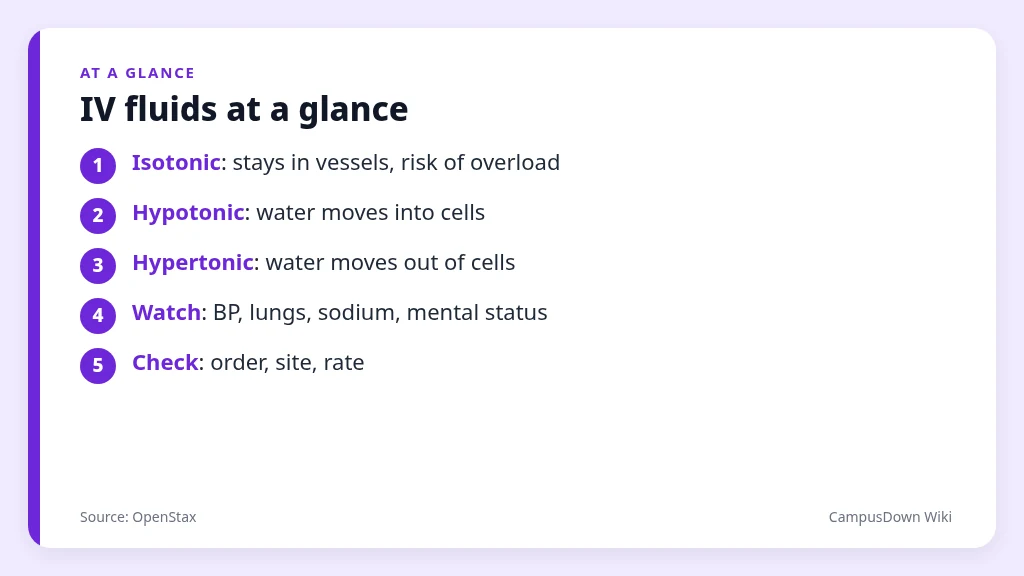
IV fluids make sense once you picture the water: isotonic stays in the vessels, hypotonic moves into cells and hypertonic pulls water out. Know the order, the risk and the exceptions.
Browse more guides like this in the Nursing Student and NCLEX hub.
This article is for general education and does not replace advice from your own doctor, nurse or pharmacist.