
Your patient was fine at 8 a.m. At noon she's pale, a little confused, and her heart rate is climbing. Is it shock? Which kind? And what do you do in the next minute?
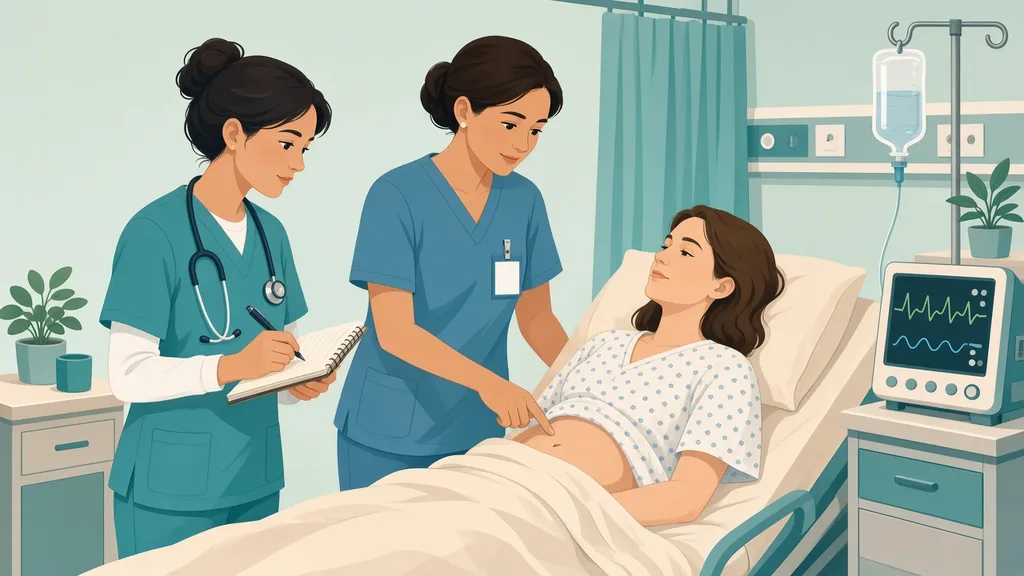
Shock is where a calm framework helps most. This guide follows OpenStax's Medical-Surgical Nursing and Pharmacology for Nurses chapters on shock. It is a study aid, not an emergency protocol. If you see signs of shock, tell your instructor or the nurse immediately and follow your facility's rapid response process. To learn more about one of the distributive types, take a closer look at sepsis recognition.
What shock is
OpenStax defines shock as a state of inadequate cellular perfusion: cells, tissues and organs don't receive enough oxygenated blood. Blood pressure depends on cardiac output (heart rate times stroke volume) and systemic vascular resistance (how tight the vessels are), so shock happens when one of three things fails: volume, the pump or the vessels. Obstruction adds a fourth route.

The four types
| Type | What fails | Examples |
|---|---|---|
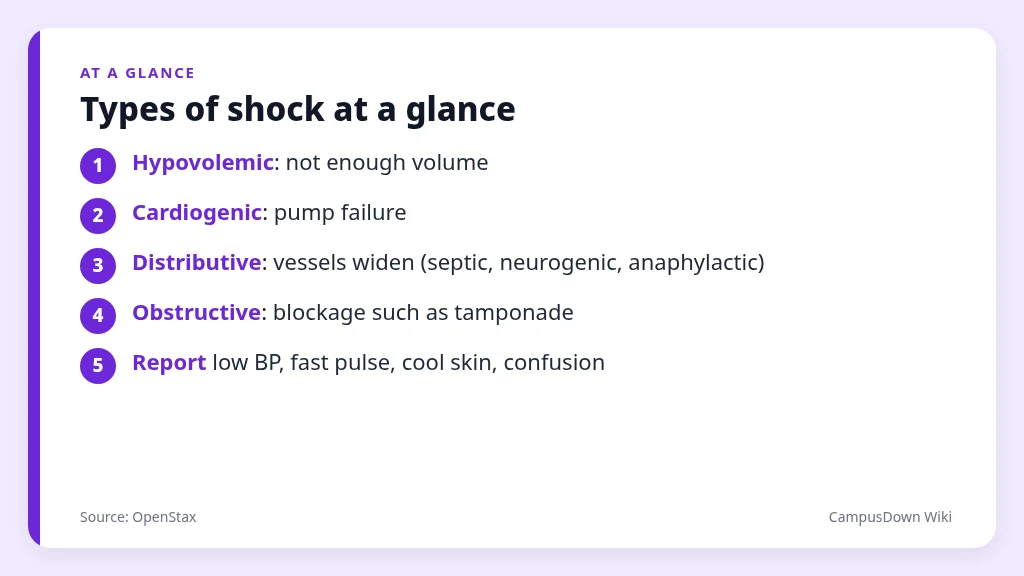
| Hypovolemic | Not enough volume in the vessels | Bleeding, severe vomiting or diarrhea, burns |
| Cardiogenic | The heart can't pump enough | Heart muscle damage after a heart attack |
| Distributive | Vessels widen and blood maldistributes | Septic, neurogenic, anaphylactic shock |
| Obstructive | A blockage stops the heart filling or pumping | Cardiac tamponade, massive pulmonary embolism |
Hypovolemic shock
OpenStax says hypovolemic shock results when there is not enough volume in the vessels to maintain perfusion. Absolute hypovolemia comes from bleeding, vomiting, diarrhea, fistula drainage or excess urine output; relative hypovolemia comes from fluid shifting into tissues, as with bowel obstruction, burns, ascites, fractures or sepsis. The body compensates with a faster heart rate and tighter vessels. Findings include increased heart rate, decreased blood pressure, increased respiratory rate, decreased urine output and cool, clammy skin. Treatment focuses on finding and stopping the source of volume loss and restoring volume; see IV fluid types.
Cardiogenic shock
OpenStax says cardiogenic shock occurs when the heart muscle has been damaged and can no longer maintain cardiac output, as after a large heart attack when part of the left ventricle dies. Think pump failure; see heart failure for related ideas.
Distributive shock
Distributive shock involves vasodilation and fluid leaving the vessels. OpenStax groups these under it:
- Septic shock: the body's overreaction to infection. Classic findings are hypotension, tachycardia, tachypnea, low urine output and mottled skin. Care happens in an intensive care environment.
- Neurogenic shock: loss of sympathetic nerve control of the vessels, most often from spinal cord injury, also from spinal anesthesia or severe head trauma. Hallmarks are hypotension and bradycardia, with warm, dry skin early. Emergency care includes ABCs and protecting the cervical spine.
- Anaphylactic shock: a whole-body allergic reaction with vasodilation and airway narrowing; wheezing, stridor or inability to breathe can occur, and it can become life-threatening quickly.
Obstructive shock
OpenStax's pharmacology chapter says obstructive shock occurs when a blockage in the chest impedes the heart's ability to pump, for example cardiac tamponade, where fluid in the pericardial sac stops the ventricles filling.
The stages
OpenStax describes four stages:
- Initial: changes happen at the cellular level without obvious signs.
2. Compensatory: blood pressure drops, with a fast heart rate, cool skin, faster breathing and less urine as the body tries to compensate. 3. Progressive: compensation fails and fluid leaks into tissues; low blood pressure, fast heart rate, low urine output, fast breathing and cool, discolored extremities with weak distal pulses. 4. Refractory: continued hypoxia leads to cell death, and recovery is unlikely.
The lesson for students: catch it in the compensatory stage. Trend vital signs, urine output, skin and mental status, not just one number.
Early signs to report
OpenStax lists low blood pressure with signs such as cool, clammy skin, an elevated heart rate and respiratory rate, a change in mental status or reduced level of consciousness as indicative of shock, and says treatment begins as soon as possible, often before the cause is confirmed. Diagnostics may include an ECG, cardiac monitoring, x-rays, blood counts, lactate and cultures, as the provider orders.
Get help now if
If a patient has low blood pressure, a rapid heart rate, cool or mottled skin, new confusion or trouble breathing, tell your instructor or the nurse immediately and call for help per facility policy. Do not wait to finish charting.
First nursing actions (student view)
Your role is to recognize, report and support under supervision:
- Get help right away and stay with the patient.
- Check airway, breathing and circulation as taught and take vital signs.
- Look at the whole picture: skin color and temperature, mental status, urine output and recent events such as bleeding, vomiting, medication or exposure to an allergen.
- Report with a structured handoff; see SBAR handoff.
- Carry out orders, such as oxygen, IV access, fluids or medicines, only as directed.
For exam purposes, use the head-to-toe assessment and the fluid assessment guide to organize your cues. For lab context, see the lab values cheat sheet.
Study tips
- Ask "volume, pump, vessels or blockage?" for each case.
- Memorize the odd one: neurogenic shock has a slow heart rate and warm skin; most other types have a fast heart rate and cool skin.
- Make a four-column table with cause, key findings, first priority and a typical example.
- Practice describing what you'd report in two sentences.
Questions for your instructor
- What are our unit's triggers for a rapid response call?
- Which vital sign changes do we report immediately?
- How does the unit handle suspected anaphylaxis or sepsis?
- What does the exam expect for the order of actions?
- How do I practice recognizing early cues in simulation?
Example scenario: noon vitals
- Who
- Clement, 25, a nursing student in Providence, Rhode Island, saw a post-surgical patient at noon who was pale, restless and had a heart rate rising across several checks.
- What happened
- He wasn't sure the numbers were bad enough to interrupt anyone.
- How it felt
- He felt anxious about overreacting.
- What they did
- He told the nurse right away, who looked at the trend, the patient's drain output and her skin, and called the provider. Clement later wrote the sequence in his notes and practiced a short SBAR script.
- How it turned out
- Clement said speaking up early felt less scary than he expected.
This is an illustrative example, not a real patient or a review.
Clement's story is an illustrative example. Facility policy and your instructor guide real actions.
Most-asked questions about types of shock
What are the types of shock in nursing school?
Hypovolemic, cardiogenic, distributive (septic, neurogenic, anaphylactic) and obstructive.
Why people ask: "types of shock nursing school" is #2 for "types of shock nursing" (US autocomplete, November 2026).
Is there a types of shock nursing quiz?
Practice with the volume, pump, vessels and blockage framework; your course will have its own quizzes.
Why people ask: "types of shock nursing quiz" is #3 for "types of shock nursing" (US autocomplete, November 2026).
Where can I find types of shock nursing notes?
Build your own table from the sections above and your course text.
Why people ask: "types of shock nursing notes" is #4 for "types of shock nursing" (US autocomplete, November 2026).
What are the 4 types of shock in nursing?
Hypovolemic, cardiogenic, distributive and obstructive, per OpenStax's pharmacology chapter.
Why people ask: "4 types of shock nursing" is #9 for "types of shock nursing" (US autocomplete, November 2026).
What is nursing management for the types of shock?
Recognize early, report, support airway, breathing and circulation and carry out orders; treatment targets the cause.
Why people ask: "types of shock and nursing management" is #10 for "types of shock nursing" (US autocomplete, November 2026).
Related on CampusDown
You can learn more about the nursing student hub and check it for yourself in the sepsis guide. For handoff in detail, see SBAR handoff.
Frequently asked questions
- What is shock?
- Inadequate cellular perfusion, per OpenStax.
- Which shock has a slow heart rate?
- Neurogenic shock, with hypotension, bradycardia and initially warm skin.
- What are the early signs?
- Low blood pressure, fast heart rate and breathing, cool or clammy skin, low urine output and confusion.
- Which type follows a heart attack?
- Cardiogenic shock, from damaged heart muscle.
- What should a student do first?
- Get help and report right away, then support care as directed.
Shock comes down to four questions: is it volume, the pump, the vessels or a blockage? Notice the pattern early, call for help and report clearly.
Browse more guides like this in the Nursing Student and NCLEX hub.
This article is for general education and does not replace advice from your own doctor, nurse or pharmacist.