
Have you seen someone limping along with a cane held on the "wrong" side, hunched over a stick that's far too short? It's one of the most common sights in any pharmacy aisle. A cane that's sized and held correctly takes real load off a painful knee or hip; a wrong one can make you lean and trip.
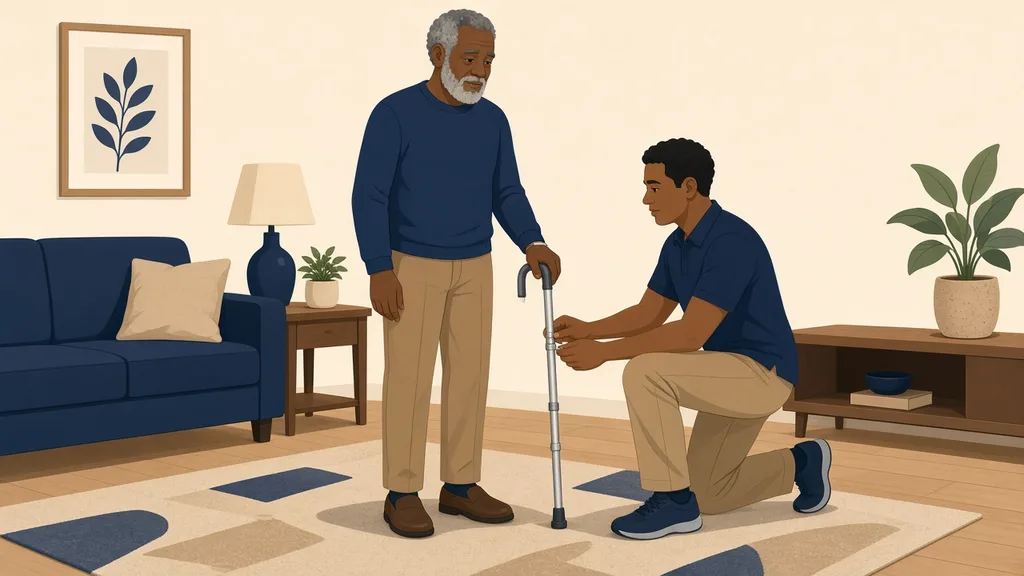
This guide explains in detail how to size and use a cane, using AAOS OrthoInfo from the American Academy of Orthopaedic Surgeons, the National Institute on Aging (NIA) and Medicare.gov, checked in November 2026. A physical therapist can check your fit in minutes.
Is a cane the right aid?
OrthoInfo says a cane can help if you have minor problems with balance or stability, some weakness in your leg or trunk, an injury or pain. For older adults, a single-point cane may help you walk more comfortably and safely and stay independent. If you need more stability, a quad cane, with four points, can be useful.
If you lean heavily on your hands, or your leg might give way, you probably need more support. See walker vs rollator.

Step 1: Set the height
- Stand up straight in your usual walking shoes, arms relaxed.
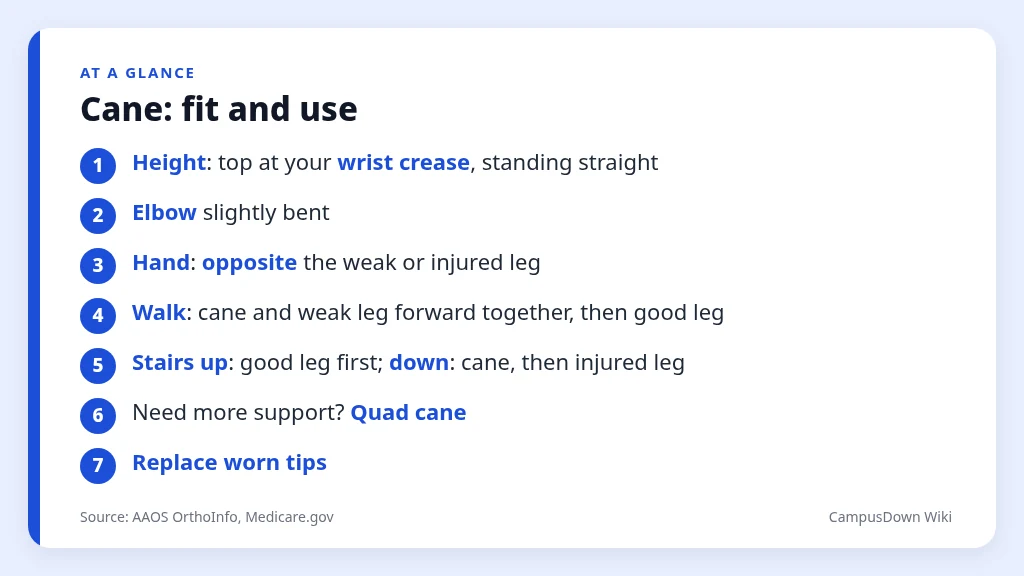
- The top of the cane should reach the crease in your wrist.
- When you hold the handle, your elbow should be slightly bent.
Adjustable aluminum canes change height with a push button; wooden canes are cut to length. Height charts based on your height alone are only a starting point, because arm length varies. Wrist crease is what matters, so check it for yourself in a mirror or with a helper.
Step 2: Choose the hand
Hold the cane in the hand opposite the side that needs support. If your right knee hurts, the cane goes in your left hand. This feels backward at first. A therapist can watch you walk and confirm it.
Step 3: Walk with it
OrthoInfo's pattern:
- Set the cane about one small stride ahead of you.
2. Step off on your injured or weaker leg, moving it forward with the cane. 3. Finish the step with your good leg.
Keep your posture tall, look ahead rather than at your feet, and take shorter steps when turning.
Stairs: "up with the good, down with the bad"
Going up:
- Hold the cane in the hand opposite your injured leg.
2. With your free hand, grasp the handrail. 3. Step up with your good leg first, then bring up the injured leg (and cane).
Going down:
- Put the cane on the step first.
2. Then the injured leg. 3. Finally the good leg, which carries your body weight.
The NIA recommends handrails on both sides of stairs at home. See our fall prevention checklist.
Single-point vs quad cane
| Type | Strengths | Trade-offs |
|---|---|---|
| Single-point cane | Light, easy on stairs and in crowds | Less support |
| Quad cane (small or wide base) | More stability; stands up on its own | Heavier; all four tips must touch the ground to be stable |
| Folding cane | Packs in a bag for travel | Joints can loosen; check before each use |
Care and safety
- Check the rubber tip often. A worn, smooth tip slips on wet floors; replacements are sold at pharmacies and medical supply stores.
- If you borrow a cane, the NIA says ask your health care provider to make sure it is the correct size and safe to use.
Medicare coverage
Medicare.gov says Part B covers canes as durable medical equipment when your doctor orders one. It doesn't cover white canes for the blind. Use a Medicare-enrolled supplier.
Example scenario: the hardware store cane
- Who
- Winston, 67, a retired high school shop teacher in Raleigh, bought a wooden cane at a hardware store when his right knee osteoarthritis flared. He held it in his right hand because, as he put it, "that's the bad side."
- What happened
- Within a month his back ached, his shoulder hurt, and he caught the cane tip on a curb and stumbled.
- How it felt
- He felt frustrated and a bit embarrassed. He'd taught teenagers to measure twice and cut once, and here he was using a tool he'd never measured. He worried he was heading for a knee replacement sooner than his doctor had said.
- What they did
- At his doctor's suggestion he saw a physical therapist, who measured from the floor to his wrist crease, cut the cane down by about two inches, moved it to his left hand and walked the hallway with him until the "cane and right leg together" rhythm stuck. They also practiced stairs: up with the good, down with the bad.
- How it turned out
- Two weeks later, his back pain had eased and he walked the curb at his grocery store without a wobble. He replaced the hardware store tip with a new rubber one and keeps a spare in his glove box.
This is an illustrative example, not a real patient or a review.
Winston is an illustrative example. A physical therapist can fit your cane and teach the right pattern.
Most-asked questions about cane height and use
How do you use a cane properly?
Hold it in the hand opposite the weak leg, set it one small stride ahead, step with the weak leg, then the good leg.
Why people ask: "how to use a cane properly" is #2 for "how to use a cane" (US autocomplete, November 2026).
How do you use a cane for balance?
For minor balance problems, a single-point cane on the side opposite your weaker leg helps; a quad cane gives more stability. If you're often unsteady, ask about a walker.
Why people ask: "how to use a cane for balance" is #3 for "how to use a cane" (US, November 2026).
Is there a cane height chart?
Charts by body height are a starting point, but the wrist-crease rule is more reliable because arm length varies.
Why people ask: "cane height chart" is #2 for "cane height" (US, November 2026).
How do you use a cane after knee replacement?
Follow your surgeon's and therapist's plan. Many people move from a walker to a cane as they heal, holding it opposite the operated knee.
Why people ask: "how to use a cane after knee replacement" is #6 for "how to use a cane" (US, November 2026).
Related on CampusDown
To take a closer look at the next step up in support, read Drive Nitro rollator. Learn more about building strength in balance exercises and sarcopenia.
Frequently asked questions
- Which hand do I hold a cane in?
- The hand opposite the weak or injured leg, according to AAOS OrthoInfo.
- How do I know if my cane is too short?
- If you lean or hunch to reach it, it's likely too short. The top should meet your wrist crease while you stand straight.
- Does Medicare pay for a cane?
- Part B covers canes as durable medical equipment with a doctor's order, but not white canes for the blind.
A cane is a small tool that works only when it fits: wrist-crease height, opposite hand, cane and weak leg together. Get it checked by a physical therapist, replace worn tips, and talk to your doctor if you feel you need more support.
Browse more guides like this in the Home Medical Devices hub.
This article is for general education and does not replace advice from your own doctor, nurse or pharmacist.