
"Mom's acting strange. Could it be a UTI?" Many families have heard that urinary tract infections cause confusion in older adults. Sometimes they do. But a positive urine test doesn't always mean an infection, and assuming it does can delay finding the real cause.

This guide uses the Infectious Diseases Society of America (IDSA) 2019 guideline on asymptomatic bacteriuria, two systematic reviews in the *Journal of the American Geriatrics Society*, and NCBI StatPearls on delirium. It explains in detail what the evidence says. Only a clinician can diagnose a UTI.
Sudden confusion is delirium
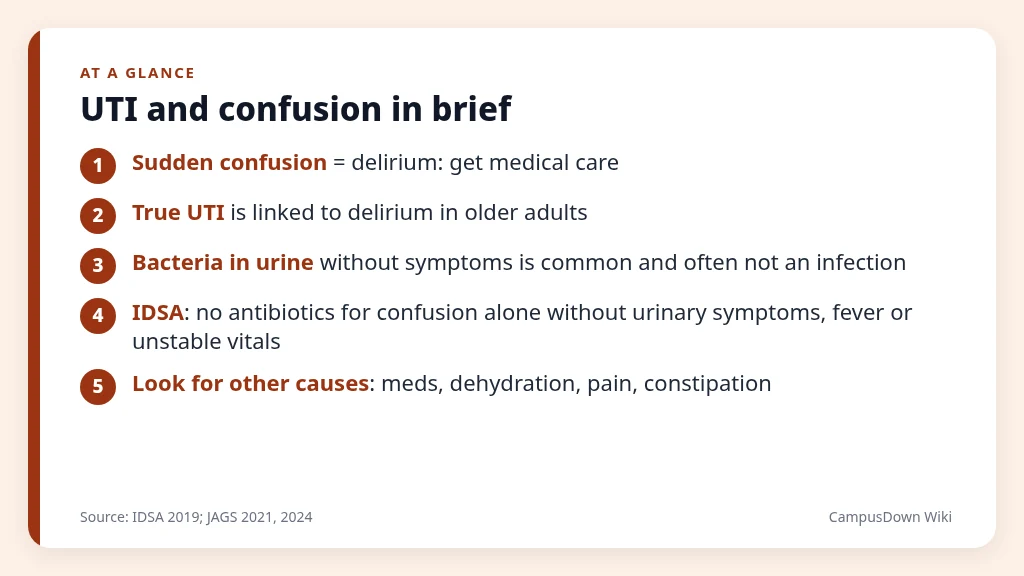
Confusion that comes on over hours or days, with trouble paying attention or changes in alertness, is delirium. It's a medical problem that needs prompt evaluation. The IDSA guideline lists contributors such as infection, certain medicines, poorly controlled pain, constipation, fever, sleep deprivation and low oxygen. See delirium in the hospital and, for slow changes over months, early signs of dementia.

What the evidence says about UTIs and confusion
- True UTIs are linked to delirium. A 2021 meta-analysis of 29 studies in people 65 and older found delirium was significantly associated with UTI. The studies were of moderate quality.
- Bacteria without infection is different. Many older adults have bacteria in their urine with no infection (asymptomatic bacteriuria). The same review found too little evidence to link it to delirium. IDSA notes a cause-and-effect link between bacteriuria and delirium hasn't been established.
- Antibiotics for confusion alone. IDSA recommends that for older adults with functional or cognitive impairment who have bacteriuria and delirium but no urinary symptoms and no fever or unstable vital signs, clinicians look for other causes and observe carefully rather than give antibiotics. A 2024 systematic review found no evidence antibiotics improve delirium in that group, and two studies suggested worse outcomes.
Why unnecessary antibiotics matter
IDSA cites harms of treating bacteria that aren't causing infection: C. difficile diarrhea, antibiotic resistance and drug side effects. See C. diff after antibiotics.
Signs that point to a real UTI
Tell the doctor about these, and learn more from the care team about what to watch:
- Painful or burning urination, or new or worse urgency or frequency
- Fever or chills
- Back or side pain, nausea or vomiting, which may suggest a kidney infection
- Low blood pressure, fast heart rate or very sleepy behavior
Get help now if
Seek urgent care for confusion with fever, shaking chills, back pain, vomiting, very low urine output or trouble staying awake. Call 911 for sudden weakness on one side, slurred speech or trouble breathing.
Other causes to check
Before blaming the bladder, ask about:
- New or changed medicines, including sleep aids and allergy pills; see anticholinergic drugs
- Dehydration; see dehydration in older adults
- Pain, constipation or urinary retention
- Poor sleep, low oxygen, other infections such as pneumonia
- Alcohol or stopping a medicine suddenly
What families can do
- Note when the confusion started and what changed.
- Bring a full medicine list.
- Ask: "Does she have urinary symptoms or a fever, or could this be something else?"
- Ask why a urine test is needed when there are no urinary symptoms, and take a closer look at the results with the doctor.
Example scenario: the third round of antibiotics
- Who
- Seraphina, 47, a dental office manager in Raleigh, North Carolina, had watched her mother, Lavinia, 86, who has mild dementia, get antibiotics three times in four months for confusion, each time after a positive urine test.
- What happened
- The last course left Lavinia with severe diarrhea, and she was more confused afterward, not less.
- How it felt
- Seraphina felt frustrated and scared; every bad day turned into another urine test, and no one seemed to look further.
- What they did
- She asked the geriatrician whether her mother had any urinary symptoms or fever, brought every pill bottle, and mentioned that a new bedtime allergy pill had started around the first episode. The doctor reviewed the medicines, checked hydration and constipation, and explained asymptomatic bacteriuria.
- How it turned out
- The allergy pill was stopped, Lavinia drank more during the day, and her bad spells became rarer. Seraphina said learning to ask "could it be something else?" changed her mother's care.
This is an illustrative example, not a real patient or a review.
Seraphina's story is an illustrative example. Never stop a prescribed antibiotic without talking to the prescriber.
Most-asked questions about UTI and confusion
How is UTI confusion in the elderly treated?
If there's a true UTI with urinary symptoms or fever, antibiotics treat the infection. If there's only bacteria in the urine without symptoms, IDSA recommends looking for other causes rather than antibiotics.
Why people ask: "uti confusion elderly treatment" is #2 for "uti confusion elderly" (US autocomplete, November 2026).
Can a kidney infection cause confusion in the elderly?
A serious infection can trigger delirium. Fever, chills, back or side pain or vomiting need prompt medical care.
Why people ask: "kidney infection confusion elderly" is #3 for "uti confusion elderly" (US, November 2026).
Does UTI make dementia worse in the elderly?
A true infection can cause delirium on top of dementia. But bacteria in urine without symptoms is common and isn't proven to cause confusion.
Why people ask: "uti dementia elderly" is #6 for "uti confusion elderly" (US, November 2026).
How long does UTI delirium take to resolve in the elderly?
It varies. Delirium can improve as the cause is treated, but some older adults take longer to recover. Ask the care team what to expect.
Why people ask: "uti delirium elderly recovery" is #7 for "uti confusion elderly" (US, November 2026).
What are UTI symptoms in elderly women?
Painful urination, new urgency or frequency, fever and back pain. Confusion alone isn't enough to diagnose a UTI.
Why people ask: "uti in elderly women symptoms" is #4 for "uti in elderly" (US, November 2026).
Related on CampusDown
To take a closer look at sudden confusion, read delirium.
Frequently asked questions
- Should every confused older adult get a urine test?
- Not automatically. IDSA advises looking for other causes when there are no urinary symptoms or signs of systemic infection.
- Is bacteria in the urine always an infection?
- No. Asymptomatic bacteriuria is common in older adults and usually isn't treated.
- Should I ask for antibiotics just in case?
- No. Talk with the doctor first. IDSA notes unnecessary antibiotics can cause C. diff, resistance and side effects.
A true UTI can cause confusion, but a positive urine test alone doesn't prove it. Watch for urinary symptoms and fever, ask about other causes, and work with the doctor to avoid antibiotics that won't help.
Browse more guides like this in the Senior Health and Medicare hub.
This article is for general education and does not replace advice from your own doctor, nurse or pharmacist.
References
- IDSA: 2019 Clinical Practice Guideline for the Management of Asymptomatic Bacteriuria
- Stall NM et al. Antibiotics for delirium in older adults with pyuria or bacteriuria: a systematic review. J Am Geriatr Soc 2024 (PubMed)
- Krinitski D et al. Associations of delirium with urinary tract infections and asymptomatic bacteriuria in adults 65 and older. J Am Geriatr Soc 2021 (PubMed)
- StatPearls (NCBI Bookshelf): Delirium