
Your patient's lips feel tingly and his hands are cramping. You tap his cheek in front of the ear and his face twitches. Which electrolyte do you suspect, and what do you do first?

Calcium and magnesium are testable, practical electrolytes. This guide uses OpenStax's Medical-Surgical Nursing chapter 10.3 (Electrolyte Imbalance) and the drug tables in its Clinical Nursing Skills chapter on fluids and electrolytes. It is a study aid, not orders; your instructor and the provider decide treatment. If you want to learn more about the other electrolytes, take a closer look at potassium and sodium.
Normal ranges
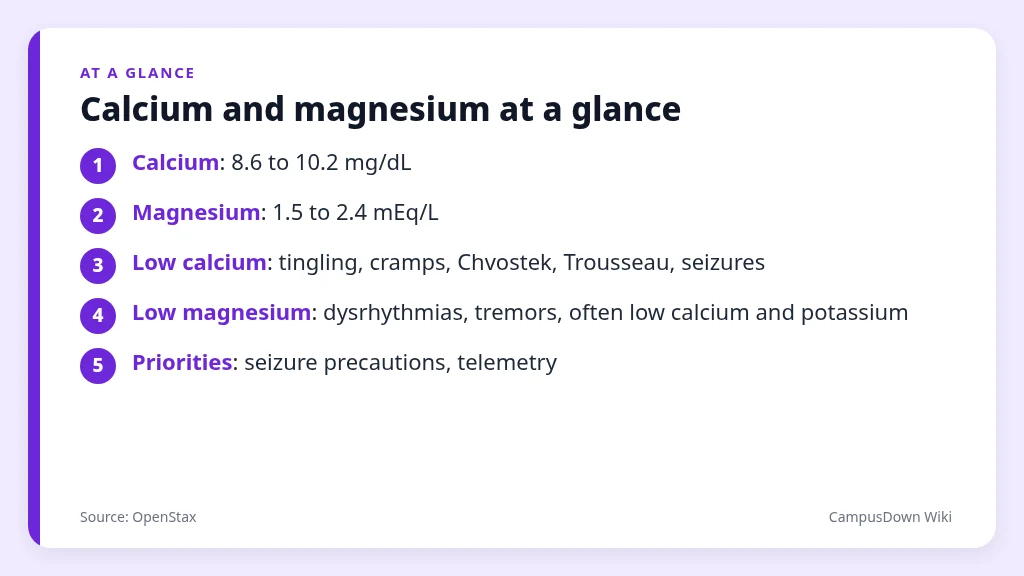
OpenStax says calcium normally ranges from 8.6 to 10.2 mg/dL (this may vary by institution) and magnesium typically from 1.5 to 2.4 mEq/L. Check your facility's reference ranges. For the full list, see the lab values cheat sheet.

Calcium: what it does
OpenStax says calcium is important for bones and teeth, nerve transmission and muscle contraction. Parathyroid hormone (PTH) is released when calcium is low and raises it by increasing reabsorption in the kidneys and gut and release from bone. Immobility releases calcium from bones; physical activity moves it into bone.
Hypocalcemia: causes and signs
OpenStax says low calcium can be caused by hypoparathyroidism, vitamin D deficiency and kidney disease, and that high phosphorus (as in kidney failure) can lower calcium. In early or gradual stages the patient may have no symptoms; acute or severe cases cause neuromuscular excitability. OpenStax lists:
- Paresthesia, especially around the lips, tongue, hands and feet
- Muscle cramps and tetany
- Dyspnea and hyperactive bowel sounds
- Seizures
- Positive Chvostek's sign: involuntary twitching of facial muscles when the facial nerve is tapped
- Positive Trousseau's sign: hand spasm after inflating a blood pressure cuff above systolic pressure for 3 minutes
Tests: serum calcium below 8.6 mg/dL, and an ECG may show a prolonged QT interval. Treatment may include lowering phosphorus if it's high, more dietary calcium and vitamin D, IV calcium replacement (calcium gluconate or calcium chloride) and treating the underlying cause.
Nursing care for hypocalcemia
OpenStax says nursing care focuses on monitoring and preventing complications, especially seizures. The main intervention is seizure precautions: pad the side rails and keep suction equipment within arm's reach, per hospital protocol. Teach patients about calcium-rich foods such as dairy, green leafy vegetables and whole grains. Evaluate for no seizure activity and a calcium level back in range. Don't try Trousseau's sign on a patient without your instructor, since it can be uncomfortable and your program will teach you when it is appropriate.
Get help now if
Seizures, severe muscle spasms, trouble breathing or a changing heart rhythm are emergencies. Call for help immediately and follow facility policy; stay with the patient.
Magnesium: what it does
OpenStax says magnesium is essential for cardiac, nerve, muscle and immune function, with about half stored in bone.
Hypomagnesemia
OpenStax says low magnesium typically results from inadequate dietary magnesium or loop diuretics, which increase magnesium loss in the urine; alcohol use disorder (poor diet and absorption) and long-term use of a proton pump inhibitor can also cause it. See furosemide and pantoprazole for those drug groups. Findings include cardiac dysrhythmias, leg cramps, lethargy and weakness, and tremors; the ECG may show premature ventricular contractions, flat or inverted T waves or a prolonged PR interval, and the serum level is below 1.5 mEq/L. Treatment may include more dietary magnesium and oral or IV magnesium; OpenStax mentions IV magnesium as a last-resort option for torsade de pointes.
Nursing care focuses on preventing deadly dysrhythmias: place the patient on continuous telemetry, monitor intake and output, give magnesium as ordered and monitor all electrolyte values, since they influence one another. OpenStax notes that low magnesium is often accompanied by low calcium and potassium, so watch for signs of those too. See ECG rhythm basics.
Hypermagnesemia
OpenStax says high magnesium usually results from kidney failure, excess magnesium replacement, or magnesium-containing laxatives or antacids. Early signs are muscle weakness and decreased reflexes; others include nausea, bradycardia and, at the extreme, asystole. Nursing care includes telemetry, intake and output, encouraging oral fluids where appropriate and teaching the patient to stop magnesium-containing medicines. OpenStax's drug table lists IV calcium gluconate as a medicine that decreases manifestations of hypermagnesemia by competing at cell receptors. Kidney links: AKI vs CKD.
Hypercalcemia in brief
OpenStax lists a calcium above 10.2 mg/dL, with constipation, increased thirst or urination, nausea and vomiting and skeletal muscle weakness, and says causes include prolonged immobilization, some cancers and parathyroid problems. Bone medicines such as alendronate work on bone breakdown; ask your instructor about their calcium effects.
Study tips
- Memorize the pair: low calcium = twitchy, high calcium = sluggish.
- Know Chvostek (face) and Trousseau (hand) and what each tests.
- Pair low magnesium with heart rhythm and low calcium with seizures.
- Remember the cluster: low magnesium often travels with low potassium and calcium.
Questions for your instructor
- What are our unit's reference ranges?
- When is telemetry ordered for electrolyte problems?
- How do we prepare seizure precautions at the bedside?
- Which medicines raise the risk of low magnesium?
- How would an exam question test Chvostek vs Trousseau?
Example scenario: the tingling lips
- Who
- Millicent, 23, a nursing student in Santa Fe, New Mexico, cared for a patient after neck surgery who said his lips and fingers felt tingly.
- What happened
- She remembered her notes but wasn't sure she should act on a small complaint.
- How it felt
- She felt a rush of nerves.
- What they did
- She told her nurse right away, who checked the chart and labs, informed the provider and set up seizure precautions at the bedside. Millicent wrote the cue-to-action list in her notes.
- How it turned out
- Millicent said small complaints are where nursing judgment starts.
This is an illustrative example, not a real patient or a review.
Millicent's story is an illustrative example. Real care follows your instructor, your facility and the provider's orders.
Most-asked questions about calcium and magnesium in nursing
What are hypocalcemia symptoms in nursing?
Tingling around the mouth and hands, cramps, tetany, positive Chvostek and Trousseau signs and seizures.
Why people ask: "hypocalcemia symptoms nursing" is #2 for "hypocalcemia signs nursing" (US autocomplete, November 2026).
What are hypocalcemia signs and symptoms in nursing?
Neuromuscular excitability: paresthesia, cramps, tetany, hyperactive reflexes, dyspnea, seizures and a prolonged QT on ECG.
Why people ask: "hypocalcemia signs and symptoms nursing" is #3 for "hypocalcemia signs nursing" (US autocomplete, November 2026).
What are the signs of low calcium?
Tingling, muscle cramps and spasms, and in severe cases seizures; report and follow orders.
Why people ask: "low calcium sign" is #5 for "hypocalcemia signs nursing" (US autocomplete, November 2026).
What are the nursing interventions for hypomagnesemia?
Continuous telemetry, intake and output, magnesium replacement as ordered and monitoring of other electrolytes.
Why people ask: "hypomagnesemia nursing interventions" is #1 for "hypomagnesemia nursing" (US autocomplete, November 2026).
What is the nursing diagnosis for hypomagnesemia?
Your program sets the wording; the main risk is cardiac dysrhythmias and injury from weakness or tremors.
Why people ask: "hypomagnesemia nursing diagnosis" is #2 for "hypomagnesemia nursing" (US autocomplete, November 2026).
How is hypomagnesemia managed in nursing?
Telemetry, replacement as ordered, diet teaching and watching related potassium and calcium levels.
Why people ask: "hypomagnesemia nursing management" is #4 for "hypomagnesemia nursing" (US autocomplete, November 2026).
What nursing considerations apply to hypomagnesemia?
Causes such as loop diuretics, alcohol use disorder and long-term PPI use; ECG monitoring and related electrolytes.
Why people ask: "hypomagnesemia nursing considerations" is #7 for "hypomagnesemia nursing" (US autocomplete, November 2026).
How do nurses assess for hypomagnesemia?
Heart rhythm and ECG, leg cramps, tremors, lethargy and weakness, and the serum level.
Why people ask: "hypomagnesemia nursing assessment" is #8 for "hypomagnesemia nursing" (US autocomplete, November 2026).
Related on CampusDown
You can learn more about the nursing student hub and check it for yourself in the lab values cheat sheet. For rhythm changes in detail, see ECG rhythm basics.
Frequently asked questions
- What is Chvostek's sign?
- Facial twitching when the facial nerve is tapped, a sign of hypocalcemia.
- What is Trousseau's sign?
- A hand spasm after a blood pressure cuff is inflated above systolic pressure for 3 minutes.
- What is the main nursing action for hypocalcemia?
- Seizure precautions, with monitoring and reporting.
- Why use telemetry for magnesium problems?
- Both low and high magnesium can cause dangerous heart rhythm changes.
- Which medicines can lower magnesium?
- Loop diuretics and long-term proton pump inhibitors, per OpenStax.
Calcium and magnesium problems show up in nerves, muscles and the heart. Know the signs, protect against seizures and dysrhythmias and report changes early.
Browse more guides like this in the Nursing Student and NCLEX hub.
This article is for general education and does not replace advice from your own doctor, nurse or pharmacist.