
Why do so many physical therapists and shoppers keep mentioning the "Nitro"? The Drive Medical Nitro is one of the most recognizable rollators in the U.S., with its big front wheels and curved frame. But a popular rollator is only safe if it fits your body and you follow its rules.

This guide pulls the facts in detail from Drive Medical's product page and specification sheet for item RTL10266 and its owner's manual, all checked in November 2026. It is not a sales review; we don't rate comfort or durability.
Model names and item numbers
- RTL10266: Nitro Aluminum Rollator, 10" casters, red frame.
- RTL10266BK: same rollator, black frame.
- The manual also lists -T item numbers (for example RTL10266-T), which retailers sell as the Nitro Tall. Check the tall version's own spec sheet for handle and seat heights; don't assume they match.

Specifications (standard RTL10266)
| Spec | Drive's listing |
|---|---|
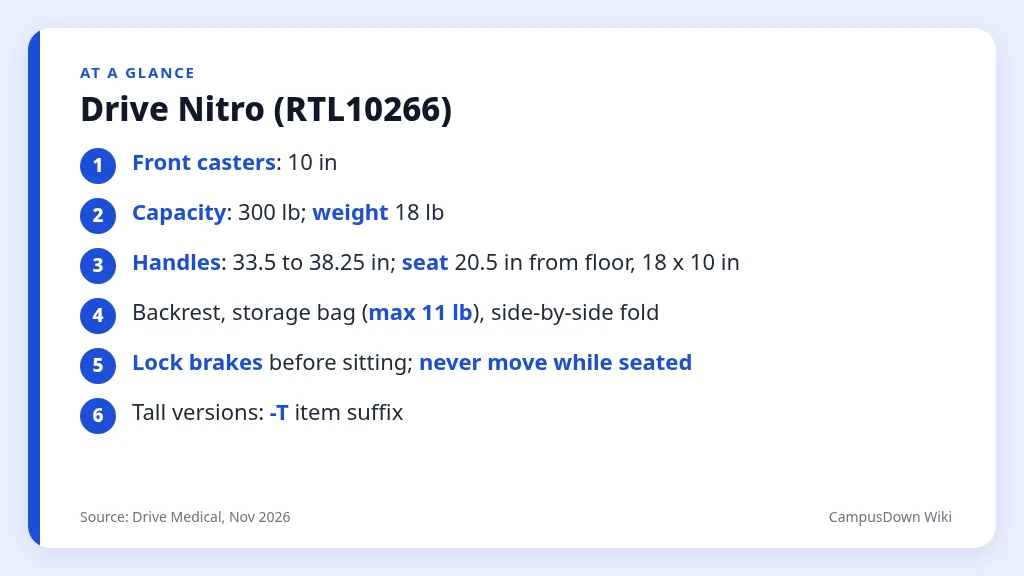
| Front casters | 10 inches |
| Weight capacity | 300 lb |
| Rollator weight | 18 lb |
| Handle height | 33.5" to 38.25" |
| Seat-to-floor height | 20.5" |
| Seat size | 18" W x 10" D |
| Bag maximum load | 11 lb (manual) |
| Warranty | Limited warranty; brake and handle housing 5 years (spec sheet); frame lifetime per manual |
Drive describes the Nitro as a Euro-style rollator with brake cables inside the frame, an adjustable contoured backrest, a cross-brace design, a clip hold and side-by-side folding, and a removable storage bag.
Will it fit you?
Before buying, take a closer look at the general walker rule from AAOS OrthoInfo: standing straight, the top of the handle reaches your wrist crease, with elbows slightly bent.
- If that height falls below 33.5" or above 38.25", the standard Nitro won't fit; ask about the tall version or another model.
- A 20.5" seat is about chair height for many adults. Sit on it in a store or with a therapist to see if your feet rest flat.
- At 300 lb capacity, users above that need a bariatric model.
How to use the brakes
From the owner's manual:
- To slow down while walking: pull both brake levers up. Brake slowly and steadily.
- To lock (parking): push both levers down. Pull up and release to unlock.
- Test the brakes regularly. Wheel wear can weaken braking.
- Adjusting: press the brake screw housing down and turn it left or right to change braking strength. If you're unsure, ask the supplier or a therapist.
Sitting safely
The manual is blunt:
- Put the Nitro on an even, solid surface.
2. Lock both brakes. It must not slip. 3. Sit straight; don't lean back. 4. Do not move the rollator while seated. It is a walking aid, not a transport device. 5. Don't use the seat on an incline or uneven ground.
Other manual warnings: make sure it is fully opened with the folding bar locked down, keep both handle knobs tight and equal, and avoid leaving it in heat above 104°F for long periods.
Folding and carrying
Pull up the seat handle to fold the frame side to side, then secure it with the red safety clasp. At 18 lb, many caregivers can lift it into a trunk, but have a plan if you can't lift that much yourself.
Medicare and buying
Medicare.gov says Part B covers walkers, including rollators, for eligible people when a doctor orders one for home use. You generally pay 20% after the deductible with a supplier that accepts assignment. Prices vary; Drive's site shows pricing only to signed-in dealers, so compare retailers and Medicare suppliers.
Example scenario: the hill to the bakery
- Who
- Marjorie, 80, a retired church organist in Pittsburgh, had walked to the same bakery every Saturday for thirty years. After a bout of pneumonia, her legs tired halfway up the hill, and her old two-wheel walker snagged on every sidewalk crack.
- What happened
- She started skipping the walk. Without it, she saw fewer neighbors and spent more of the weekend in her chair.
- How it felt
- Marjorie felt her world shrinking and was quietly frightened that this was "the beginning of the end." She also didn't trust wheels, and pictured a rollator running away downhill.
- What they did
- Her physical therapist measured her wrist crease at about 35 inches, well inside the Nitro's range. They practiced brakes for two sessions: up to slow, down to park, and down before every sit. Her doctor wrote an order and a Medicare supplier provided one.
- How it turned out
- By the third Saturday, Marjorie made it to the bakery, resting on the seat at the halfway bench with the brakes locked. She keeps her purchases under the bag limit and says the big wheels made the cracks "stop being enemies."
This is an illustrative example, not a real patient or a review.
Marjorie is an illustrative example. A therapist should fit and train you on any rollator.
Most-asked questions about the Drive Nitro rollator
What are the Drive Nitro rollator specifications?
10-inch front casters, 300 lb capacity, 18 lb weight, 33.5 to 38.25 inch handles, 20.5 inch seat height and an 18 x 10 inch seat, per Drive's listing for RTL10266.
Why people ask: "drive nitro rollator specifications" is #7 for "drive nitro rollator" (US autocomplete, November 2026).
How much does the Drive Nitro rollator weigh?
Drive lists 18 lb for RTL10266, with a 21.5 lb carton shipping weight.
Why people ask: "drive nitro rollator weight" is #9 for "drive nitro rollator" (US, November 2026).
Is there a tall Nitro rollator?
Yes. The manual lists -T item numbers, sold as the Nitro Tall. Check its own spec sheet for heights.
Why people ask: "nitro rollator tall" is #6 for "nitro rollator" (US, November 2026).
How do you adjust the brakes on a Nitro rollator?
The manual says to press the brake screw housing down and turn it left or right to change braking strength, then test the brakes.
Why people ask: "nitro rollator brake adjustment" is #8 for "nitro rollator" (US, November 2026).
Where can I get Drive Nitro rollator parts?
Drive's product page links a Parts Finder, and lists accessories such as a Nitro cup holder (10266-CH).
Why people ask: "drive nitro rollator parts list" is #3 for "drive nitro rollator" (US, November 2026).
Related on CampusDown
Not sure you need a rollator at all? Learn more in walker vs rollator and cane height and use. You can check it for yourself at home with our fall prevention checklist, and build leg strength with balance exercises.
Frequently asked questions
- Can someone push me in a Nitro rollator?
- No. The manual says do not move the rollator while seated; use a transport chair.
- Can I hang groceries on the Nitro?
- Use the bag only for objects and don't overload it; the manual sets an 11 lb maximum. Heavy bags on handles can tip a rollator.
- Is the Nitro good for indoors?
- The manual says it suits indoor and outdoor use, but check that it fits through doorways and turns in your bathroom before buying.
The Nitro's big wheels and light frame suit many active older adults, but fit and brake habits matter more than the brand. Get measured, practice the brakes, and talk to your doctor or physical therapist before you buy.
Browse more guides like this in the Home Medical Devices hub.
This article is for general education and does not replace advice from your own doctor, nurse or pharmacist.