
Can you stand on one foot long enough to pull on a sock? If that question makes you smile nervously, you're not alone. Balance quietly fades with age and inactivity, and most people don't notice until they wobble on a curb. The encouraging part is that balance is trainable, at almost any age.
This guide is built on the National Institute on Aging (NIA) exercise guidance and the U.S. Preventive Services Task Force (USPSTF) 2024 recommendation, checked in November 2026. It is a starting point, not a personal prescription. Talk to your doctor before starting, especially if you have fallen, feel dizzy, or have heart, joint or nerve problems.
Why balance work matters
- The NIA says older adults need three types of activity: aerobic, muscle-strengthening and balance. Balance exercises help prevent falls and fall-related injuries.
- The USPSTF recommends exercise interventions to prevent falls in community-dwelling adults 65 and older who are at increased risk (Grade B). The most common program components were gait, balance and functional training, followed by strength work.
- In the studies USPSTF reviewed, the most common pattern was 2 to 3 sessions per week for 12 months. Benefits come from consistency.

How often
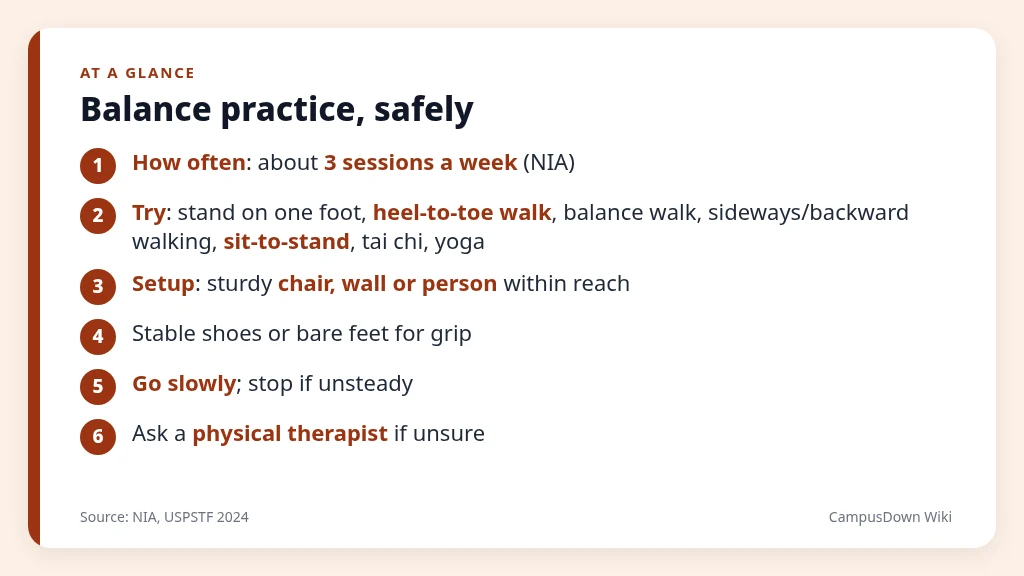
The NIA suggests aiming for about three sessions of balance exercises a week, alongside working up to 150 minutes of moderate aerobic activity and muscle-strengthening work. Balance practice can be short; many people fold it into daily routines.
Set up a safe practice spot
Use the NIA safety tips:
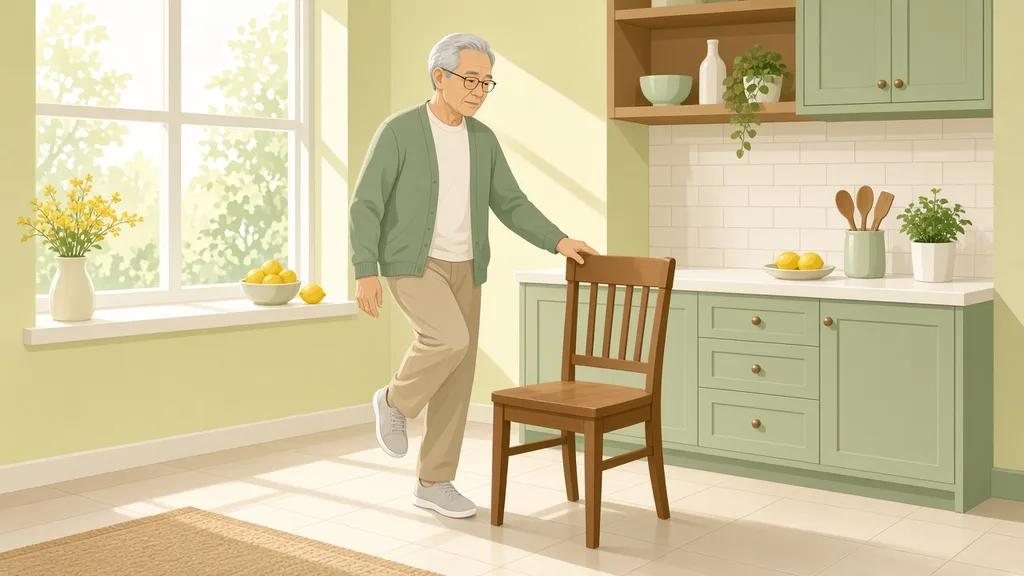
- Have a sturdy chair, a person or a wall nearby to hold for support. A kitchen counter works well.
- Wear comfortable, stable footwear, or go barefoot for grip on a non-slip floor or mat.
- Go slowly and mindfully.
- Listen to your body. If you feel unsteady, steady yourself right away.
- If you're unsure about a movement, ask your doctor or physical therapist.
Clear the area of rugs and clutter first; see our fall prevention checklist.
The NIA's balance exercise examples
Below, each example from the NIA list is described with a cautious starting version. A physical therapist can show you each one in detail and set your level.
1. Standing from a sitting position
Sit near the front of a sturdy chair without wheels, feet flat. Lean slightly forward and stand up, using your hands only as much as you need. Sit back down slowly. This builds the leg strength you use every time you get off the toilet or out of a car.
2. Standing on one foot
Stand behind a sturdy chair with both hands on its back. Lift one foot slightly and hold, then switch. As it gets easier, use one hand, then a fingertip.
3. The heel-to-toe walk
Next to a counter or wall, place the heel of one foot just in front of the toes of the other, then step again. Look ahead, not down. This trains balance on a narrow base, like a curb edge.
4. The balance walk
Walk slowly in a straight line beside a wall or counter, focusing on steady, controlled steps.
5. Walking backward or sideways
With a hand on the counter, take slow steps sideways along it, then a few steps backward. Small steps; no rushing.
6. Tai chi and yoga
Tai chi is a slow "moving meditation" that the NIA lists as a balance activity. Learn more in tai chi for fall prevention. Gentle or chair yoga can help too.
7. Wobble board
The NIA lists it, but it's an advanced tool. Use one only after a therapist says you're ready, and with support in reach.
How to progress safely
- Change one thing at a time: less hand support, a longer hold, or eyes on a fixed point farther away.
- Never progress to standing in the middle of the room alone if you've had recent falls.
- Pair balance work with strength exercises; weak legs are a fall risk on their own. See sarcopenia.
When to see a physical therapist
Ask your doctor for a referral if you've fallen, use a cane or walker, feel dizzy, have numb feet, or are recovering from surgery or a stroke. The USPSTF notes effective programs include supervised individual physical therapy and group classes. Medicare Part B covers outpatient physical therapy that your doctor or therapist certifies as medically necessary; check your plan.
Get help now if
Stop and seek care if exercise causes dizziness, chest pain or pressure, or nausea, warning signs the NIA lists for activity. Dizziness when standing up can be orthostatic hypotension.
Example scenario: the kitchen counter routine
- Who
- Percy, 74, a retired accountant in Sacramento, noticed he grabbed the door frame when pulling on his shoes and wobbled stepping off curbs.
- What happened
- He'd been a weekend golfer until a back injury two years earlier, and since then he'd mostly sat. A near-fall in a parking lot left him gripping his wife's arm.
- How it felt
- He felt old for the first time, and irritated. He'd always been the steady one in the family, and now his grandkids watched him on stairs.
- What they did
- His doctor referred him to a physical therapist, who gave him a kitchen-counter routine: sit-to-stands, one-foot holds with fingertips on the counter, and heel-to-toe steps along the counter edge. He did it while the coffee brewed, three or four mornings a week, and joined a weekly community tai chi class.
- How it turned out
- After three months, Percy could put on his shoes standing at the counter and stepped off curbs without reaching for anyone. He still keeps a hand near the counter for the hardest moves, because his therapist said that's not cheating; it's how you practice without falling.
This is an illustrative example, not a real patient or a review.
Percy is an illustrative example. Your program should come from your doctor or physical therapist.
Most-asked questions about balance exercises for seniors
What are good balance exercises for seniors at home?
The NIA lists standing on one foot, heel-to-toe walking, the balance walk, walking sideways or backward, sit-to-stand and tai chi or yoga, with a sturdy chair or counter nearby.
Why people ask: "balance exercises for seniors at home" is #2 for "balance exercises for seniors" (US autocomplete, November 2026).
Do balance exercises prevent falls in seniors?
The USPSTF found with moderate certainty that exercise interventions provide a moderate net benefit in preventing falls in adults 65+ at increased risk.
Why people ask: "balance exercises for seniors to prevent falls" is #7 for "balance exercises for seniors" (US, November 2026).
Are there balance exercises for the elderly with pictures or a PDF?
The NIA points to workout videos on its YouTube channel, and the CDC STEADI site has a Chair Rise Exercise handout. Ask your therapist for a printed plan.
Why people ask: "balance exercises for seniors pdf" is #3 for "balance exercises for seniors" (US, November 2026).
What exercises help balance problems?
Balance training helps many people, but dizziness or vertigo has causes your doctor should check. NIA notes a therapist can design exercises for some balance disorders.
Why people ask: "exercises for balance problems" is #5 for "exercises for balance" (US, November 2026).
Related on CampusDown
If you use a cane, check it for yourself with cane height and use. Worry about falling can stop you from practicing; take a closer look at fear of falling.
Frequently asked questions
- How long until balance improves?
- It varies. USPSTF studies usually ran exercise programs for months, most often 12. Consistency matters more than intensity.
- Is it safe to do balance exercises alone?
- With a sturdy support within reach and starting easy, many people can. If you've fallen recently, practice with a therapist or another person first.
- Should I do balance exercises if I use a walker?
- Possibly, but ask your physical therapist which ones are safe for you.
Balance is a skill you can rebuild a few minutes at a time. Set up a safe spot, practice about three times a week, add strength and walking, and talk to your doctor or physical therapist about the right level for you.
Browse more guides like this in the Senior Health and Medicare hub.
This article is for general education and does not replace advice from your own doctor, nurse or pharmacist.