
Can a slow, quiet exercise really help you stay on your feet? Tai chi looks gentle, almost like dancing underwater. Yet NCOA notes that many studies have shown tai chi to be one of the most effective exercises for preventing falls.
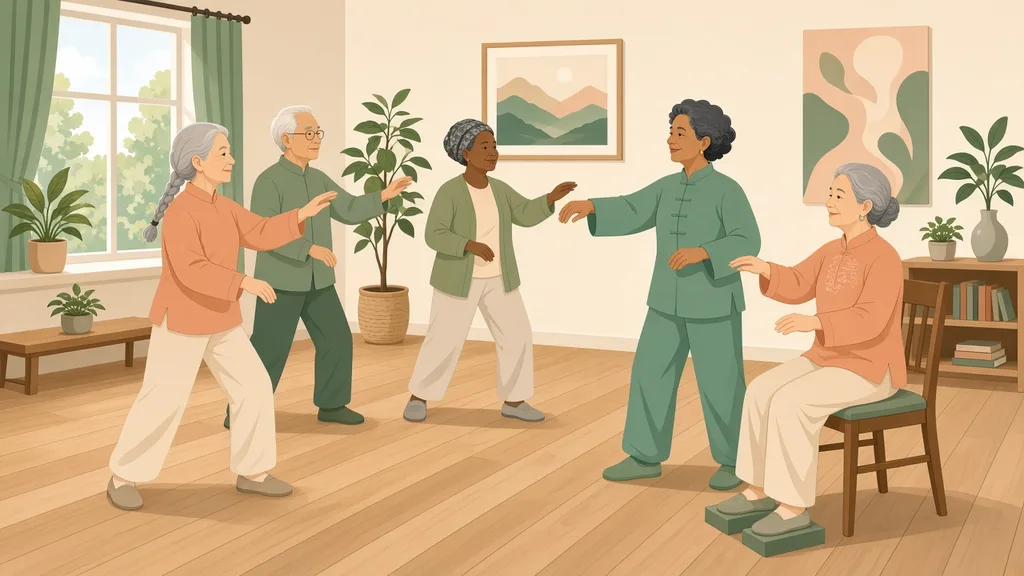
This guide pulls together findings from the National Center for Complementary and Integrative Health (NCCIH) at NIH, the National Institute on Aging (NIA), the U.S. Preventive Services Task Force (USPSTF) and the National Council on Aging (NCOA), checked in November 2026. It explains in detail what tai chi can and can't do. Talk to your doctor before starting, especially if you've had recent falls, dizziness or joint surgery.
What tai chi is
NCCIH describes tai chi as a series of slow, gentle movements and postures, with a meditative state of mind and controlled breathing. It began as a martial art in China and has shifted toward health and rehabilitation. The NIA calls it a "moving meditation" and lists it among recommended balance exercises.
Every movement involves shifting weight smoothly from one leg to the other, turning the trunk and stepping in different directions.

What the evidence shows
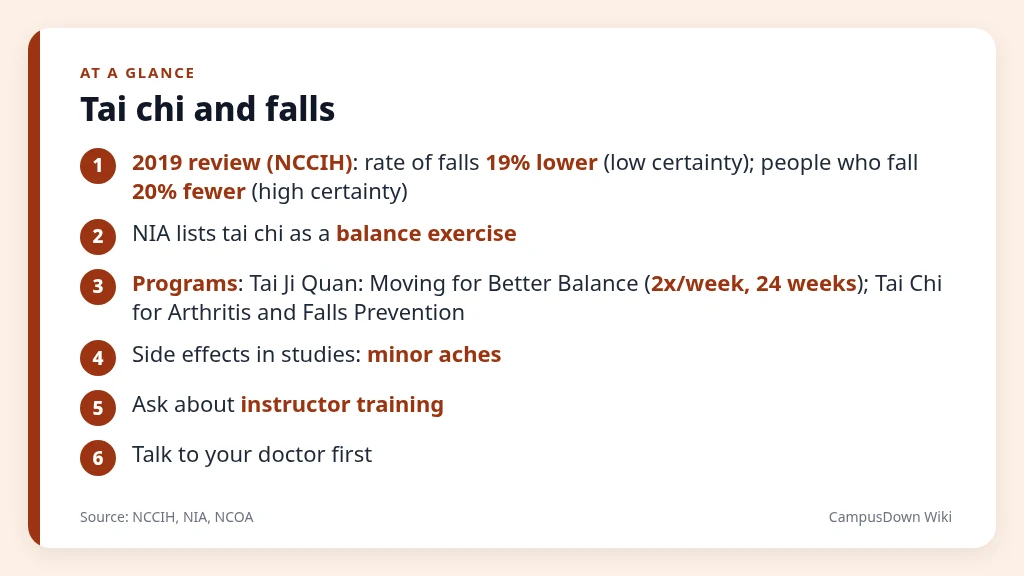
NCCIH summarizes a 2019 review of exercise for preventing falls in community-dwelling older people. Compared with control interventions not thought to reduce falls:
- Tai chi may reduce the rate of falls by 19% (low-certainty evidence; 7 studies, 2,655 participants).
- Tai chi may reduce the number of people who fall by 20% (high-certainty evidence; 8 studies, 2,677 participants).
NCCIH also says tai chi may help balance and falls in people with Parkinson's disease, though certainty varies, and it is unknown whether it reduces falls after stroke or in osteoarthritis or heart failure. For knee osteoarthritis, updated 2019 American College of Rheumatology and Arthritis Foundation guidelines strongly recommend tai chi.
The USPSTF's broader 2024 recommendation supports exercise interventions for adults 65+ at increased risk of falls, with gait, balance and functional training the most common components.
Recognized programs
NCOA lists evidence-based falls prevention programs, including two tai chi programs:
| Program | Format (per NCOA) | Notes |
|---|---|---|
| Tai Ji Quan: Moving for Better Balance | Two 1-hour sessions a week for 24 weeks | In person at home or in the community, or online |
| Tai Chi for Arthritis and Falls Prevention | Group classes by trained instructors | Aimed at strength, flexibility, balance and stamina for people with arthritis |
Your local Area Agency on Aging, senior center, YMCA or hospital wellness program may host these. Ask whether a class is one of the recognized programs.
Is it safe?
NCCIH reports that in a 2019 review of 24 studies, adverse events were similar between tai chi, other active interventions and no intervention. Events linked to tai chi were minor, such as musculoskeletal aches and pain.
To keep it safe:
- Start with a beginner or seated class. Chair tai chi lets you learn arm and trunk movements while your balance improves.
- Keep a chair nearby at home practice, just like the NIA's other balance exercises.
- Don't push into pain, particularly in knees and hips. Keep knees soft and stances short.
- Tell the instructor about joint replacements, osteoporosis, dizziness or neuropathy.
Choosing an instructor
NCCIH notes that tai chi organizations offer different training and certification programs, so ask about the instructor's training and experience. Questions to ask:
- Is this a recognized program like Tai Ji Quan: Moving for Better Balance or Tai Chi for Arthritis and Falls Prevention?
- Have you taught older adults with balance problems?
- Is there a seated option?
Example scenario: the class she almost skipped
- Who
- Imogene, 70, a retired dental hygienist in Portland, Maine, broke her wrist slipping on ice the winter before. After the cast came off, her doctor mentioned a tai chi class at the senior center.
- What happened
- She signed up but nearly didn't go. She pictured a room of graceful experts and herself wobbling at the back.
- How it felt
- Since the fracture she'd felt brittle, and anxious every time she stepped off a curb. She was embarrassed that a single slip had made her so timid.
- What they did
- The instructor, trained in Tai Ji Quan: Moving for Better Balance, started her with short stances and let her hold a chair back for the first two weeks. Imogene went twice a week, every week, and practiced a few movements while her kettle boiled.
- How it turned out
- By the end of the 24-week program, she walked across her icy driveway with confidence and had signed up for the next session. She says the biggest change wasn't her legs but her head: she trusted her feet again.
This is an illustrative example, not a real patient or a review.
Imogene is an illustrative example. Results vary, and your doctor can advise you.
Most-asked questions about tai chi for fall prevention
Does tai chi help with fall prevention in the elderly?
A 2019 review reported by NCCIH found tai chi may reduce the number of older people who fall by 20% (high certainty) and the rate of falls by 19% (low certainty).
Why people ask: "tai chi for fall prevention in the elderly" is #5 for "tai chi fall prevention" (US autocomplete, November 2026).
Is tai chi good for arthritis and fall prevention?
NCOA lists Tai Chi for Arthritis and Falls Prevention as an evidence-based program, and 2019 ACR/Arthritis Foundation guidelines strongly recommend tai chi for knee osteoarthritis.
Why people ask: "tai chi for fall prevention and arthritis" is #4 for "tai chi fall prevention" (US, November 2026).
Is tai chi good for seniors who are beginners?
Yes, with a beginner or seated class and a trained instructor. Studies report mostly minor aches.
Why people ask: "tai chi for seniors beginners" is #8 for "tai chi for seniors" (US, November 2026).
Are there tai chi chair exercises for seniors?
Many classes offer seated versions, which help you learn movements safely while balance improves.
Why people ask: "tai chi chair exercises for seniors" is #8 for "tai chi" (US, November 2026).
Related on CampusDown
Pair tai chi with the home routine in balance exercises for seniors. To learn more about making your home safer, see our fall prevention checklist, and take a closer look at worry-driven inactivity in fear of falling.
Frequently asked questions
- How often should I do tai chi?
- Tai Ji Quan: Moving for Better Balance runs twice a week for 24 weeks; NCCIH notes session frequency varied across studies.
- Can I learn tai chi from videos?
- Videos can help you practice, but an in-person instructor can correct your stance and adjust for joint problems.
- Is tai chi enough on its own?
- Many people combine it with strength work, walking, a medicine review and home fixes. Ask your doctor about your overall fall risk.
Tai chi is slow, social and backed by solid evidence for preventing falls. Find a recognized program, start seated if you need to, and stick with it for months, not weeks. Talk to your doctor first if you have joint, heart or balance problems.
Browse more guides like this in the Senior Health and Medicare hub.
This article is for general education and does not replace advice from your own doctor, nurse or pharmacist.