
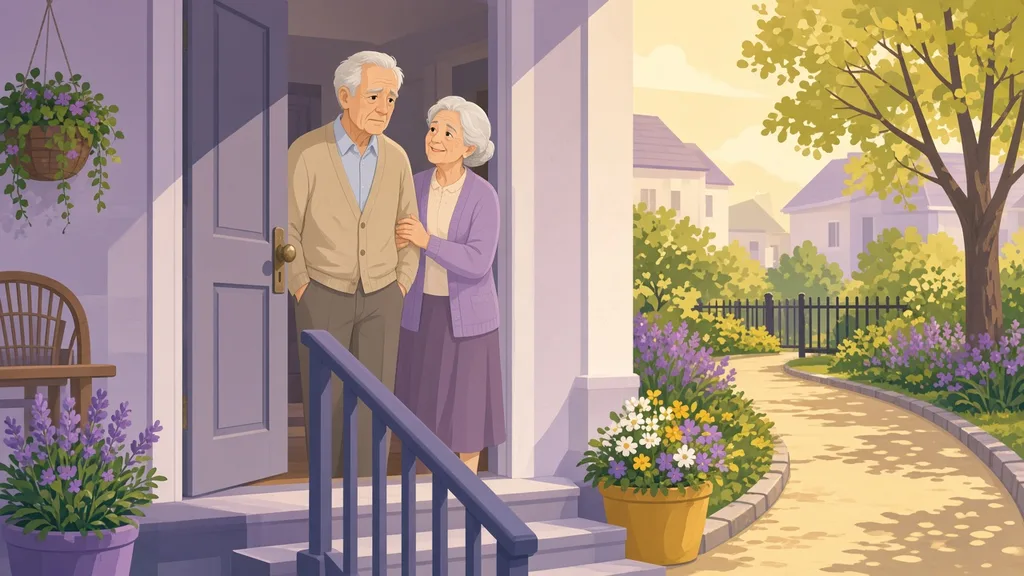
When did your father last walk to the mailbox? If he has started saying "maybe tomorrow" to walks, church or the grocery store, the problem may not be his legs. It may be fear. Fear of falling is common, understandable and, left alone, one of the quieter ways older adults lose independence.
This guide uses the CDC, the National Institute on Aging (NIA) and the National Council on Aging (NCOA), checked in November 2026. It explains in detail why fear matters and what helps, for the person who's afraid and for the family watching.
Why fear of falling matters
The NIA says many older adults fear falling, even if they haven't fallen before, and that the fear can lead them to avoid walking, shopping or social activities.
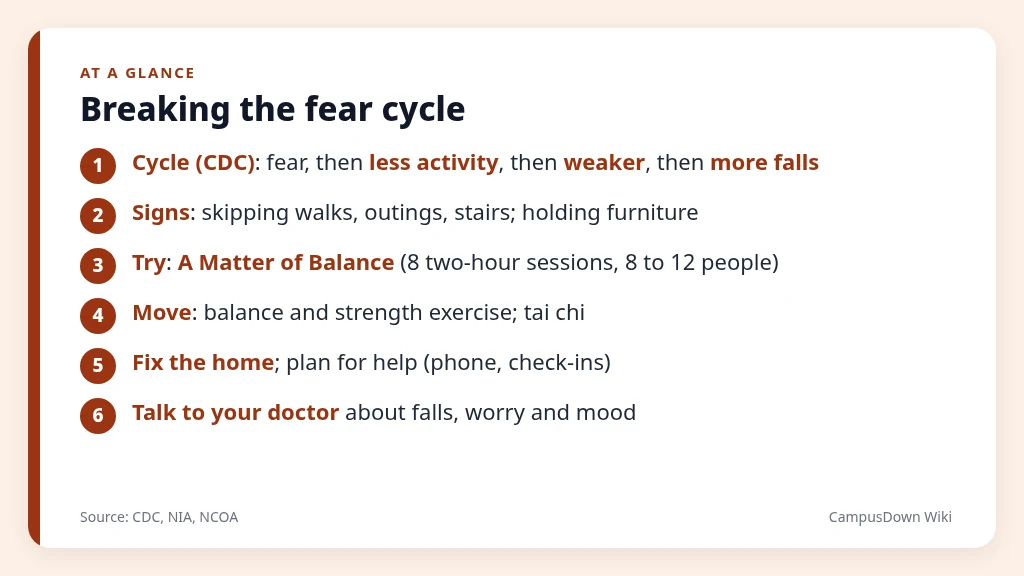
The CDC describes the cycle:
- Many people who fall, even without injury, become afraid of falling.
2. The fear causes them to cut down on everyday activities. 3. Being less active makes them weaker. 4. Weakness increases the chance of falling.
The NIA's message is direct: don't let a fear of falling keep you from being active. Staying active is important to keeping your body healthy and actually helps prevent falls.

Signs to watch for in a parent
- Skipping walks, outings, church or clubs they used to enjoy.
- Avoiding stairs, the shower or the yard.
- Holding furniture and walls when moving around the house. The CDC's Stay Independent checklist includes both "I am worried about falling" and "I steady myself by holding onto furniture."
- Saying "I'm just tired" more often, or seeming low. Sadness is also on the CDC checklist; see depression.
What helps
1. Name it and tell the doctor
Fear isn't silly, and it's worth raising at any appointment. The NIA advises telling your doctor about every fall. The doctor can look for causes, such as medicines, blood pressure drops (orthostatic hypotension), vision or foot problems, and can refer to physical therapy. If worry is constant or spills into other parts of life, ask about anxiety; see generalized anxiety disorder.
2. Join A Matter of Balance
NCOA lists A Matter of Balance as an evidence-based program designed to reduce fear of falling and increase activity:
- Eight two-hour classes, for a small group of 8 to 12 participants, led by trained coaches.
- Participants learn to view falls and fear of falling as controllable, set realistic activity goals, make small changes to reduce home fall risks, and exercise to build strength and balance.
- It's aimed at adults who have started to restrict their activity because of concern about falling and who live independently in the community.
Ask your local Area Agency on Aging, senior center or hospital where it runs near you.
3. Build strength and balance, safely
Confidence follows capability. Start with a supported routine from balance exercises for seniors or a beginner class from tai chi for fall prevention. A physical therapist can set a safe level.
4. Make the home trustworthy
Fear eases when the environment is safer. Use our fall prevention checklist: handrails, night lights, grab bars, clear floors.
5. Have a plan for "what if"
Much of the dread is about lying on the floor alone. Learn how to get up after a fall, keep a charged phone on you, and set up daily check-ins. Some families use a medical alert device or a smartwatch with fall detection.
How families can help without hovering
- Ask, don't announce. "What would make walking to the park feel safer?" works better than "You need a walker."
- Walk with them at first, then gradually step back.
- Celebrate small wins, like the first solo trip to the mailbox.
- Avoid taking over every task. Doing everything for someone can feed the cycle the CDC describes.
Example scenario: the front door
- Who
- Bertram, 81, a retired railroad dispatcher in Omaha, slipped on wet leaves on his porch last fall. He wasn't hurt, but he stopped going on his morning walks with his wife Loretta.
- What happened
- Over the winter he stopped driving to his weekly coffee group, then stopped going down to the basement workshop. He spent most days in his recliner.
- How it felt
- Bertram told Loretta he was "just taking it easy." Privately, he was frightened every time he looked at the porch steps, and ashamed that a fall that didn't even hurt him had changed so much. Loretta felt helpless and lonely, watching him shrink.
- What they did
- At his checkup, Loretta mentioned the change. His doctor found his legs had weakened noticeably and referred him to physical therapy and an A Matter of Balance class at the library. Their son added a second porch handrail and motion lights. In class, Bertram heard others describe the same fear, and practiced getting up from the floor with a coach.
- How it turned out
- By late spring he was walking around the block with Loretta again, using the handrail every time. He went back to his coffee group, where he admitted to the guys that the class "was the best thing I didn't want to do."
This is an illustrative example, not a real patient or a review.
Bertram and Loretta are illustrative examples. A doctor can help decide what fits your situation.
Most-asked questions about fear of falling
Why do elderly people develop a fear of falling?
It can follow a fall, even one without injury, or develop without any fall at all. The NIA notes many older adults fear falling even if they haven't fallen.
Why people ask: "fear of falling elderly" is #1 for "fear of falling elderly" (US autocomplete, November 2026).
How do you overcome fear of falling in the elderly?
Combine a program like A Matter of Balance with strength and balance exercise, home safety fixes, a plan for getting help, and a doctor's review of causes.
Why people ask: "overcoming fear of falling in elderly" is #7 for "fear of falling elderly" (US, November 2026).
Does fear of falling restrict mobility in elderly fallers?
Yes. The CDC says fear leads people to cut down on everyday activities, which weakens them and raises fall risk.
Why people ask: "fear of falling and restriction of mobility in elderly fallers" is #9 for "fear of falling elderly" (US, November 2026).
How does fear of falling affect elderly people with dementia?
People with dementia may not explain their fear clearly; watch for avoiding stairs or clinging to furniture, and ask their doctor about a supervised exercise plan.
Why people ask: "fear of falling elderly dementia" is #2 for "fear of falling elderly" (US, November 2026).
Related on CampusDown
Isolation brings its own health risks; learn more in social isolation. To check the steps for yourself, see getting up after a fall.
Frequently asked questions
- Is fear of falling a diagnosis?
- It's a recognized problem clinicians ask about, and it appears on the CDC's Stay Independent checklist. Tell your doctor if it's limiting your life.
- Will using a cane or walker make me more dependent?
- A properly fitted aid can let you stay active. Ask a therapist; see our walker vs rollator guide.
- How long is A Matter of Balance?
- Eight two-hour sessions, according to NCOA.
Fear of falling is a reasonable feeling with an unreasonable cost if it keeps you home. Name it, take a closer look at its causes with your doctor, join a program, and rebuild strength one safe step at a time.
Browse more guides like this in the Senior Health and Medicare hub.
This article is for general education and does not replace advice from your own doctor, nurse or pharmacist.