
Your doctor says your LDL is too high and writes a prescription for a statin. Then you read the pharmacy handout, scroll through a few forums and wonder whether the muscle aches you've heard about are in your future. What does the evidence on the label actually say?

This guide covers atorvastatin, sold as Lipitor, using MedlinePlus's atorvastatin drug information page and the FDA-approved Lipitor prescribing information (revised April 2024; FDA notes the posted version may not be the latest). It is general education, not personal advice. Don't start, stop or change a statin on your own, and use this page to prepare questions, not to pick a dose. To learn more about each point, take a closer look at the sections below.
What atorvastatin is for
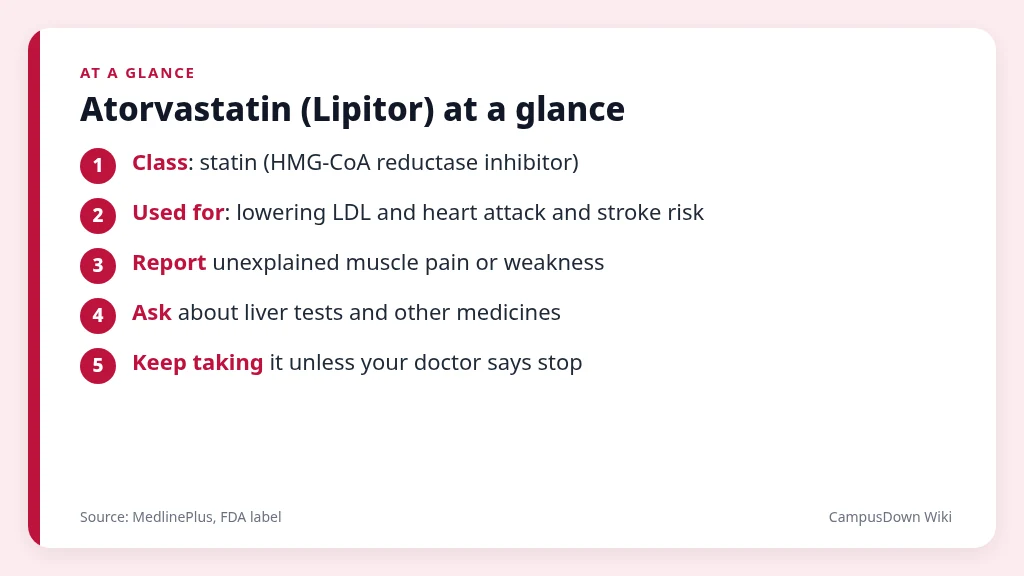
MedlinePlus says atorvastatin is used to reduce the risk of heart attack and stroke and to decrease the amount of cholesterol in the blood. It belongs to a class called HMG-CoA reductase inhibitors, or statins, which work by slowing how much cholesterol your body makes. MedlinePlus's cholesterol medicines page adds that statins also increase the liver's ability to remove LDL cholesterol already in the blood. That lowers the amount that can build up on artery walls and block blood flow to the heart, brain and other parts of the body.
The FDA label describes it as an HMG-CoA reductase inhibitor (statin) indicated to reduce the risk of heart attack, stroke, revascularization procedures and angina in adults with multiple risk factors for coronary heart disease or with established disease, and as an add-on to diet to lower LDL cholesterol in several conditions. For background on the number your doctor is watching, see LDL cholesterol.

How it's taken (in general terms)
MedlinePlus says the tablet is taken once a day with or without food, at around the same time every day, and the liquid suspension on an empty stomach. It says to take it exactly as directed, continue even if you feel well and not stop without talking to your doctor, and that a doctor may start with a low dose and increase gradually. The label says LDL cholesterol may be rechecked as early as four weeks after starting. Your prescriber chooses the dose for you; this page doesn't.
A missed tablet: MedlinePlus says to skip it and continue your regular schedule, and not to double up.
The muscle question
Muscle aches are the side effect people talk about most. The FDA label's warning is specific: statins can cause myopathy and rhabdomyolysis, and patients should promptly report unexplained muscle pain, tenderness or weakness, particularly if accompanied by malaise or fever. Risk factors the label lists include age 65 or older, uncontrolled hypothyroidism, kidney impairment, certain other medicines and higher doses. The label says the medicine should be stopped if markedly elevated CK levels occur or myopathy is diagnosed or suspected, and that it may need to be paused during an acute serious illness at high risk of kidney failure. Those decisions belong to a clinician.
MedlinePlus lists muscle pain, tenderness or weakness, extreme tiredness, fever or flu-like symptoms, dark-colored urine, nausea, yellowing of the skin or eyes, and pain in the upper right abdomen among the symptoms to report right away, and says milder effects such as diarrhea, heartburn, gas, joint pain, forgetfulness and confusion should be mentioned if severe or persistent.
Get help now if
Call your doctor promptly for unexplained muscle pain, tenderness or weakness, especially with fever or unusual tiredness, and get emergency help for trouble breathing, swelling of the face or throat or chest pain. Don't wait for your next appointment.
Liver, memory and blood sugar notes
- Liver: the label says increases in liver enzymes have occurred, with rare reports of liver failure, and advises considering liver enzyme tests before starting and as clinically indicated afterward. MedlinePlus says to tell your doctor if you have or have had liver disease, and to watch for yellowing of the skin or eyes and dark urine.
- Memory: the label says there have been rare reports of cognitive impairment such as memory loss and confusion with statins, generally nonserious and reversible after stopping. If you notice changes, tell your prescriber rather than stopping on your own.
- Blood sugar: the label says increases in HbA1c and fasting glucose have been reported with statins, so people with diabetes or prediabetes should discuss monitoring. See diabetes in older adults.
Other medicines, grapefruit and alcohol
MedlinePlus says to tell your doctor and pharmacist about all prescription and nonprescription medicines, vitamins, supplements and herbal products, and names cimetidine and niacin as nonprescription products that may interact. The label says some other drugs and large quantities of grapefruit juice (more than 1.2 liters daily) can raise the risk of muscle problems, and it notes interactions with digoxin and oral contraceptives. MedlinePlus says to talk to your doctor about grapefruit and about alcohol, since alcohol can increase the risk of serious side effects, and to mention it if you drink more than two alcoholic beverages a day.
A brown bag medicine review helps your pharmacist catch interactions. If you also take heart or blood pressure medicines, such as lisinopril or losartan, make sure every prescriber sees the full list.
Pregnancy and breastfeeding
Both sources say atorvastatin may harm a fetus and that breastfeeding is not recommended during treatment. MedlinePlus says to tell your doctor if you are pregnant or plan to be, and to call your doctor right away if you become pregnant while taking it. If this applies to you, ask for guidance early.
Statins and heart conditions
Statins are often part of a bigger plan for people at risk of heart disease or with conditions such as heart failure or atrial fibrillation. Your clinician will weigh benefits and risks based on your history. Keep taking it as directed, and ask what results would tell you the plan is working.
Questions to bring to your appointment
- What is my cholesterol goal, and how will we check progress?
- Which side effects should make me call right away, and who should I call?
- Do I need liver or other lab tests, and when?
- Do any of my other medicines, supplements or foods interact?
- What if I get muscle aches? Please don't let me stop without a plan.
- Does my blood sugar need extra monitoring?
Example scenario: the weekend ache
- Who
- Jerome, 61, a high school custodian in Dayton, Ohio, started atorvastatin after his cholesterol and family history worried his doctor.
- What happened
- A few weeks later his calves ached after a weekend of yard work, and a coworker told him that statins "wreck your muscles."
- How it felt
- He felt nervous and tempted to quit the pills, but he also didn't want to ignore a real warning.
- What they did
- He called his clinic, described when the ache started, how bad it was and whether there was fever or dark urine, and listed everything he took. The nurse relayed his answers to the prescriber, who arranged a check-in rather than telling him to guess.
- How it turned out
- Jerome said it felt good to have a plan other than stopping or toughing it out.
This is an illustrative example, not a real patient or a review.
Jerome's story is an illustrative example. Decisions about your statin are made with your own clinician.
Most-asked questions about atorvastatin
Are there long term side effects of atorvastatin?
The label describes muscle, liver, memory and blood sugar effects to watch for; ask your prescriber how you will be monitored over time.
Why people ask: "atorvastatin side effects long term" is #10 for "atorvastatin side effects" (US autocomplete, November 2026).
Are atorvastatin side effects different in women?
The sources used here describe adults generally. Both flag pregnancy and breastfeeding; ask your prescriber about your own risk factors.
Why people ask: "atorvastatin side effects in females" is #2 for "atorvastatin side effects" (US autocomplete, November 2026).
Are atorvastatin side effects different in men?
The FDA label lists risk factors such as age 65 or older and kidney or thyroid conditions rather than sex; ask about your own.
Why people ask: "atorvastatin side effects in men" is #3 for "atorvastatin side effects" (US autocomplete, November 2026).
What are atorvastatin side effects in the elderly?
The label lists age 65 or older as a risk factor for muscle problems, and MedlinePlus asks you to mention age 65 or older to your doctor.
Why people ask: "atorvastatin side effects in elderly" is #4 for "atorvastatin side effects" (US autocomplete, November 2026).
Can atorvastatin cause dizziness?
The FDA label lists dizziness under nervous system effects reported after approval; call your doctor if it's new or severe.
Why people ask: "atorvastatin side effects dizziness" is #9 for "atorvastatin side effects" (US autocomplete, November 2026).
Related on CampusDown
You can learn more about LDL cholesterol and check it for yourself in the medicines hub. For another heart medicine in detail, see apixaban (Eliquis).
Frequently asked questions
- Does atorvastatin always cause muscle pain?
- No. The label lists myopathy as a risk to watch for and asks patients to report unexplained muscle pain, tenderness or weakness promptly.
- Should I stop atorvastatin if I feel fine?
- No. MedlinePlus says to continue even if you feel well and not to stop without talking to your doctor.
- Is grapefruit a problem?
- The label says to avoid large quantities of grapefruit juice, more than 1.2 liters daily; MedlinePlus says to talk with your doctor about grapefruit.
- Do I need liver tests?
- The label says to consider liver enzyme tests before starting and as clinically indicated afterward. Your prescriber decides.
- Is it safe in pregnancy?
- Both sources say it may harm a fetus. Tell your doctor if you are pregnant or plan to be.
A statin can lower cholesterol and heart risks, and it comes with a few things to watch. Report unexplained muscle symptoms promptly, keep your prescriber and pharmacist in the loop and never stop on your own.
Browse more guides like this in the Medicines hub.
This article is for general education and does not replace advice from your own doctor, nurse or pharmacist.