
Did you open your result and feel the floor drop? Failing the NCLEX hurts, especially after years of school and a long wait. It is also common enough that NCSBN has a clear process for what comes next, and a report designed to help you pass the next time.

Here is what the official rules say, how to read your report, and how to build a retake plan. Take a closer look at the fee change if you plan to register near February 2027.
Your Candidate Performance Report
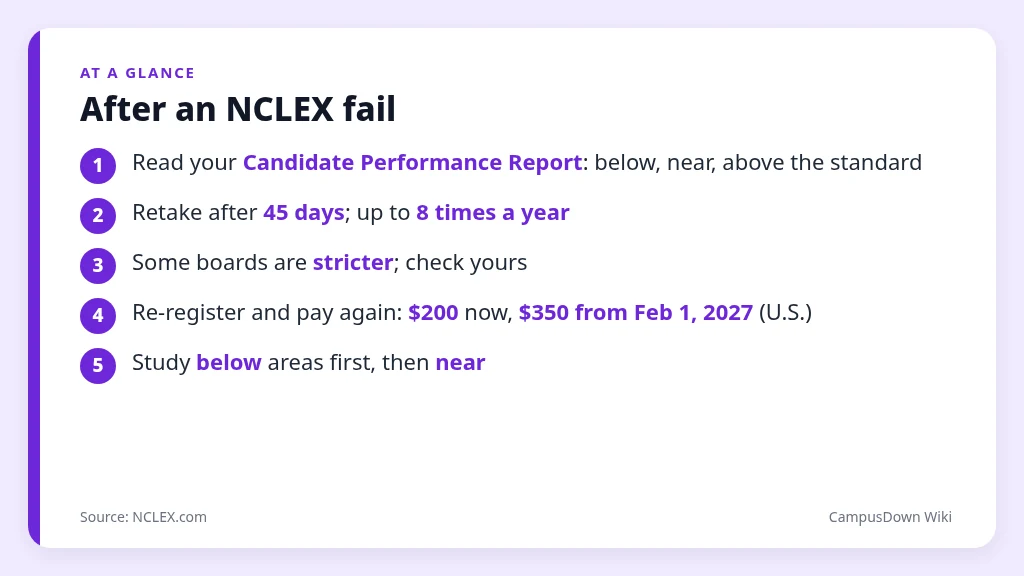
NCSBN sends a Candidate Performance Report (CPR), a two-page individualized document, to candidates who do not pass. It shows your performance in each test plan content area and in clinical judgment as:
- Below the passing standard
- Near the passing standard
- Above the passing standard
NCSBN advises studying below areas first, then near areas, and keeping up above areas too. The exam is not graded in sections; overall performance decides pass or fail. If you did not answer the minimum number of items, you get an abbreviated CPR with no diagnostic detail.

The retake rules
From NCLEX.com:
- You can retake 45 days after your exam.
- With a participating board, you can test up to eight times a year, with 45 test-free days between exams.
- Some boards require longer waits or fewer attempts; your new Authorization to Test (ATT) will show the dates.
Re-registering and fees
You re-register with Pearson and pay again. The U.S. registration fee is $200, and NCLEX.com says it will be $350 starting February 1, 2027. Registration fees are not refunded. Your board may have its own re-application steps and fees.
A retake plan that uses your report
- Take a few days before planning. Disappointment is normal.
2. Rank areas from the CPR: below, then near. 3. Rebuild your study plan around those areas using test plan percentages; see the study plan guide. 4. Practice full case studies if clinical judgment was weak; review the six steps. 5. Look at how you test, not just what you know: pacing, misreading, changing answers. 6. Address anxiety directly if it played a part; see NCLEX test anxiety.
Questions to ask your nursing board
- How long must I wait before retesting, and how many attempts do you allow?
- Do I need to re-apply or pay a board fee before re-registering with Pearson?
- Is there a limit on time since graduation or a remediation requirement after several attempts?
- When will my new Authorization to Test be issued, and how long is it valid?
Writing the answers down keeps your retake timeline realistic and avoids surprise fees.
A plan is easier to start when someone is beside you. Here is one example.
Example scenario: the report on the kitchen table
- Who
- Malik, 25, a BSN graduate in Illinois who had already accepted a new-grad job offer, failed his NCLEX-RN at 85 questions.
- What happened
- His CPR showed Pharmacological Therapies and Reduction of Risk Potential below the passing standard, and he had to tell his future nurse manager.
- How it felt
- He felt humiliated and angry at himself, and for two days he would not answer his phone.
- What they did
- His older sister, a respiratory therapist, sat with him, highlighted the CPR, and helped him build an 8-week plan focused on pharmacology and case studies. His manager agreed to hold his start date.
- How it turned out
- He retested after the waiting period, passed, and kept the highlighted CPR in his locker as a reminder that one result did not define his career.
This is an illustrative example, not a real patient or a review.
Malik is an illustrative example, not a real person.
Get help now if
Rules vary by board. You can check it for yourself with your nursing regulatory body before scheduling, and talk to your doctor or a counselor if disappointment turns into lasting low mood.
Most-asked questions after failing
What does it mean if I failed the NCLEX in 85 questions?
The computer was 95% certain your ability was below the standard at the minimum length; your CPR shows where to focus.
Why people ask: "failed nclex in 85 questions" is the #1 Google suggestion for "failed nclex" (US autocomplete, November 2026).
What should I do if I failed the NCLEX twice?
Use both CPRs to look for patterns, check your board's attempt limits, and consider structured remediation.
Why people ask: "failed nclex twice" is #4 and "failed nclex twice what to do" is #8 for "failed nclex" (US, November 2026).
What is the NCLEX retake policy?
Retake after 45 days, up to eight times a year with 45 test-free days between, unless your board is stricter.
Why people ask: "nclex retake policy" is the #1 suggestion for "nclex retake" (US, November 2026).
How much does an NCLEX retake cost in 2027?
$200 for U.S. candidates now, rising to $350 on February 1, 2027, plus any board fees.
Why people ask: "nclex retake fee" is #3 for "nclex retake", and "nclex cost 2027" is #7 for "nclex cost" (US, November 2026).
Frequently asked questions
- Does failing at 150 mean I was close?
- Running to 150 means your ability was near the standard; see how the NCLEX stops.
- Will I see the same questions?
- No. NCSBN says a repeat candidate will not see the same item again in the current pool.
- Can I check results early next time?
- Yes, through official Quick Results if your board participates.
- Can I change exam type or board after registering?
- NCLEX.com lists a $50 fee for U.S. candidates to change exam type or nursing regulatory body after registration.
A failed attempt is a setback with a map attached. You can learn more about each rule in detail on NCLEX.com, and start your plan from the areas your report flags.
Browse more guides like this in the Nursing Student and NCLEX hub.
This article is for general education and does not replace advice from your own doctor, nurse or pharmacist.