
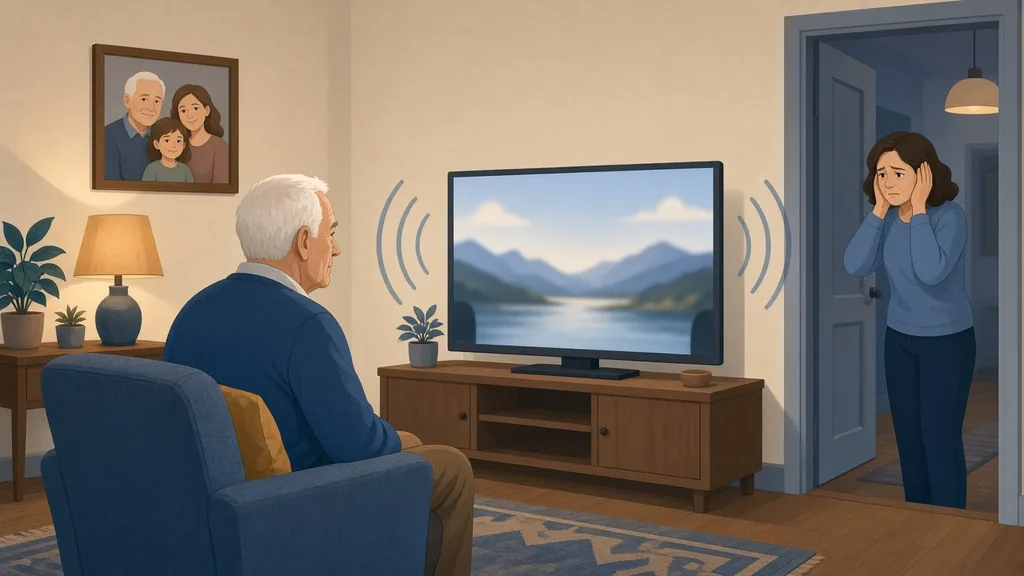
Have you noticed the TV getting louder every time you visit your parents, while Dad insists everyone else just mumbles? That moment of quiet friction is how age-related hearing loss often first shows up. It is rarely the person with the hearing loss who spots it first.
This guide uses the National Institute on Deafness and Other Communication Disorders (NIDCD) and the National Institute on Aging (NIA), checked in November 2026. It covers how common age-related hearing loss is, why it happens, and the signs families notice. It also explains who to see and how to talk about it without starting a fight.
What presbycusis is
Age-related hearing loss is also called presbycusis (prez-buh-KYOO-sis). The NIDCD describes it as hearing loss that develops gradually as we age. Key features:
- It usually affects both ears, about equally.
- Because it is slow, people often don't realize they have lost hearing.
- It can make it hard to understand speech and to tolerate loud sounds.
- It tends to run in families.
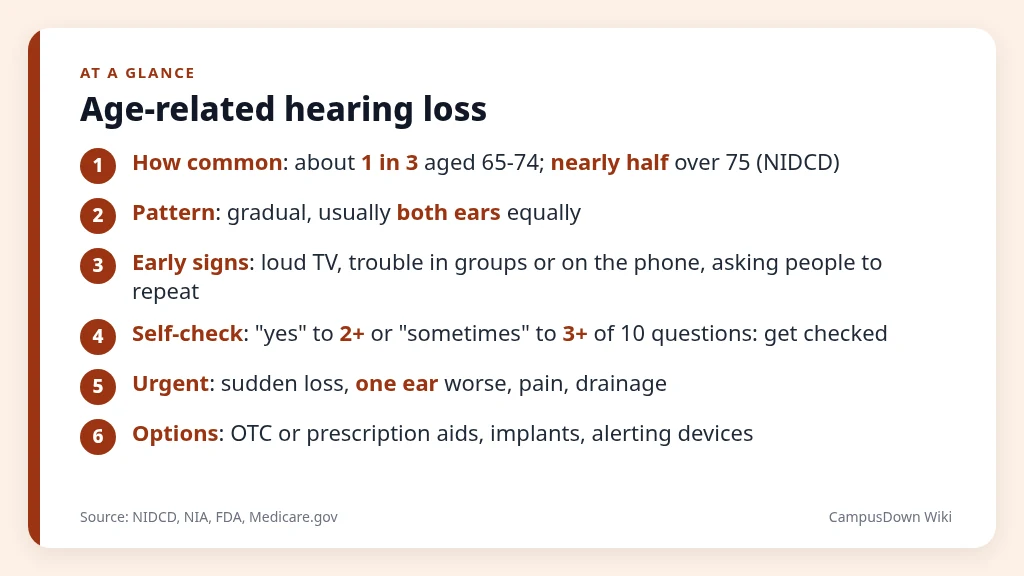
It is very common. The NIDCD reports that about 15% of U.S. adults report some trouble hearing, about one in three people aged 65 to 74 has hearing loss, and nearly half of those older than 75 have difficulty hearing.

Why it happens
The NIDCD and NIA point to several causes that often overlap:
- Inner ear changes, the most common, plus changes in the middle ear and along the nerve pathways to the brain
- Long-term noise exposure, from lawn mowers and leaf blowers to loud music and firearms
- Genes that make some people more susceptible
- Health conditions such as high blood pressure and diabetes, which are linked with hearing loss
- Medicines that can harm the inner ear, including some chemotherapy drugs, some antibiotics, and aspirin at some doses. The NIA says to check with your doctor if you notice a change while taking a medicine. Don't stop a prescribed medicine, such as low-dose aspirin, on your own.
Scientists don't yet know how to prevent age-related hearing loss itself. You can protect against noise-induced loss by turning devices down, moving away from noise, and wearing earplugs or earmuffs.
The signs families notice first
Because the person with hearing loss often adapts without realizing it, families see clues first. The FDA's list of signs of mild to moderate loss lines up with what relatives describe:
- The TV or radio is louder than others like
- Trouble following speech in noisy places or groups
- Difficulty on the phone
- Tiredness after listening
- Asking people to repeat themselves, or answering a different question than the one asked
- Pulling back from gatherings, church or clubs
The NIA notes older adults who can't hear well are sometimes mistaken for confused or uncooperative. That can feed isolation and loneliness.
A 10-question self-check
The NIDCD offers questions adapted from the Revised Hearing Handicap Inventory. Sit down together and take a closer look at them with your parent, or try them yourself. Does a hearing problem cause you:
- Difficulty listening to TV or radio?
2. Difficulty at a party? 3. To feel frustrated talking with family? 4. To feel left out in a group? 5. Difficulty visiting friends, relatives or neighbors? 6. To feel challenged? 7. To feel it limits your personal or social life? 8. To feel uncomfortable talking to friends? 9. To avoid groups of people? 10. To visit people less often than you would like?
The NIDCD says that answering "yes" to two or more, or "sometimes" to three or more, suggests you could have hearing loss and should consider a hearing check.
Why it is worth acting on
The NIA links untreated hearing loss with:
- Faster cognitive decline and a higher risk of **dementia**. A recent analysis found people using hearing aids or cochlear implants had a lower risk of long-term cognitive decline than people with uncorrected loss.
- Depression and withdrawal
- Falls, even with small amounts of loss
- Safety, such as missing warning sounds while driving
Hearing loss also makes it harder to follow a doctor's advice and to hear smoke alarms and doorbells, the NIDCD says. Tinnitus, ringing or buzzing in the ears, is common in older adults and is sometimes the first sign of hearing loss.
Example scenario: the Sunday dinners
- Who
- Rupert, 78, a retired railroad conductor in Kansas City, had always been the storyteller at Sunday dinner. His daughter Gwendolyn noticed he had gone quiet, laughed a beat late at jokes, and kept the TV so loud the neighbors mentioned it.
- What happened
- When she brought it up, he snapped that people "mumble these days" and that his hearing was fine for a man his age. She dropped it, but she watched him sit out the grandkids' conversations.
- How it felt
- Gwendolyn felt guilty for pushing and sad watching him fade out of the family's noise. Rupert, privately, felt embarrassed and afraid that hearing aids meant he was "getting old."
- What they did
- Instead of arguing, she printed the NIDCD self-check and asked him to try it "for her." He said "sometimes" to four questions. She offered to drive him to his annual wellness visit, where he asked his doctor about it himself. The doctor checked for earwax and referred him to an audiologist; Medicare covered the ordered diagnostic test.
- How it turned out
- The audiologist found moderate loss in both ears and talked him through options. Rupert chose aids after a demo, and at the next Sunday dinner he told a story about a 1970s snowstorm on the Santa Fe line. Gwendolyn said hearing him laugh on time was the best part.
This is an illustrative example, not a real patient or a review.
Rupert and Gwendolyn are illustrative examples, not real patients. Every family's conversation looks different.
Who to see
The NIDCD describes three kinds of help:
- Primary care: often the first stop. Can check for wax or infection, look for other causes, and refer you.
- Otolaryngologist (ENT): a doctor who diagnoses and treats ear disorders and finds out why you have trouble hearing.
- Audiologist: trained to measure hearing loss and recommend and fit devices such as hearing aids.
Medicare.gov says Part B covers diagnostic hearing exams when your doctor orders them. You can also see an audiologist once every 12 months without an order for non-acute hearing loss that develops over many years. Original Medicare doesn't cover hearing aids themselves.
Get help now if
Age-related loss is gradual and affects both ears. Sudden hearing loss, loss in one ear, ringing in one ear, ear pain, drainage or dizziness are not typical of presbycusis. See a doctor promptly; read sudden sensorineural hearing loss.
Treatment and devices
The NIDCD and NIA list:
- Hearing aids. Adults with perceived mild to moderate loss can buy OTC aids; prescription aids serve greater or more complex loss. Compare them in OTC vs prescription hearing aids, or learn more about the AirPods Pro Hearing Aid feature.
- Cochlear implants for severe loss or profound deafness, which need surgery and hearing therapy.
- Assistive listening devices: phone amplifiers, captioning apps, and hearing loops in theaters and places of worship.
- Alerting devices that flash or vibrate for doorbells, smoke alarms and alarm clocks.
Before any of these, rule out a simple cause. Earwax can muffle hearing; see earwax buildup.
How to talk so a parent can hear you
The NIA suggests:
- Face the person, in good light, and keep eye contact.
- Speak a little louder than normal, but don't shout. Keep a natural pace.
- Don't cover your mouth, eat or chew gum while talking.
- Rephrase rather than repeat the same words.
- Turn off the TV and pick quiet spots in restaurants.
- Let one person talk at a time, and include them in the conversation.
Most-asked questions about age-related hearing loss
What is age-related hearing loss called?
Presbycusis. It comes on gradually with age and usually affects both ears equally.
Why people ask: "age related hearing loss is called" is #2 for "age related hearing loss" (US autocomplete, November 2026).
What causes hearing loss in the elderly?
The NIDCD lists inner ear changes, middle ear and nerve pathway changes, long-term noise, genes, conditions like high blood pressure and diabetes, and some medicines.
Why people ask: "hearing loss in elderly causes" is #2 for "hearing loss in elderly" (US, November 2026).
Is hearing loss in the elderly linked to dementia?
The NIA says older adults with hearing loss have a greater risk of dementia, and a recent analysis found hearing aid or implant users had a lower risk of long-term cognitive decline.
Why people ask: "hearing loss in elderly and dementia" is #3 for "hearing loss in elderly" (US, November 2026).
What is the treatment for hearing loss in the elderly?
Hearing aids (OTC or prescription), cochlear implants for severe loss, and assistive listening and alerting devices. Treatment depends on severity.
Why people ask: "hearing loss in elderly treatment" is #8 for "hearing loss in elderly" (US, November 2026).
Is age-related hearing loss conductive or sensorineural?
Mostly sensorineural. The NIDCD says aging can damage the inner ear's hair cells, which causes sensorineural hearing loss.
Why people ask: "age related hearing loss conductive or sensorineural" is #8 for "age related hearing loss" (US, November 2026).
Related on CampusDown
Sleep often changes in later life too; see sleep changes with aging. To check it for yourself before choosing devices, read getting used to new hearing aids.
Frequently asked questions
- Can age-related hearing loss be reversed?
- The damage is usually permanent, but hearing aids and other devices can help you hear and communicate better.
- Can I prevent age-related hearing loss?
- The NIDCD says scientists don't yet know how, but you can protect against noise-induced loss with lower volumes and ear protection.
- Does Medicare pay for a hearing test?
- Part B covers diagnostic hearing exams your doctor orders, and one audiologist visit every 12 months without an order for non-acute loss.
- Is it normal for hearing loss to affect one ear more?
- Age-related loss usually affects both ears equally. One-sided loss should be checked by a doctor.
Age-related hearing loss is common, gradual and easy to miss, but it is not something to simply live with. A short self-check, an honest conversation and a referral can open the door to devices and habits that keep a parent in the conversation. Talk to your doctor about a hearing check, and get help right away for any sudden or one-sided change.
Browse more guides like this in the Senior Health and Medicare hub.
This article is for general education and does not replace advice from your own doctor, nurse or pharmacist.