
Did you put in your new hearing aids, hear your own voice boom like you were talking inside a barrel, and wonder if you had made an expensive mistake? Almost everyone has some version of that moment. It is usually the start of a learning curve, not a sign the aids are wrong.

This guide pulls together what the FDA and the NIDCD say about the adjustment period, plus setup advice from Apple and hearing aid makers. All of it was checked in November 2026. It covers what the first weeks often feel like, which problems are normal, and which ones need a fix.
How long it takes
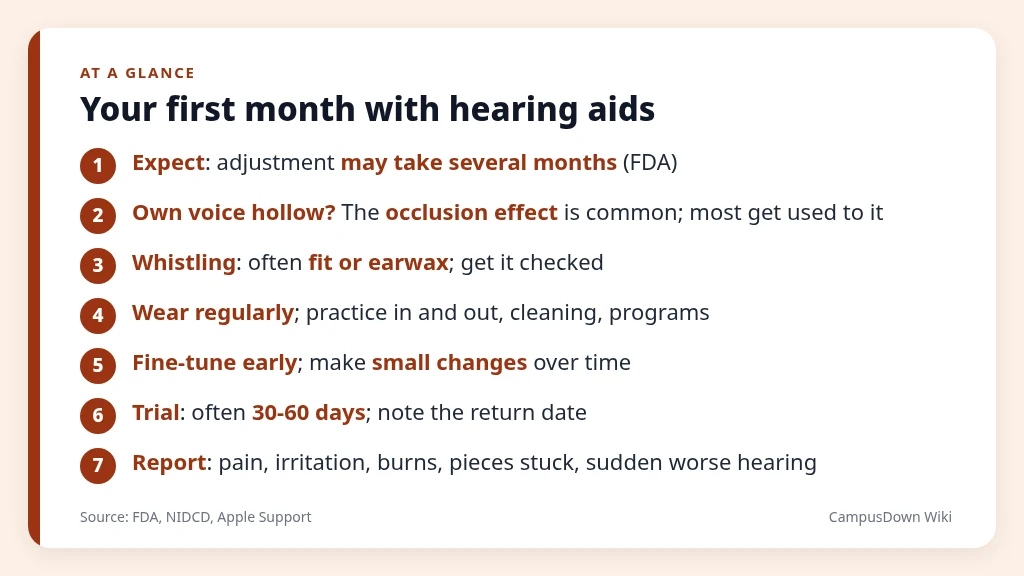
The FDA says hearing aids usually come with an adjustment period that may take several months, and that settings may need changing over time. The NIDCD puts it plainly: a hearing aid will not restore normal hearing, but with practice it will increase your awareness of sounds and where they come from. Both agencies say wearing your aids regularly is what helps you adjust.
Apple gives similar advice for its AirPods Pro Hearing Aid feature: make small changes over time as you get used to amplification.

What the first weeks often feel like
It helps to take a closer look at the most common early complaints and what the NIDCD and FDA say about each.
"My own voice sounds weird"
A plugged-up feeling that makes your voice sound louder inside your head is called the occlusion effect. The NIDCD says it is very common for new users and most people get used to it over time. Ask your audiologist whether a correction is possible. Open-fit or vented domes are one option the FDA describes for reducing it.
"Everything sounds sharp or tinny"
Many new users say paper rustling, running water and their own footsteps sound strangely crisp. Sounds you stopped hearing slowly over years may seem to come back all at once. If it stays uncomfortable after the first days, ask for a fine-tuning rather than turning the aids off.
"It whistles"
The NIDCD says whistling (feedback) can come from an aid that doesn't fit well, isn't working well, or is clogged by earwax or fluid. Check the dome and wax guard, then ask your provider; see our earwax guide.
"Background noise is too much"
The NIDCD notes hearing aids don't completely separate the sounds you want from the ones you don't. Settings can often be adjusted. Programs for noisy places, directional microphones and noise reduction exist for this reason.
"They feel uncomfortable"
Some people find aids slightly uncomfortable at first. The NIDCD suggests asking your audiologist how long to wear them each day while you adjust. Real pain or soreness is not normal and should be checked.
A simple first-month plan
This plan follows the FDA and NIDCD advice to wear the aids regularly and practice their features. Your audiologist may suggest a different schedule.
- Days 1-3: quiet places. Wear them at home. Listen to the fridge, the clock, your partner's voice. Practice putting them in and taking them out, telling left from right, cleaning and charging or changing batteries.
2. Week 1: one-on-one talks. Have short conversations face to face. Try the phone. Note what sounds wrong and where. 3. Week 2: TV and small groups. Watch TV at a normal volume. Try a family meal. Learn your programs or app settings for different places. 4. Weeks 3-4: harder places. Try a restaurant, a store or a place of worship. Use your noisy-place program if you have one. 5. Every week: write it down. Keep a short list of problems, with the setting. That list is what makes an adjustment visit or remote request useful.
The FDA also suggests learning to adjust program settings in different listening environments. Remote-care brands such as Jabra Enhance Select let you send that list through an app and receive new settings without an office visit.
Example scenario: the barrel voice
- Who
- Silas, 70, a retired church deacon in Birmingham, got prescription hearing aids after his wife, Frances, said she was tired of being his "interpreter" at Bible study.
- What happened
- The first morning, his own voice sounded hollow, the kettle sounded like a siren and his shoes squeaked on the kitchen tile. At lunch with friends, the clatter of dishes drowned out everything.
- How it felt
- He felt cheated and a little foolish. He told Frances the aids were "too much" and put them in the drawer for two days, afraid he had wasted the money.
- What they did
- Frances reminded him the audiologist had said to call within the first week. He went back with a short list: hollow voice, loud dishes, whistling when he hugged someone. The audiologist changed his domes to a more open style, lowered some high-pitch settings slightly, and showed him how to use the restaurant program. She also asked him to wear the aids every day, starting at home.
- How it turned out
- By the end of the month, Silas wore them from breakfast to bedtime. The whistle during hugs was gone, and his own voice sounded nearly normal. At Bible study he answered a question before Frances could repeat it, and she squeezed his hand under the table.
This is an illustrative example, not a real patient or a review.
Silas is an illustrative example, not a real patient. Your own adjustment path will depend on your hearing and your devices.
Use your trial period well
The NIDCD says most manufacturers allow a 30- to 60-day trial, during which aids can be returned for a refund; ask which fees are nonrefundable. Some OTC brands offer longer windows. The FDA notes the OTC rule does not require a warranty, so read the terms. Then:
- Put the return date on your calendar.
- Test the aids in every place that matters: work, church, restaurants, the car.
- Ask for adjustments early, not on the last day.
- If OTC aids don't help enough, the FDA suggests seeing a hearing professional. You can learn more about switching paths in OTC vs prescription hearing aids.
Small habits that help
- Charge or change batteries at the same time every day; see batteries vs rechargeable.
- Avoid hairspray and other hair products while wearing aids, as the FDA and NIDCD advise.
- Bring your phone to the fitting to test how it works with the aids, as the NIDCD suggests.
- Tell family and friends you are adjusting. Ask them to face you and speak clearly.
Get help now if
Stop wearing the aids and contact your provider or doctor if you have ear pain, skin irritation, cuts or a burn, a piece of the device stuck in your ear, or a sudden drop in hearing. The FDA asks people to report these problems through MedWatch or 1-800-FDA-1088.
Most-asked questions about getting used to hearing aids
How long does it take to get used to hearing aids?
The FDA says the adjustment period may take several months. Wearing the aids regularly and getting early adjustments helps.
Why people ask: "how long get used to hearing aids" is #9 for "getting used to hearing aids" (US autocomplete, November 2026).
Why do my new hearing aids sound tinny?
Many new users find sound sharp at first. If it stays uncomfortable, ask for fine-tuning rather than stopping. The FDA notes settings may need adjusting over time.
Why people ask: "new hearing aids sound tinny" is #8 for "new hearing aids" (US, November 2026).
My new hearing aids are too loud. What should I do?
Lower the volume or switch programs if your aids allow it, and ask your provider to adjust the settings. Apple recommends small changes over time for its AirPods feature.
Why people ask: "new hearing aids too loud" is #9 for "new hearing aids" (US, November 2026).
Can new hearing aids cause headaches?
The FDA and NIDCD don't list headaches as an expected effect. Settings that are too loud or a poor fit can be uncomfortable, so ask for an adjustment; see a doctor for headaches that persist.
Why people ask: "new hearing aids cause headaches" is #10 for "new hearing aids" (US, November 2026).
What are tips for getting used to hearing aids?
Wear them daily, start in quiet places, practice handling and programs, keep a problem list, and use your trial period for adjustments.
Why people ask: "tips for getting used to hearing aids" is #8 for "getting used to hearing aids" (US, November 2026).
Related on CampusDown
Using AirPods? You can check it for yourself in our AirPods Pro Hearing Aid feature guide. For why hearing changed in the first place, see age-related hearing loss and tinnitus.
Frequently asked questions
- Should I wear hearing aids all day from the start?
- The NIDCD suggests asking your audiologist how long to wear them while you adjust. Regular daily wear is the goal.
- Is it normal for my voice to sound strange?
- Yes. The occlusion effect is very common in new users, and most people get used to it. Ask about domes or venting if it bothers you.
- Why do my hearing aids whistle?
- Often a poor fit or earwax. Check the dome and wax guard, then see your provider.
- Can I return hearing aids if they don't work for me?
- Many makers offer a trial period. The NIDCD says 30 to 60 days is common. Check the terms before you buy.
The first month with hearing aids is a training period for your ears, your brain and your habits. Wear them daily, write down what sounds wrong and ask for adjustments early. Talk to your audiologist or doctor about anything painful or any sudden change, and give yourself time.
Browse more guides like this in the Senior Health and Medicare hub.
This article is for general education and does not replace advice from your own doctor, nurse or pharmacist.