
A patient's chart says "GCS 13" at 2 PM and "GCS 11" at 4 PM. What changed, and who needs to know right now?
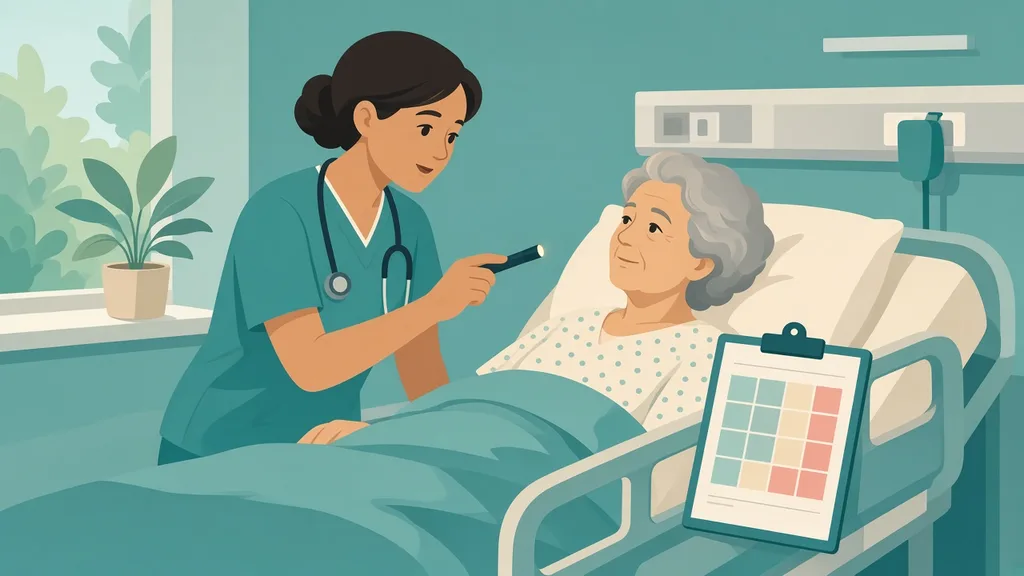
This guide uses the official Glasgow Coma Scale website (glasgowcomascale.org, its "What is GCS," FAQ and GCS-P pages) and OpenStax Medical-Surgical Nursing (section 17.1, Intracranial Pressure Changes). It is for education only. Follow your instructor, facility policy and the provider's orders. If you want to learn more about the problem a falling GCS may signal, take a closer look at increased intracranial pressure and Cushing's triad.
What the scale is for
The site says the scale was described in 1974 by Graham Teasdale and Bryan Jennett as a way to communicate about the level of consciousness of patients with an acute brain injury. It guides initial decision making and monitors trends in responsiveness that signal the need for new actions. It can be applied to impairment of consciousness from any cause, though it has been used most in head injuries; in conditions such as stroke, extra information about focal deficits matters too. OpenStax says the GCS has been used since 1974 and is a vital tool to assess level of consciousness.

The three parts
The official page lists the ratings for each component:
- Eyes: spontaneous, to sound, to pressure, none
- Verbal: orientated, confused, words, sounds, none
- Motor: obeys commands, localising, normal flexion, abnormal flexion, extension, none
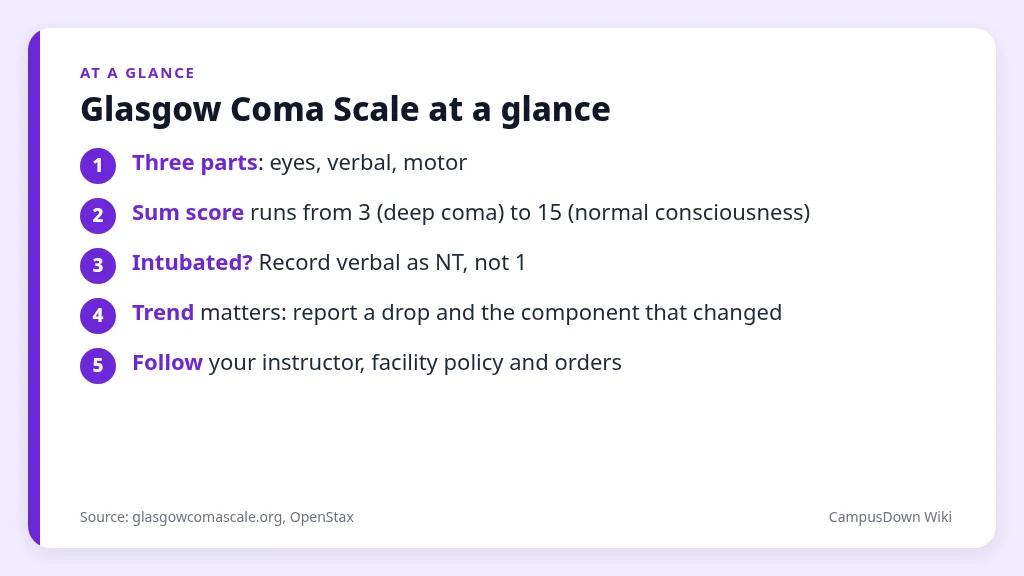
The site explains that the numbers were added later, to enter findings into a databank (its example: E3, V4, M5 = score 12). The commonly taught point values are eyes 1 to 4, verbal 1 to 5 and motor 1 to 6, which gives the site's stated range: the lowest possible score is 3, indicating deep coma, and the highest is 15, indicating normal consciousness. Confirm the exact numbering on your facility's chart.
The site stresses "use the scale, not just the score": describing each response gives a clearer picture than the sum.
Interpreting the sum score
The site notes a widely used classification stratifies early severity of head injury into mild (sum score 13 to 15), moderate (9 to 12) and severe (below 8). OpenStax says patients with a GCS lower than 8 should be monitored for increased intracranial pressure. Different references word the cut-off slightly differently, so use your instructor's or facility's definition. The site also says the sum score can lose detail: reliability of the components is usually high, and the sum is lower in reliability (the score can be variable).
Stimulation technique
For motor responses in patients who don't obey commands, the site describes pressure at the finger nail bed, trapezius muscle and supraorbital notch, and says rubbing the knuckles on the sternum is strongly discouraged because it can cause bruising and responses are hard to interpret. Follow your facility's technique.
Intubated, sedated or hard-to-test patients
The site lists factors that interfere: language or cultural differences, hearing loss, speech impediment, intubation or tracheostomy, sedation or paralysis, and other injuries. It advises:
- For intubation or tracheostomy, record the verbal component as "NT" (not testable); the eye and motor components can still be assessed and the trend is still useful.
- Do not use "1" to record a missing component.
- Do not report a total score when a component is not testable because it will be low and may imply the patient is more unwell than they are.
- For sedation or paralysis, temporarily reversing it (a "wake up test") is mentioned as an option; that is a provider decision.
Children
The site says the scale can be used without modification for children over 5 years old. For younger children and infants, a Paediatric Glasgow Coma Scale adapts the verbal and motor responses (for example, cries, vocal sounds, words). Your facility uses its own pediatric tool.
How often and what change matters
The site says observations should begin as soon as possible to establish a baseline and be repeated frequently at first, reducing frequency when a pattern is stable. It quotes NICE head injury guidance for acute head injury: every half hour until GCS 15, then half-hourly for 2 hours, hourly for 4 hours, then 2-hourly (adults and children, per NICE as cited by the site); your facility's orders govern. It lists urgent reappraisal for a sustained drop of one point for at least 30 minutes (with extra weight on the motor score), any drop of 3 or more points in eye opening or verbal scores, or 2 or more in motor response.
It adds that rigid criteria for change aren't appropriate; things that matter include the pattern before the change, the level before the change, which component changed (motor changes usually call for a response sooner) and whether the change persists on repeat assessment, ideally confirmed by a colleague.
Get help now if
A falling level of consciousness, new confusion, unequal pupils, repeated vomiting or seizure needs immediate escalation per your facility's policy. Call the nurse in charge, the provider or the rapid response team right away.
Pupils: GCS-P
The site explains the GCS-Pupils score (2018) combines the GCS score with pupil reactivity (loss of reactivity: both pupils 2, one pupil 1, neither 0) with possible values 1 to 15. Whether your facility uses it varies.
Questions to ask your instructor or preceptor
- Which chart and point values does our unit use?
- How often do we check, and who do we call for a change?
- How do we document an intubated patient's verbal component?
- Which pediatric scale do we use?
- Where do pupils get documented?
Example scenario: the two-point drop
- Who
- Sinclair, 22, a nursing student in Pittsburgh, Pennsylvania, checked a patient after a fall and noticed the patient's eyes opened only to sound and the motor response seemed weaker than earlier.
- What happened
- He wasn't sure whether the change was "enough" to report.
- How it felt
- He felt nervous about bothering busy staff.
- What they did
- He repeated the check with his preceptor, who confirmed the change; they notified the provider and rechecked on the unit's schedule. Sinclair documented each component, not just the sum.
- How it turned out
- Sinclair said describing eyes, voice and movement made it easy to speak up.
This is an illustrative example, not a real patient or a review.
Sinclair's story is an illustrative example. Always follow your instructor, facility policy and the provider's orders.
Most-asked questions about the Glasgow Coma Scale
What is a Glasgow Coma Scale score?
The sum of the eye, verbal and motor ratings, ranging from 3 (deep coma) to 15 (normal consciousness).
Why people ask: "glasgow coma scale score" is #2 for "glasgow coma scale" (US autocomplete, November 2026).
Where can I find a Glasgow Coma Scale chart?
Use your facility's chart; the official site lists the ratings for each component and a structured approach.
Why people ask: "glasgow coma scale chart" is #3 for "glasgow coma scale" (US autocomplete, November 2026).
What does a Glasgow Coma Scale score of 15 mean?
Normal consciousness, the highest possible score, per the official site.
Why people ask: "glasgow coma scale score 15" is #4 for "glasgow coma scale" (US autocomplete, November 2026).
How is the Glasgow Coma Scale interpreted?
Sum scores are often grouped as mild (13 to 15), moderate (9 to 12) and severe (below 8) for head injury, but trends and each component matter.
Why people ask: "glasgow coma scale interpretation" is #6 for "glasgow coma scale" (US autocomplete, November 2026).
What does a Glasgow Coma Scale score of 3 mean?
The lowest possible score, indicating deep coma, per the official site.
Why people ask: "glasgow coma scale 3" is #7 for "glasgow coma scale" (US autocomplete, November 2026).
What is a GCS of 15?
The maximum score, indicating normal consciousness.
Why people ask: "glasgow coma scale 15" is #8 for "glasgow coma scale" (US autocomplete, November 2026).
What is the range of the Glasgow Coma Scale?
3 to 15 for the GCS sum score; the GCS-P ranges from 1 to 15.
Why people ask: "glasgow coma scale range" is #9 for "glasgow coma scale" (US autocomplete, November 2026).
Is there a Glasgow Coma Scale scoring sheet?
Facilities use observation charts; the official site describes a specially designed chart that makes changes easy to spot, and your unit's chart governs.
Why people ask: "glasgow coma scale scoring sheet" is #2 for "glasgow coma scale scoring" (US autocomplete, November 2026).
How do I interpret Glasgow Coma Scale scoring?
Use the score together with the component findings and the trend, and follow your unit's escalation rules.
Why people ask: "glasgow coma scale scoring interpretation" is #3 for "glasgow coma scale scoring" (US autocomplete, November 2026).
How is the Glasgow Coma Scale scored for intubated patients?
Record verbal as NT (not testable), not 1; don't report a total score; track the eye and motor trend.
Why people ask: "glasgow coma scale scoring for intubated patients" is #5 for "glasgow coma scale scoring" (US autocomplete, November 2026).
Is there a pediatric Glasgow Coma Scale?
Yes; the scale works unchanged for children over 5, and a Paediatric version adapts verbal and motor responses for younger children; use your facility's tool.
Why people ask: "glasgow coma scale scoring pedia" is #6 for "glasgow coma scale scoring" (US autocomplete, November 2026).
What does Glasgow Coma Scale scoring chart mean for nursing?
Chart each component and the time so trends are visible; the site says the chart helps detect clinical changes.
Why people ask: "glasgow coma scale scoring chart" is #7 for "glasgow coma scale scoring" (US autocomplete, November 2026).
What is the meaning of Glasgow Coma Scale scoring?
It communicates level of consciousness, guides early decisions and tracks trends.
Why people ask: "glasgow coma scale scoring meaning" is #8 for "glasgow coma scale scoring" (US autocomplete, November 2026).
What is a normal Glasgow Coma Scale score?
15 indicates normal consciousness.
Why people ask: "glasgow coma scale scoring normal" is #10 for "glasgow coma scale scoring" (US autocomplete, November 2026).
Related on CampusDown
You can learn more about the nursing student hub and check it for yourself in head-to-toe assessment. For documentation habits in detail, see nursing charting and documentation, and for a related change in mental status see delirium in the hospital.
Frequently asked questions
- What is the lowest and highest score?
- 3 and 15.
- How do I document an intubated patient's verbal response?
- As NT (not testable), not 1, and don't report a total.
- Is the GCS only for head injury?
- No; it can describe impaired consciousness from any cause, with extra focal assessments in conditions like stroke.
- What drop should I escalate?
- Follow your facility's rules; the site cites NICE criteria such as a sustained one-point drop or larger drops in components.
- Is the GCS reliable?
- The site says components are usually highly reliable and the sum score somewhat less, and training helps.
The Glasgow Coma Scale describes eyes, voice and movement. Know the 3 to 15 range, record NT for untestable parts, trend each component, learn your unit's escalation rules and speak up early when a score or component drops.
Browse more guides like this in the Nursing Student and NCLEX hub.
This article is for general education and does not replace advice from your own doctor, nurse or pharmacist.