
Your first steps out of bed hurt at the back of your heel, and it eases once you warm up. Did you pull something, or is something building?
If you walk, run or play weekend sports, this can be Achilles tendinitis. This guide uses MedlinePlus's articles on Achilles tendinitis (reviewed August 2024), heel pain and Achilles tendonitis aftercare (reviewed July 2025) and Achilles tendon rupture aftercare (reviewed June 2026). It is general information, not a diagnosis; a clinician should examine your foot and tendon. If you want to learn more about pain medicines, take a closer look at acetaminophen.
What it is
MedlinePlus says Achilles tendinitis occurs when the tendon that connects the back of your leg to your heel becomes swollen and painful near the bottom of the foot. The Achilles tendon links the calf muscles to the heel bone, lets you push your foot down, and works every time you walk, run or jump. It's also called Achilles tendonitis or tendinopathy.

Why it happens
Heel pain is most often due to overuse, rarely an injury. MedlinePlus lists these as making it more likely:
- A sudden increase in the amount or intensity of activity
- Very tight calf muscles
- Running on hard surfaces, running too often, or jumping a lot (basketball, for example)
- Shoes without proper support
- A foot that suddenly turns in or out
Overuse tendinitis is most common in younger people such as walkers, runners and other athletes. Tendinitis from arthritis is more common in middle-aged and older adults: a bone spur at the back of the heel can irritate the tendon, and flat feet put more tension on it. For joint-related pain, see osteoarthritis.
Symptoms
MedlinePlus lists:
- Pain in the heel and along the tendon when walking or running
- Pain and stiffness, often worse in the morning
- A tendon that is painful to touch or move
- Swelling and warmth
- Trouble standing on your toes
- Trouble finding shoes that fit comfortably because of heel pain
A provider examines for tenderness along the tendon and pain when you stand on your toes. X-rays can check for bone problems, and an MRI may be done if surgery is being considered or a tear is possible.
Self-care at home
MedlinePlus's aftercare steps:
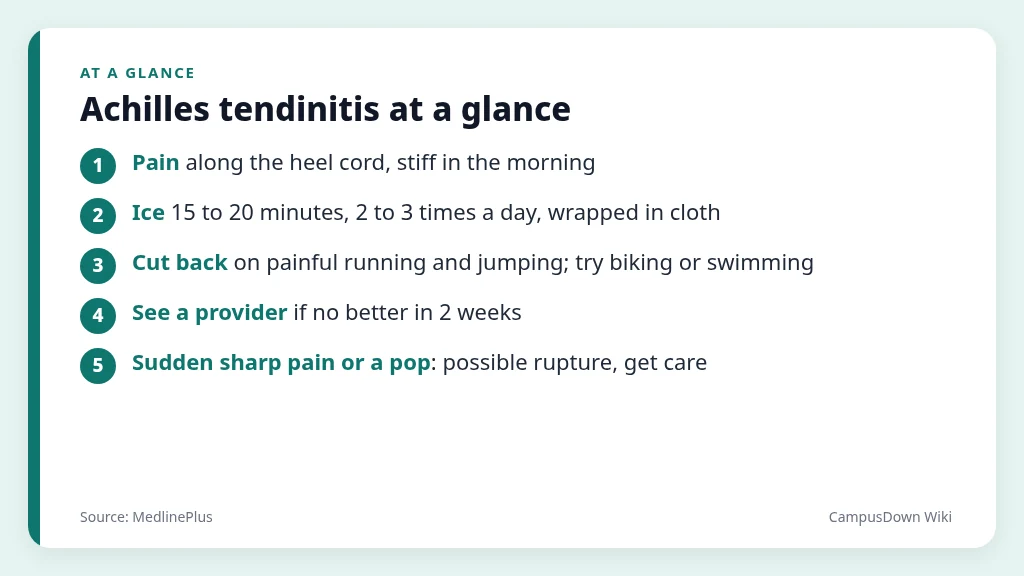
- Ice the tendon for 15 to 20 minutes, 2 to 3 times a day, using an ice pack wrapped in cloth, never directly on skin. Remove it if the area gets numb.
- Stop or cut back the activities that hurt, such as running or jumping.
- Switch to biking, swimming or other activities that don't strain the tendon.
- Choose soft, smooth surfaces and avoid hills when walking or running.
- Increase activity gradually.
- Use a walking boot or heel lifts if your provider recommends them.
- Pain medicines: MedlinePlus says aspirin, ibuprofen or naproxen may reduce inflammation and pain, but talk with your provider first if you have heart disease, high blood pressure, kidney disease, or a history of stomach ulcers or internal bleeding, and never take more than the label or your provider recommends. See kidney function and a medication review.
Exercises
MedlinePlus says your provider or physical therapist can show you stretching exercises or eccentric loading exercises. Do them gently; don't over-stretch, which can injure the tendon. Range-of-motion exercises help you regain movement in all directions, and strengthening exercises help prevent tendinitis from coming back. MedlinePlus doesn't give a routine or a number of sets on these pages, so ask a clinician or physical therapist for one that fits you.
Shoes, braces and heel lifts
MedlinePlus lists footwear changes that may help: a brace, boot or cast to keep the heel and tendon still while swelling goes down; heel lifts placed under the heel in the shoe; and shoes that are softer over and under the heel cushion. It also says that not wearing supportive shoes makes tendinitis more likely. Which option is right depends on your foot and your provider's advice.
Other treatments
If the above doesn't help, MedlinePlus says options include injections (platelet-rich plasma or steroids) to reduce inflammation, though the tendon can become weaker after an injection and should be protected, and extracorporeal shock wave therapy as an alternative to surgery. Surgery may remove inflamed tissue or abnormal areas of tendon, or a bone spur, if other treatments fail.
How long it takes
MedlinePlus says it may take at least 2 to 3 months for the pain to go away, and in most cases lifestyle changes help. Symptoms may return if you don't limit painful activity or maintain the strength and flexibility of the tendon.
Not healing?
- If symptoms don't improve with self-care in 2 weeks, see your provider; if the injury still doesn't heal, you may need a physical therapist.
- Contact your provider if heel pain around the tendon is worse with activity, if symptoms worsen, or if you can't push off without extreme pain or weakness.
Rupture warning signs
Get help now if
MedlinePlus says Achilles tendinitis makes a rupture more likely. A rupture often causes a sudden sharp pain as if you were hit in the back of the heel, sometimes with a snap, crack or pop, trouble walking or going up stairs, difficulty standing on your toes, and bruising or swelling. Get medical care promptly.
After a rupture, MedlinePlus says treatment depends on whether the tear is partial or complete; a partial tear rarely needs surgery and may use a splint or boot for about 6 weeks, while a complete, retracted tear may need surgery.
Common questions
- Plantar fasciitis: MedlinePlus's heel topic says tendinitis, bursitis and fasciitis are all types of inflammation of tissues around the heel; a clinician can tell which one you have.
- KT tape or specific products: MedlinePlus doesn't address them; ask a clinician or physical therapist.
- Prevention: keep your calf muscles strong and flexible, and avoid overusing a weak or tight Achilles tendon.
Questions for your clinician
- Is this tendinitis, or something else in the heel?
- Which footwear or heel lift should I try?
- Which exercises are right for me, and how often?
- When can I return to running or jumping?
- Which pain medicine is safe given my conditions?
Example scenario: the weekend 10K
- Who
- Violet, 46, a school librarian in Albuquerque, New Mexico, doubled her weekly running after signing up for a 10K, and her heel started to ache along the tendon each morning.
- What happened
- She kept running through it, hoping it would pass.
- How it felt
- She felt frustrated and a bit scared of missing the race.
- What they did
- She saw a clinic, learned it looked like Achilles tendinitis, switched to cycling and swimming, started the exercises a therapist showed her, and added a heel lift. She watched for any sudden sharp pain.
- How it turned out
- Violet said slowing down felt like losing, until the pain stopped ruling her mornings.
This is an illustrative example, not a real patient or a review.
Violet's story is an illustrative example. A clinician should examine any heel or tendon pain that persists.
Most-asked questions about Achilles tendinitis
How is Achilles tendonitis treated?
Mainly without surgery: ice, less painful activity, smoother surfaces, exercises, heel lifts or a boot, and anti-inflammatory medicine if appropriate; other options exist if those fail.
Why people ask: "achilles tendonitis treatment" is #2 for "achilles tendonitis" (US autocomplete, November 2026).
What exercises help Achilles tendonitis?
A provider or physical therapist can teach gentle stretching, eccentric loading and strengthening exercises; avoid over-stretching.
Why people ask: "achilles tendonitis exercises" is #3 for "achilles tendonitis" (US autocomplete, November 2026).
Should I use a brace for Achilles tendonitis?
MedlinePlus lists a brace, boot or cast as options to keep the heel and tendon still while swelling goes down, if your provider recommends one.
Why people ask: "achilles tendonitis brace" is #4 for "achilles tendonitis" (US autocomplete, November 2026).
What are the symptoms of Achilles tendonitis?
Heel and tendon pain with walking or running, morning stiffness, tenderness, swelling, warmth and trouble standing on your toes.
Why people ask: "achilles tendonitis symptoms" is #5 for "achilles tendonitis" (US autocomplete, November 2026).
What shoes are best for Achilles tendonitis?
MedlinePlus suggests supportive shoes, softer cushioning over and under the heel, and heel lifts if your provider recommends them.
Why people ask: "achilles tendonitis shoes" is #6 for "achilles tendonitis" (US autocomplete, November 2026).
What if Achilles tendonitis is not healing?
If self-care doesn't help in 2 weeks, see your provider; you may need a physical therapist or other treatment, and it can take at least 2 to 3 months to settle.
Why people ask: "achilles tendonitis not healing" is #8 for "achilles tendonitis" (US autocomplete, November 2026).
How is Achilles tendonitis different from plantar fasciitis?
MedlinePlus says tendinitis, bursitis and fasciitis are different types of heel inflammation; a clinician can tell which applies.
Why people ask: "achilles tendonitis vs plantar fasciitis" is #10 for "achilles tendonitis" (US autocomplete, November 2026).
Related on CampusDown
You can learn more about the health topics hub and check it for yourself in the fall prevention checklist. For foot health in detail, see peripheral neuropathy and the feet.
Frequently asked questions
- How often should I ice it?
- MedlinePlus says 15 to 20 minutes, 2 to 3 times a day, with a cloth between the ice and your skin.
- Can I keep running?
- MedlinePlus says to stop or decrease painful activities and try biking or swimming.
- How long does it take to heal?
- It may take at least 2 to 3 months for the pain to go away.
- When should I see a provider?
- If self-care doesn't help in 2 weeks, or sooner for sharp pain or trouble walking.
- What does a rupture feel like?
- A sudden sharp pain in the back of the heel, sometimes with a pop, and trouble pushing off.
Achilles tendinitis usually improves with relative rest, good footwear and gentle strengthening, but it can take months. See a provider if there's no progress in 2 weeks and seek care at once for a sudden sharp pain or pop.
Browse more guides like this in the U.S. Health Topics hub.
This article is for general education and does not replace advice from your own doctor, nurse or pharmacist.