
You have a headache, a stuffy nose and a sore back. You reach for a pain reliever and a nighttime cold medicine. Did you just take acetaminophen twice?

Acetaminophen is easy to buy and easy to double up on. This guide uses MedlinePlus (revised October 2025), the FDA's consumer update on acetaminophen and the Drug Facts label for Tylenol Extra Strength on DailyMed (updated July 2026). It is general information, not personal advice, and it does not tell you how much to take; your product label and your pharmacist decide that. If you want to learn more about reviewing everything you take, take a closer look at the brown bag medication review.
What it is used for
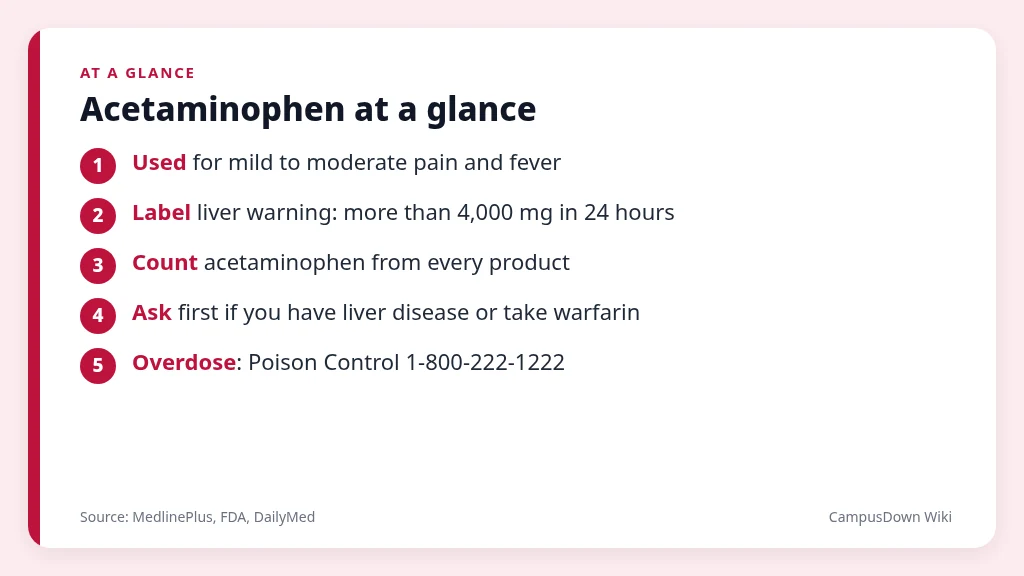
MedlinePlus says acetaminophen is used to relieve mild to moderate pain and to reduce fever. It is in a class of medicines called analgesics and antipyretics. It comes as tablets, chewables, capsules, liquids, extended-release tablets and orally disintegrating tablets, and you can buy it without a prescription. MedlinePlus lists brand names including Tylenol, Panadol and Feverall, and says acetaminophen is also called APAP and paracetamol.

The label limit
MedlinePlus says to take it exactly as directed and not to take more than the label indicates. The FDA says the current maximum recommended adult dose of acetaminophen is 4,000 milligrams per day for all the medicines you might be taking. The Tylenol Extra Strength Drug Facts label puts it this way in its liver warning: severe liver damage may occur if you take
- more than 4,000 mg of acetaminophen in 24 hours
- with other drugs containing acetaminophen
- 3 or more alcoholic drinks every day while using the product
Note that individual products can set a lower ceiling in their own directions. The Extra Strength label, for example, tells adults and children 12 and over not to take more than 6 caplets in 24 hours unless directed by a doctor, and not to use it for more than 10 days unless directed by a doctor. The FDA explains that some products have directions that give a maximum for that product below 4,000 mg. Follow the directions on the package in your hand, and ask a pharmacist if two labels seem to disagree.
Get help now if
Taking more than the label directs can cause severe liver damage, sometimes without early symptoms. If you or someone else may have taken too much, call Poison Control at 1-800-222-1222 right away, even if there are no symptoms. If the person has collapsed, had a seizure, has trouble breathing or can't be awakened, call 911.
Where it hides
The FDA says more than 600 prescription and over-the-counter medicines contain acetaminophen, including many cold, flu and allergy products and prescription pain relievers combined with opioids such as codeine, oxycodone and hydrocodone. MedlinePlus notes that cough and cold products can contain the same ingredient, so taking them together could cause an overdose. The Tylenol label says not to use it with any other drug containing acetaminophen, prescription or nonprescription.
The FDA suggests you:
- know how many milligrams of acetaminophen are in each medicine
- not take more than one over-the-counter medicine containing acetaminophen
- not combine a prescription and an over-the-counter medicine containing it unless a health professional advises it
- ask your prescriber whether a new prescription contains it
On prescription labels the word may be shortened: the FDA lists APAP, Acetaminoph, Acetaminop, Acetamin and Acetam. Nighttime cold and pain products that also contain an antihistamine such as diphenhydramine count too; read the Active ingredients box.
Liver disease, alcohol and warfarin
The Tylenol label says to ask a doctor before use if you have liver disease, and to ask a doctor or pharmacist before use if you take the blood thinner warfarin. The FDA says to talk to your health care professional if you have a history of liver disease or drink three or more alcoholic beverages a day. For warfarin, see warfarin. For other pain relievers, see low-dose aspirin and ask your pharmacist how they fit with the rest of your list; MedlinePlus says to tell your doctor and pharmacist about all the medicines, vitamins and supplements you take.
Pregnancy and children
MedlinePlus says to tell your doctor if you are pregnant, plan to become pregnant or are breastfeeding. For children, MedlinePlus says to read the label carefully to make sure the product is right for the child's age, never to give children products made for adults, and to use the dose that matches the child's weight, or age if weight is unknown, from the chart on the package; ask the child's doctor if you don't know. The Tylenol Extra Strength label says to ask a doctor for children under 12. MedlinePlus also says combination cough and cold products shouldn't be used in children younger than 2.
Side effects and when to stop
MedlinePlus says to stop taking acetaminophen and call your doctor immediately or get emergency care for:
- red, peeling or blistering skin, rash, hives, itching, or swelling of the face, throat, tongue or lips, hoarseness, trouble breathing or swallowing
- yellowing of the skin or whites of the eyes, upper belly pain, dark urine or pale stools
The label also says to stop use and ask a doctor if pain gets worse or lasts more than 10 days, fever gets worse or lasts more than 3 days, new symptoms occur, or redness or swelling is present.
Overdose signs
MedlinePlus lists nausea, vomiting, loss of appetite, upper belly pain, yellow skin or eyes, sweating, extreme tiredness or flu-like symptoms and unusual bleeding or bruising. The FDA adds that some people have no symptoms after an overdose, symptoms may take several days to appear, and they can mimic a cold or flu at first.
Storage and disposal
MedlinePlus says to keep it in its original container, tightly closed, out of children's reach and away from heat and moisture, and not to flush unneeded medicine; use a take-back program.
Questions for your pharmacist
- Do any of my other medicines contain acetaminophen?
- What is the daily limit on the label of the product I use?
- Is acetaminophen right for me given my liver, my alcohol use and my other medicines?
- Which cold and flu products can I use alongside it?
- What should I do if I think I took too much?
Example scenario: the cold medicine
- Who
- Evander, 56, a school custodian in Dayton, Ohio, had a head cold and took a pain reliever for his back, then a nighttime cold medicine before bed.
- What happened
- He later noticed both labels listed acetaminophen as an active ingredient.
- How it felt
- He felt embarrassed and worried he had hurt his liver.
- What they did
- He called Poison Control, who asked what he had taken and when, and told him what to watch for and whether to be seen. Afterward he made a list of the medicines in his cabinet and had his pharmacist circle the ones with acetaminophen.
- How it turned out
- Evander said reading the Active ingredients box first is now automatic.
This is an illustrative example, not a real patient or a review.
Evander's story is an illustrative example. In a real situation, call Poison Control or your clinician.
Most-asked questions about acetaminophen
What is the acetaminophen max dose in 24 hours?
The Tylenol Extra Strength label warns of liver damage above 4,000 mg of acetaminophen in 24 hours and tells adults to take no more than 6 caplets of that product; follow your own label and ask your pharmacist.
Why people ask: "acetaminophen max dose in 24 hours" is #2 for "acetaminophen max dose" (US autocomplete, November 2026).
What is the acetaminophen max dose per day?
The FDA says the current maximum recommended adult amount is 4,000 mg per day from all medicines combined; your label may set a lower limit.
Why people ask: "acetaminophen max dose per day" is #3 for "acetaminophen max dose" (US autocomplete, November 2026).
What is the acetaminophen max dose with liver disease?
The label says to ask a doctor before use if you have liver disease; your doctor decides what is right for you.
Why people ask: "acetaminophen max dose liver disease" is #4 for "acetaminophen max dose" (US autocomplete, November 2026).
What is the acetaminophen max dose for adults?
See the label for your product; the FDA's overall ceiling counts every medicine containing acetaminophen.
Why people ask: "acetaminophen max dose for adults" is #6 for "acetaminophen max dose" (US autocomplete, November 2026).
What about the acetaminophen max dose in pregnancy?
MedlinePlus says to tell your doctor if you are pregnant, plan to become pregnant or are breastfeeding.
Why people ask: "acetaminophen max dose pregnancy" is #9 for "acetaminophen max dose" (US autocomplete, November 2026).
What is the Tylenol max dose for an adult?
Follow the Drug Facts label on your product, and count other acetaminophen sources toward the daily total.
Why people ask: "tylenol max dose adult" is #5 for "tylenol max dose" (US autocomplete, November 2026).
What is the Tylenol max dose for kids?
Use the chart on a children's product by weight or age, never an adult product, and ask the child's doctor if unsure, per MedlinePlus.
Why people ask: "tylenol max dose kids" is #9 for "tylenol max dose" (US autocomplete, November 2026).
Related on CampusDown
You can learn more about the medicines hub and check it for yourself in the polypharmacy guide. For combination products in detail, see diphenhydramine.
Frequently asked questions
- Is Tylenol the same as acetaminophen?
- Tylenol is a brand name of acetaminophen, per MedlinePlus.
- How do I know if a product contains acetaminophen?
- Read the Active ingredients box, and watch for abbreviations such as APAP on prescription labels.
- Can I drink alcohol with acetaminophen?
- The label warns of liver damage with 3 or more alcoholic drinks every day; ask your pharmacist about your situation.
- When should I stop and call a doctor?
- For rash, swelling, trouble breathing, yellow skin or eyes, dark urine, or if pain lasts more than 10 days or fever more than 3 days.
- Who do I call after a possible overdose?
- Poison Control at 1-800-222-1222, or 911 if the person has collapsed or can't be awakened.
Acetaminophen is a common medicine that needs a careful eye on labels: count every source, respect the liver warning and call for help early if you think you took too much.
Browse more guides like this in the Medicines hub.
This article is for general education and does not replace advice from your own doctor, nurse or pharmacist.