
Are your mother's ankles bigger than they were last week, and her shoes suddenly tight? Maybe it's a long day on her feet. Maybe it's something her heart, kidneys or medicines are trying to say. It's worth finding out.
This guide is based on MedlinePlus's edema pages and NIH News in Health's "When Body Parts Swell." It explains in detail what the swelling can mean. Swelling should be looked at by a doctor. Don't stop or change medicines on your own.
What edema is
MedlinePlus defines edema as swelling caused by fluid in your body's tissues. It usually shows up in the feet, ankles and legs, but it can affect the hands, face or entire body. NIH explains that when body fluids build up in one place, it leads to swelling, and that it can be temporary (after sitting or standing in summer heat, for example) or a sign of an underlying condition.

Common causes
MedlinePlus lists:
- Too much salt (sodium)
- Heart failure
- Kidney disease
- Liver problems such as cirrhosis
- Thyroid disease
- Poor nutrition or too little albumin in the blood
- Burns, including sunburn
- Some medicines, including corticosteroids and medicines for heart disease, high blood pressure or diabetes
NIH explains that in congestive heart failure the heart has trouble pumping, which can cause fluid to pool in the legs, and with liver or kidney damage, fluid can build up in the limbs. It also notes lymphedema, caused by damage to the lymphatic system and most often in the U.S. after cancer surgery.
Medicines can be the cause
Both NIH and MedlinePlus say some medicines cause swelling. NIH says switching to a different medicine may help if a drug is the cause, but that decision belongs to your prescriber. A common example is amlodipine, a blood pressure medicine whose ankle swelling is listed as a side effect; read our amlodipine guide. Do a brown bag review and ask about medicines that can be risky for older adults.
Warning signs: don't wait
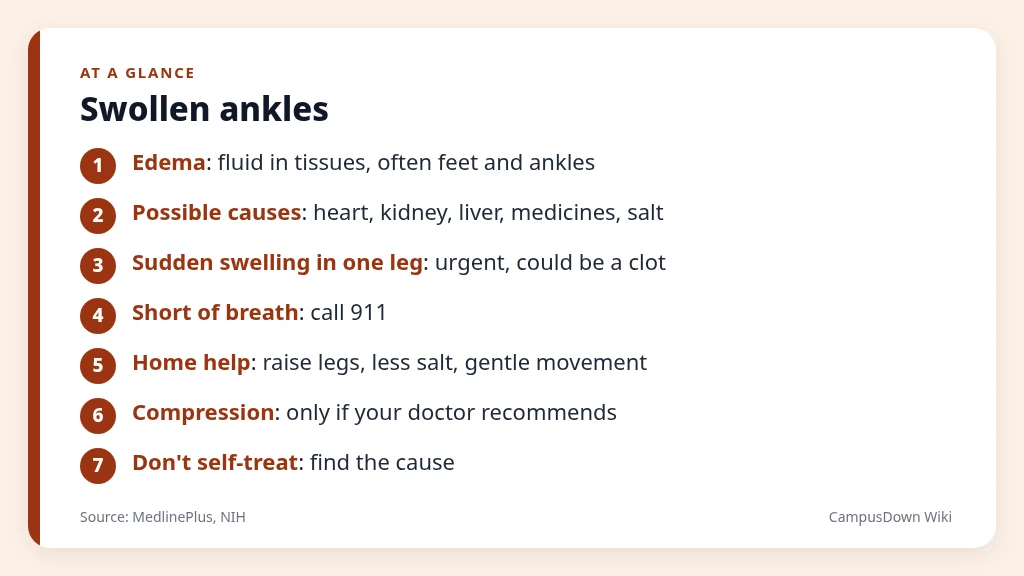
NIH says a dangerous blood clot (deep vein thrombosis, DVT) can cause sudden swelling, and advises seeing a provider right away for sudden swelling in one or more limbs, or minor swelling that's getting worse over time.
Get help now if
Call 911 if swelling comes with shortness of breath or chest pain. These can be signs of a serious problem. MedlinePlus also says lying down with legs raised shouldn't be done if it makes you short of breath; call your provider instead.
Questions your doctor may ask
MedlinePlus says your provider will take your medical history and examine you. Expect questions about when the swelling began, whether it's in one area or all over, and what you've tried. Tests may include blood tests, kidney and liver function tests, urinalysis, an ECG or echocardiogram, and X-rays. You can learn more about kidney tests in eGFR and kidney function.
Home measures your doctor may suggest
NIH's "Wise Choices" list and MedlinePlus say:
- Prop up swollen legs when sitting or lying, ideally above heart level, unless it makes you short of breath.
- Limit salt: sodium makes the body retain fluid. Check food labels.
- Exercise gently: ask your provider for safe exercises.
- Wear loose clothes and shoes, except for compression garments if your doctor recommends them. You can take a closer look at compression socks and mmHg before buying.
- Take prescribed medicine exactly as directed (for example a water pill, called a diuretic).
- If your doctor has asked for daily weights, follow them; our heart failure daily weight guide explains how.
MedlinePlus adds that with long-term swelling, you can ask about preventing skin breakdown.
Falls and swelling
Swollen feet can make shoes slip and balance feel off. Use our fall prevention checklist, and choose supportive, roomy footwear that fits.
Example scenario: the sock line that kept growing
- Who
- Cordell, 76, a retired dairy farmer in Eau Claire, Wisconsin, noticed the sock lines at his ankles getting deeper every evening. His wife, Adeline, 74, a retired school nurse, pressed on his shin and saw the dent stay.
- What happened
- Over two weeks he started waking at night short of breath and sleeping with an extra pillow. He blamed the weather and his age.
- How it felt
- Cordell felt annoyed that his body was becoming a project. Adeline felt a quiet fear she had seen before in her years as a nurse.
- What they did
- She insisted on a visit. His doctor asked when the swelling began, checked his heart and kidneys, ordered tests and reviewed all of his medicines. The doctor found a treatable cause, adjusted his plan, and gave instructions on daily weights, salt and when to call. Adeline kept a small notebook of his weights and symptoms.
- How it turned out
- Cordell said the notebook irritated him until it showed the swelling going down. Adeline said she slept better when the numbers were written down.
This is an illustrative example, not a real patient or a review.
Cordell's story is an illustrative example. Swelling has many causes, and only an exam can tell them apart.
Most-asked questions about swollen ankles in older adults
Why are my elderly parent's ankles swollen?
Common causes include salt, heart, kidney or liver problems and some medicines. NIH says any swelling should be looked at by a provider.
Why people ask: "swollen ankles elderly causes" is #9 for "swollen ankles elderly" (US autocomplete, November 2026).
Can heart failure cause swollen ankles in older adults?
Yes. NIH says in heart failure fluid can pool in the legs. Heart failure needs a doctor's diagnosis and treatment.
Why people ask: "swollen ankles elderly heart failure" is #5 for "swollen ankles elderly" (US autocomplete, November 2026).
What causes swollen feet and ankles in the elderly?
MedlinePlus lists salt, heart failure, kidney disease, liver disease, thyroid disease, poor nutrition and certain medicines.
Why people ask: "what causes swollen feet and ankles in the elderly" is #7 for "swollen feet and ankles in the elderly" (US autocomplete, November 2026).
What's the treatment for swollen feet and ankles in the elderly?
It depends on the cause. Raising the legs, limiting salt, gentle movement, compression and prescribed medicines may help.
Why people ask: "swollen feet and ankles in elderly treatment" is #4 for "swollen feet and ankles in the elderly" (US autocomplete, November 2026).
Why are an elderly woman's ankles swollen?
The causes are the same for women and men. A provider should examine and review medicines.
Why people ask: "swollen ankles elderly woman" is #2 for "swollen ankles elderly" (US autocomplete, November 2026).
Why are an elderly man's ankles swollen?
See the list of causes above; see a provider for sudden or worsening swelling.
Why people ask: "swollen ankles elderly man" is #3 for "swollen ankles elderly" (US autocomplete, November 2026).
Related on CampusDown
You can learn more about daily weights and compression socks.
Frequently asked questions
- Is some swelling normal in older age?
- It's common, but NIH says any swelling should be looked at.
- Should I stop my blood pressure pill if my ankles swell?
- No. Call your prescriber; stopping can be dangerous.
- Are compression stockings safe for everyone?
- Not always. Ask your doctor first, especially with circulation problems.
- When is swelling an emergency?
- Sudden swelling with breathlessness or chest pain, or sudden swelling in one leg. Call 911 or go to the ER.
Swollen ankles are a symptom, not a diagnosis. See a provider, bring the medicine list, and ask what's causing it before you reach for home remedies.
Browse more guides like this in the Senior Health and Medicare hub.
This article is for general education and does not replace advice from your own doctor, nurse or pharmacist.