
You run your fingers along your neck after a cold and feel a small tender bump. Is it just your body fighting off a virus, or something to get checked?

This guide uses the MedlinePlus encyclopedia article "Swollen lymph nodes" (reviewed January 14, 2026). It is general information, not a diagnosis; a clinician needs to examine you to find the cause. If you want to learn more about the infections that often come with swollen glands, take a closer look at shingles.
What lymph nodes do
MedlinePlus says lymph nodes are present throughout your body and are an important part of your immune system, helping your body recognize and fight germs, infections and other foreign substances. "Swollen glands" means enlargement of one or more lymph nodes, and the medical name is lymphadenopathy. In a child, a node is considered enlarged if it is more than 1 centimeter (0.4 inch) wide.

Where you can feel them
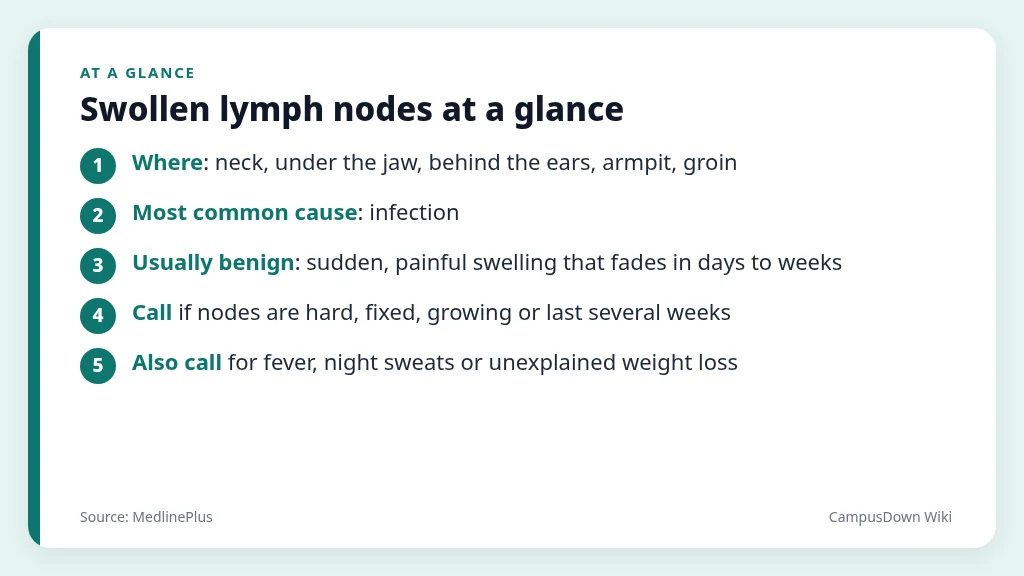
Common areas include the groin, armpit, neck (a chain of nodes on each side of the front, both sides and down the back of the neck), under the jaw and chin, behind the ears and on the back of the head. Which nodes swell depends on the cause and the body parts involved, which is why nodes under the jaw often swell with tooth or throat problems and groin nodes with leg or genital infections.
Common causes
MedlinePlus says infections are the most common cause, including an abscessed or impacted tooth, an ear infection, colds, flu and other infections, inflamed gums (gingivitis), mononucleosis, mouth sores, sexually transmitted illness, tonsillitis, tuberculosis and skin infections. Immune or autoimmune disorders such as HIV and rheumatoid arthritis can cause swelling; see rheumatoid arthritis. Cancers such as leukemia, Hodgkin disease and non-Hodgkin lymphoma can cause swollen nodes, and a nearby lymph node is often the first place a cancer spreads. Certain medicines, including seizure medicines such as phenytoin, and typhoid immunization can also cause swelling. Tick bites can come with swollen nodes too; see tick bites and Lyme disease.
Painful or painless
MedlinePlus says swollen lymph nodes that appear suddenly and are painful are usually due to injury or infection, while slow, painless swelling may be due to cancer or a tumor. Painful nodes are generally a sign that your body is fighting an infection; the soreness usually goes away in a couple of days without treatment, though the node may not return to its normal size for several weeks. That doesn't mean a painless node is always cancer; it means a new painless lump that isn't shrinking should be examined.
When to contact a provider
MedlinePlus says to contact your health care provider if:
- The nodes don't get smaller after several weeks or keep getting larger.
- They are red and tender.
- They feel hard, irregular or fixed in place.
- You have fever, night sweats or unexplained weight loss (see night sweats).
- Any node in a child is larger than 1 centimeter.
Get help now if
Seek urgent care for swollen nodes with trouble breathing or swallowing, a high fever with chills and confusion, rapidly spreading redness or severe pain, since these can signal a serious infection such as sepsis; see sepsis.
What to expect at the visit
Your provider will examine you and ask when the swelling began, whether it came on suddenly and whether any nodes hurt when pressed. MedlinePlus says tests may include blood tests (liver function tests, kidney function tests and a complete blood count with differential), a lymph node biopsy, a chest x-ray and a CT scan of the chest and abdomen, and that treatment depends on the cause. The page doesn't recommend specific home remedies or antibiotics, so treatment decisions belong to your clinician.
Questions for your doctor
- What is the most likely cause for my node, based on where it is?
- Should we wait and recheck, or test now?
- Which symptoms should send me back sooner?
- Could any of my medicines be responsible?
- Do I need a specialist or imaging?
Example scenario: the lump after the cold
- Who
- Emeric, 36, a high school band director in Madison, Wisconsin, noticed a small tender lump under his jaw during a cold.
- What happened
- He felt worried when it was still there two weeks later.
- How it felt
- He kept checking it in the mirror and lost sleep.
- What they did
- He called his primary care office, mentioned how long it had lasted and that he had no fever or weight loss, and was scheduled for an exam and blood tests. Emeric kept notes on its size and any new symptoms.
- How it turned out
- Emeric said having a clear checklist of what to watch kept his worry in proportion.
This is an illustrative example, not a real patient or a review.
Emeric's story is an illustrative example. Don't wait if a lump is hard, fixed, growing or comes with fever, night sweats or weight loss.
Most-asked questions about swollen lymph nodes
What does a swollen lymph node under the jaw mean?
Common causes include tooth, throat, ear and mouth infections; MedlinePlus says infections are the most common cause, and you should get checked if it doesn't shrink in several weeks.
Why people ask: "swollen lymph nodes under jaw" is #2 for "swollen lymph nodes" (US autocomplete, November 2026).
What does a swollen lymph node in the armpit mean?
The armpit is a common place to feel nodes; infections are the most common cause, and nodes that are hard, fixed, growing or lasting weeks need an exam.
Why people ask: "swollen lymph nodes armpit" is #4 for "swollen lymph nodes" (US autocomplete, November 2026).
What does a swollen lymph node on one side of the neck mean?
Infections are the most common cause and nodes are often swollen on the side near the problem; see a provider if it lasts several weeks, grows or feels hard or fixed.
Why people ask: "swollen lymph nodes in neck one side" is #5 for "swollen lymph nodes" (US autocomplete, November 2026).
What does a swollen lymph node in the groin mean?
The groin is a common area for nodes; infections are the most common cause, so tell your provider about skin or genital symptoms.
Why people ask: "swollen lymph nodes in groin" is #6 for "swollen lymph nodes" (US autocomplete, November 2026).
What does a swollen lymph node in the groin mean for women?
MedlinePlus doesn't separate by sex; infections are the most common cause, and a provider can check for related skin, leg or reproductive causes.
Why people ask: "swollen lymph nodes in groin female" is #7 for "swollen lymph nodes" (US autocomplete, November 2026).
What does a swollen lymph node under the jaw on one side mean?
Often a nearby infection such as a tooth, mouth or throat problem; get checked if it lasts several weeks or feels hard or fixed.
Why people ask: "swollen lymph nodes under jaw one side" is #8 for "swollen lymph nodes" (US autocomplete, November 2026).
What does a swollen lymph node in the groin mean for men?
The page doesn't separate by sex; infections including sexually transmitted ones can cause it, so see a provider.
Why people ask: "swollen lymph nodes in groin male" is #9 for "swollen lymph nodes" (US autocomplete, November 2026).
What does a swollen lymph node behind the ear mean?
The area behind the ears is a common place for nodes; ear infections, colds and scalp or skin infections are typical causes.
Why people ask: "swollen lymph nodes behind ear" is #10 for "swollen lymph nodes" (US autocomplete, November 2026).
What does a painful swollen lymph node on one side of the neck mean?
Sudden, painful swelling is usually due to injury or infection and often settles in a couple of days; see a provider if red and tender or not shrinking.
Why people ask: "swollen lymph nodes in neck one side painful" is #3 for "swollen lymph nodes in neck" (US autocomplete, November 2026).
What is the treatment for swollen lymph nodes in the neck?
Treatment depends on the cause; MedlinePlus doesn't list home remedies, so ask your clinician after an exam.
Why people ask: "swollen lymph nodes in neck treatment" is #4 for "swollen lymph nodes in neck" (US autocomplete, November 2026).
What does a swollen neck node with no other symptoms mean?
Infections are the most common cause, and painless slow swelling may be due to cancer or a tumor, so a node that persists for weeks should be examined.
Why people ask: "swollen lymph nodes in neck one side no other symptoms" is #5 for "swollen lymph nodes in neck" (US autocomplete, November 2026).
What does a swollen neck node with a sore throat mean?
Tonsillitis and other throat infections are listed causes; see a provider for severe pain, trouble swallowing or fever.
Why people ask: "swollen lymph nodes in neck and sore throat" is #7 for "swollen lymph nodes in neck" (US autocomplete, November 2026).
What does a swollen neck node behind the ear mean?
Nodes behind the ears often swell with ear, scalp or throat infections; check in if it lasts several weeks.
Why people ask: "swollen lymph nodes in neck behind ear" is #8 for "swollen lymph nodes in neck" (US autocomplete, November 2026).
What does a swollen neck node mean?
Most often an infection, but cancers and some medicines can also cause it; hard, fixed, growing or long-lasting nodes should be examined.
Why people ask: "swollen lymph nodes in neck meaning" is #9 for "swollen lymph nodes in neck" (US autocomplete, November 2026).
Why are my neck lymph nodes swollen when I'm not sick?
Infections that have passed, medicines and immune conditions can cause it; MedlinePlus says to contact a provider if nodes don't shrink after several weeks.
Why people ask: "swollen lymph nodes in neck but not sick" is #10 for "swollen lymph nodes in neck" (US autocomplete, November 2026).
Related on CampusDown
You can learn more about the health topics hub and check it for yourself in tick bites and Lyme disease. For another symptom to track in detail, see night sweats, and for serious infection see sepsis.
Frequently asked questions
- What causes swollen lymph nodes?
- Most often infections; also immune conditions, some cancers and certain medicines.
- How long do they stay swollen?
- Painful nodes often settle in a couple of days, but may take several weeks to return to normal size.
- When should I see a doctor?
- If nodes don't shrink after several weeks, keep growing, are red and tender, or feel hard, irregular or fixed.
- Which symptoms make it more urgent?
- Fever, night sweats or unexplained weight loss.
- What tests might I need?
- Blood tests, a lymph node biopsy, a chest x-ray or a CT scan, depending on the cause.
Swollen lymph nodes are most often an infection that settles within days to weeks, but hard, fixed, growing or long-lasting nodes, or nodes with fever, night sweats or weight loss, need a clinician's exam. Note when the swelling began, how it feels and any other symptoms, and call your provider if it doesn't shrink.
Browse more guides like this in the U.S. Health Topics hub.
This article is for general education and does not replace advice from your own doctor, nurse or pharmacist.