
You find a tiny dark speck on the back of your knee after a walk. It is firmly attached. Do you pick at it, call your doctor first, or something else?

This guide uses CDC pages on what to do after a tick bite (updated July 15, 2025), the signs and symptoms of untreated Lyme disease (May 15, 2024) and Lyme prevention (May 21, 2026). It is general information, not a diagnosis; a clinician decides whether you need testing or treatment. If you want to learn more about the glands that sometimes swell after an infection, take a closer look at swollen lymph nodes.
Step 1: remove the tick right away
CDC says if you find a tick attached to your skin, remove it as soon as possible, and don't wait to go to a healthcare provider, since delaying could increase your risk of a tickborne disease. A plain set of tweezers works very well.
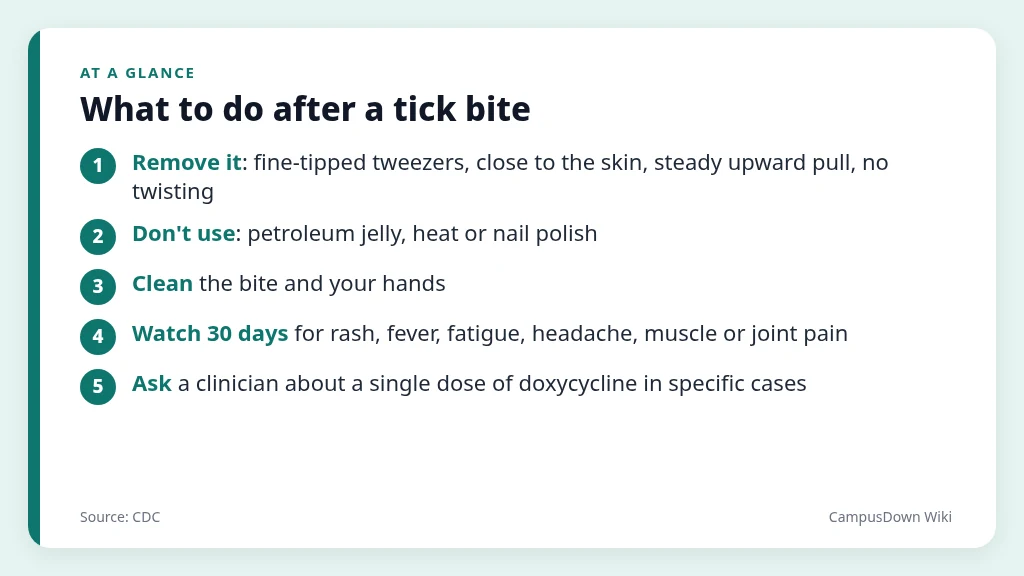
- Grasp the tick as close to the skin's surface as possible with clean fine-tipped tweezers (regular tweezers or fingers if you have nothing else), avoiding squeezing the tick's body.
2. Pull the tick away from the skin with steady, even pressure; don't twist or jerk, which can break off the mouthparts. If mouthparts stay in the skin, your body will push them out as it heals; you can remove them with tweezers if it's easy, and otherwise leave them alone. 3. Dispose of a live tick by placing it in a sealed container, wrapping it tightly in tape, flushing it down the toilet or putting it in alcohol; don't crush it with your fingers. 4. Clean the bite area and your hands with soap and water, rubbing alcohol or hand sanitizer. 5. Do a careful full-body tick check, because there may be other ticks.

What not to do
CDC says don't use petroleum jelly, heat, nail polish or other substances to make the tick detach, since this may agitate it and force infected fluid into the skin. Tick testing is generally not recommended: labs that test ticks don't have to meet the quality standards of clinical labs, a positive result doesn't mean you were infected, a negative result can give false assurance and symptoms would likely start before results arrive.
Step 2: watch for 30 days
CDC's fact sheet says to watch for symptoms for 30 days and call your healthcare provider if you get a rash, fever, fatigue, headache, muscle pain or joint swelling and pain. If you develop a rash or fever within several weeks of removing a tick, see your doctor and mention the bite, when it happened and where you likely got the tick. Treatment of tickborne diseases is based on symptoms, exposure history and sometimes blood tests, and most can be treated with a short course of antibiotics.
Do you need antibiotics after a bite?
CDC says in general it doesn't recommend antibiotics after tick bites, but in certain circumstances a single dose of doxycycline may lower the risk of Lyme disease. Its clinician guidance lists the circumstances: the bite occurred where Lyme disease is common, the tick can be identified as an adult or nymphal blacklegged tick, it was likely attached for at least 36 hours, treatment can start within 72 hours of removal and there is no contraindication. Antibiotic prophylaxis has not been shown to prevent other tickborne diseases. Ask a clinician promptly if you may qualify; see doxycycline. Information on lone star ticks isn't covered by this guidance, so ask your clinician.
What the Lyme rash looks like
CDC says the erythema migrans (EM) rash occurs in about 70 to 80 percent of infected people, begins at the bite site after 3 to 30 days (on average about 7), expands gradually over several days to 12 inches (30 cm) or more, may feel warm, is rarely itchy or painful, sometimes clears as it enlarges to give a target or bull's-eye look, can appear anywhere on the body and doesn't always look like a classic bull's-eye. A small bump or redness right at the bite site that looks like a mosquito bite is common, goes away in 1 to 2 days and is not a sign of Lyme disease. A similar rash occurs with Southern Tick-associated Rash Illness (STARI), which is not Lyme disease.
Other signs
Early (3 to 30 days): fever, chills, headache, fatigue, muscle and joint aches and swollen lymph nodes, which may occur without a rash. Later (days to months): severe headaches and neck stiffness, additional EM rashes, facial palsy, arthritis with severe joint pain and swelling (especially the knees), intermittent tendon, muscle and joint pain, heart palpitations or an irregular heartbeat (Lyme carditis), dizziness or shortness of breath, nerve pain and shooting pains, numbness or tingling in the hands or feet. Seek medical attention if you have these and recent tick exposure. See palpitations at night.
Get help now if
Call your doctor promptly for a spreading rash, fever, severe headache with neck stiffness, a drooping face, a very fast or irregular heartbeat, or severe joint swelling after a possible tick bite. Call 911 for trouble breathing, chest pain or fainting.
Prevention
CDC says blacklegged (deer) ticks cause Lyme disease; it is most common in the Northeast, mid-Atlantic and upper Midwest; many people are exposed in their own yards; and ticks can be active whenever winter temperatures are above freezing. To prevent bites: avoid grassy, brushy or wooded areas; use EPA-registered repellents containing DEET, picaridin, IR3535, oil of lemon eucalyptus, PMD or 2-undecanone; wear long sleeves and pants or clothing pre-treated with 0.5% permethrin; check your body, clothing, gear and pets after being outdoors; shower soon after; and consider a lint roller for unattached ticks. A 3-foot-wide barrier of wood chips or gravel between lawns and wooded areas can reduce tick habitat.
Questions for your clinician
- Was this tick likely attached long enough to matter in my area?
- Do I qualify for a single dose of doxycycline, and how soon must I take it?
- Which symptoms should I watch for, and for how long?
- Should I be tested if I develop symptoms?
- Is anything about my health a reason to be more careful?
Example scenario: the speck on the knee
- Who
- Kenneth, 45, a surveyor in Hartford, Connecticut, found a tick behind his knee after clearing brush at a job site.
- What happened
- He felt tempted to wait for his doctor's appointment and wasn't sure how to take it off.
- How it felt
- He worried he would crush it and make things worse.
- What they did
- He used clean fine-tipped tweezers to pull it straight out with steady pressure, put it in a sealed container, cleaned the bite and called his clinic to ask whether he needed a single dose of doxycycline. Kenneth marked the date on his calendar and watched for a rash or fever for 30 days.
- How it turned out
- Kenneth said knowing the exact steps made the moment less stressful.
This is an illustrative example, not a real patient or a review.
Kenneth's story is an illustrative example. Ask your clinician about your own situation and risk.
Most-asked questions about tick bites
What should I do next after a tick bite?
Remove the tick with fine-tipped tweezers, clean the bite and your hands and watch for symptoms for 30 days; ask a clinician whether you need antibiotics.
Why people ask: "tick bite what to do next" is #3 for "tick bite what to do" (US autocomplete, November 2026).
What should I do after a deer tick bite?
Remove it promptly and ask a clinician about a single dose of doxycycline if it was an identified blacklegged tick attached 36 hours or more in an area where Lyme disease is common and treatment can start within 72 hours.
Why people ask: "deer tick bite what to do" is #4 for "tick bite what to do" (US autocomplete, November 2026).
What should I do after a suspected tick bite?
Do a full-body tick check, remove any attached tick and watch for rash, fever, fatigue, headache or muscle and joint pain for 30 days.
Why people ask: "suspected tick bite what to do" is #5 for "tick bite what to do" (US autocomplete, November 2026).
What should I do after a possible tick bite?
Check your skin and clothing, shower, remove any tick safely and watch for symptoms; see a doctor for a rash or fever within several weeks.
Why people ask: "possible tick bite what to do" is #6 for "tick bite what to do" (US autocomplete, November 2026).
What should a person do after a human tick bite?
Follow the same steps: remove the tick, clean the area and watch for 30 days.
Why people ask: "tick bite human what to do" is #8 for "tick bite what to do" (US autocomplete, November 2026).
What does a tick bite look like?
A small bump or redness at the bite that fades in 1 to 2 days is common and isn't Lyme disease; a rash that expands over days, sometimes with a bull's-eye look, needs a doctor.
Why people ask: "tick bite what does it look like" is #10 for "tick bite what to do" (US autocomplete, November 2026).
What should I do after a lone star tick bite?
CDC's Lyme guidance covers blacklegged ticks and doesn't address lone star ticks, so remove the tick, watch for symptoms and ask your clinician.
Why people ask: "lone star tick what to do after bite" is #2 for "tick bite what to do after" (US autocomplete, November 2026).
What should I do after a tick bite on a person?
Remove the tick with tweezers, clean the area and watch for 30 days.
Why people ask: "what to do after tick bite human" is #3 for "tick bite what to do after" (US autocomplete, November 2026).
What should I do after getting a tick bite?
Remove it right away, don't use petroleum jelly or heat, and see a doctor for a rash or fever within several weeks.
Why people ask: "what to do after getting tick bite" is #4 for "tick bite what to do after" (US autocomplete, November 2026).
What do you do after you get a tick bite?
Pull the tick straight out with steady pressure, dispose of it safely, clean the area and do a tick check for others.
Why people ask: "what do you do after you get a tick bite" is #5 for "tick bite what to do after" (US autocomplete, November 2026).
What is tick bite after care?
Clean the bite area and your hands and watch for rash, fever, fatigue, headache, muscle pain or joint swelling for 30 days.
Why people ask: "tick bite after care" is #6 for "tick bite what to do after" (US autocomplete, November 2026).
Related on CampusDown
You can learn more about the health topics hub and check it for yourself in swollen lymph nodes. For an antibiotic in detail, see doxycycline, and for outdoor safety in summer see heat exhaustion versus heat stroke.
Frequently asked questions
- How do I remove a tick?
- Use clean fine-tipped tweezers close to the skin and pull straight out with steady pressure, without twisting.
- Should I use petroleum jelly or a match?
- No; CDC says these can agitate the tick and push infected fluid into the skin.
- How long should I watch for symptoms?
- 30 days; call for rash, fever, fatigue, headache, muscle pain or joint swelling.
- Do I need antibiotics?
- CDC generally doesn't recommend them, but a single dose of doxycycline may be considered in specific situations; ask a clinician quickly.
- What does the Lyme rash look like?
- A rash at the bite that expands over days, sometimes with a bull's-eye look, usually 3 to 30 days after the bite.
After a tick bite, remove the tick promptly with fine-tipped tweezers, clean the area, skip the folk remedies and watch for symptoms for 30 days. Ask a clinician quickly if you might qualify for a single dose of doxycycline, and see a doctor for any rash or fever within several weeks.
Browse more guides like this in the U.S. Health Topics hub.
This article is for general education and does not replace advice from your own doctor, nurse or pharmacist.