
It's a scorching afternoon and your neighbor, who was mowing the lawn, sits down and says he feels dizzy and nauseated. Is he overheated, or is this an emergency?

This guide uses CDC and NIOSH pages on heat-related illnesses (NIOSH page dated March 3, 2026; CDC's clinical overview of heat, September 18, 2025; NIOSH's first aid sheet, 2024). Their examples focus on workers, but the symptoms and steps apply to anyone. It is general information, not a substitute for emergency care. If you want to learn more about fluid loss, take a closer look at dehydration signs in adults.
Get help now if
Heat stroke is a medical emergency. If someone is confused, has slurred speech, has a seizure or loses consciousness in the heat, call 911 right away and start cooling them while you wait.
Heat exhaustion
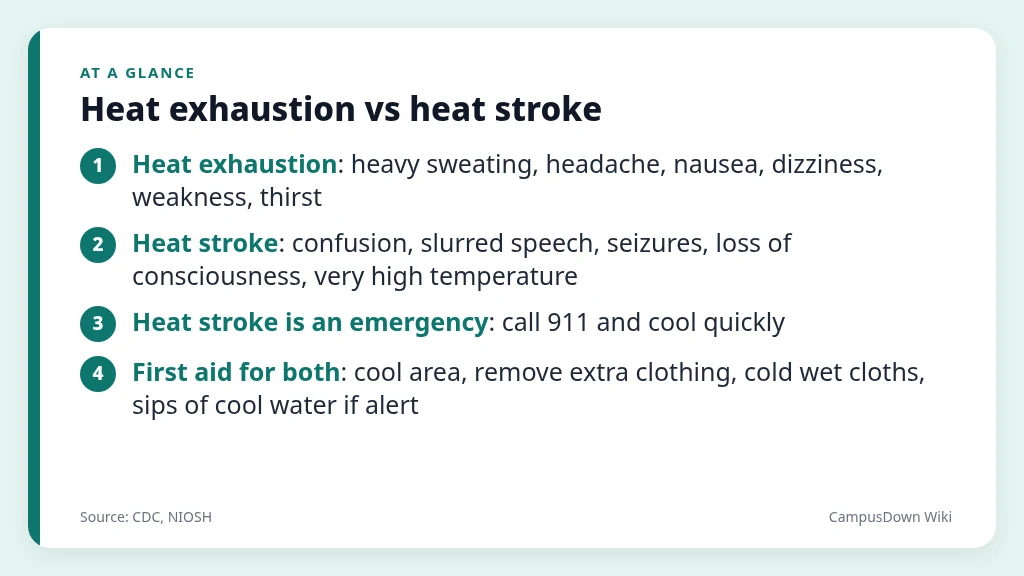
CDC says heat exhaustion is the body's response to an excessive loss of water and salt, usually through excessive sweating. The listed symptoms are headache, nausea, dizziness, weakness, irritability, thirst, heavy sweating, elevated body temperature and decreased urine output. CDC's travel page notes people at highest risk include the elderly, those with high blood pressure and those working or exercising in the heat.
First aid, per NIOSH:
- Take the person to a clinic or emergency room for evaluation, or call 911 if medical care is unavailable.
- Have someone stay with them until help arrives.
- Move them from the hot area and give liquids to drink; encourage frequent sips of cool water.
- Remove unnecessary clothing, including shoes and socks.
- Cool them with cold compresses, or have them wash their head, face and neck with cold water.

Heat stroke
CDC says heat stroke is the most serious heat-related illness: the body can no longer control its temperature, it rises rapidly, the sweating mechanism fails and the body can't cool down. Body temperature can rise to 106°F or higher within 10 to 15 minutes, and heat stroke can cause permanent disability or death without emergency treatment. The listed symptoms are confusion, altered mental status, slurred speech, loss of consciousness (coma), hot, dry skin or profuse sweating, seizures and a very high body temperature. CDC's travel page also lists lack of sweating and skin that feels very hot. So a person can be sweating or not, and a change in thinking is the red flag.
First aid, per NIOSH:
- Call 911.
- Stay with the person until emergency services arrive.
- Move them to a shaded, cool area and remove outer clothing.
- Cool them quickly: a cold water or ice bath if possible, wet the skin, place cold wet cloths on the skin, soak the clothing with cool water and circulate air around them.
- Place cold wet cloths or ice on the head, neck, armpits and groin.
NIOSH's first aid sheet says when treating severe heat illness, cooling is the first priority, and altered mental state can be a sign of heat stroke and requires immediate attention. It doesn't cover giving fluids to a confused person, so follow the 911 dispatcher's instructions.
Side by side
| Heat exhaustion | Heat stroke | |
|---|---|---|
| Thinking | Irritable, may feel dizzy | Confused, slurred speech, may lose consciousness |
| Sweating | Heavy sweating | Hot, dry skin or heavy sweating |
| Other signs | Headache, nausea, weakness, thirst, less urine | Seizures, very high body temperature |
| Urgency | Medical evaluation; call 911 if care is unavailable | Call 911 immediately |
Cramps and fainting
NIOSH's sheet says muscle cramps, pain or spasms in the abdomen, arms or legs, alone or with other symptoms, should not be ignored, and get medical help if the person has heart problems, is on a low-sodium diet or if cramps don't subside within 1 hour. For heat syncope (fainting), sit or lie down in a cool place when feeling faint or dizzy and slowly drink water or clear juice. The pages don't define "heat stress" separately; it is the general strain from heat that can lead to these illnesses.
Who is at higher risk
CDC's clinical overview lists infants and children, pregnant women, adults over 65, people with disabilities, mental health conditions or chronic health conditions, people with substance-use disorders, people who lack housing or cooling, who are socially isolated or who work or exercise in heat. It adds that many medications, including over-the-counter ones, can impair heat tolerance and the body's ability to regulate temperature. Ask your pharmacist about water pills such as furosemide, blood pressure medicines such as lisinopril and alcohol, which is covered in alcohol and aging. See dehydration in older adults and the senior health hub.
Make a plan
CDC's five-step heat action plan for patients: assess risk factors, learn how to stay cool, stay hydrated, think about air quality and make a medication plan for the hottest days. Talk to your clinician before a heat wave about any medicine that needs adjusting.
Questions for your clinician
- Do any of my medicines raise my risk in the heat?
- How much fluid should I drink on hot days, given my heart or kidney condition?
- Which symptoms mean I should go to urgent care?
- Who can check on me during a heat wave?
- Should I avoid certain activities when the heat is high?
Example scenario: the mower
- Who
- Jocelyn, 63, a retired nurse in Phoenix, Arizona, saw her neighbor sit down in the yard after mowing and say he felt dizzy and sick.
- What happened
- His shirt was soaked and he was irritable but still able to answer questions.
- How it felt
- She worried it would turn into something worse.
- What they did
- She helped him into the shade, removed his boots and put cold wet cloths on his neck, gave him cool water in sips and called his doctor, keeping a close watch for confusion. Jocelyn knew that if he became confused, slurred his speech or passed out she would call 911 at once.
- How it turned out
- Jocelyn said she was glad she had learned the difference between the two.
This is an illustrative example, not a real patient or a review.
Jocelyn's story is an illustrative example. If there is confusion, slurred speech, a seizure or loss of consciousness, call 911.
Most-asked questions about heat exhaustion and heat stroke
What is the treatment for heat exhaustion versus heat stroke?
For heat exhaustion move to a cool area, remove extra clothing, cool the person and give sips of cool water, then get medical evaluation; for heat stroke call 911 and cool quickly with cold water or an ice bath.
Why people ask: "heat exhaustion vs heat stroke treatment" is #4 for "heat exhaustion vs heat stroke" (US autocomplete, November 2026).
Is there a heat exhaustion versus heat stroke chart?
The side-by-side table above summarizes the CDC and NIOSH symptom lists; the key difference is confusion, slurred speech, seizures or loss of consciousness in heat stroke.
Why people ask: "heat exhaustion vs heat stroke chart" is #6 for "heat exhaustion vs heat stroke" (US autocomplete, November 2026).
How does heat stress compare with heat exhaustion and heat stroke?
The CDC and NIOSH pages describe heat exhaustion and heat stroke as heat-related illnesses without defining heat stress separately.
Why people ask: "heat exhaustion vs heat stroke vs heat stress" is #7 for "heat exhaustion vs heat stroke" (US autocomplete, November 2026).
How do heat cramps compare with heat exhaustion and heat stroke?
Cramps are muscle spasms that shouldn't be ignored; get medical help if cramps last over 1 hour or you have heart problems or a low-sodium diet.
Why people ask: "heat exhaustion vs heat stroke vs heat cramps" is #8 for "heat exhaustion vs heat stroke" (US autocomplete, November 2026).
What does CDC say about heat exhaustion versus heat stroke?
CDC and NIOSH describe heat exhaustion as water and salt loss and heat stroke as the most serious heat illness, an emergency needing 911 and rapid cooling.
Why people ask: "heat exhaustion vs heat stroke cdc" is #9 for "heat exhaustion vs heat stroke" (US autocomplete, November 2026).
Is there a heat exhaustion versus heat stroke PDF?
NIOSH has a first aid sheet for heat illness (publication 2024-100); see the references below.
Why people ask: "heat exhaustion vs heat stroke pdf" is #10 for "heat exhaustion vs heat stroke" (US autocomplete, November 2026).
What are the symptoms of heat exhaustion and heat stroke?
Heat exhaustion: headache, nausea, dizziness, weakness, thirst and heavy sweating; heat stroke: confusion, slurred speech, seizures, loss of consciousness and very high temperature.
Why people ask: "heat exhaustion and heat stroke symptoms" is #2 for "heat exhaustion vs heat stroke symptoms" (US autocomplete, November 2026).
What are the signs of heat exhaustion and heat stroke?
Heat exhaustion causes heavy sweating, dizziness and weakness; heat stroke causes confusion, hot dry skin or profuse sweating, seizures and a very high temperature.
Why people ask: "heat exhaustion and heat stroke signs" is #3 for "heat exhaustion vs heat stroke symptoms" (US autocomplete, November 2026).
What are the signs and symptoms of heat exhaustion versus heat stroke?
The key difference is mental status: confusion, slurred speech or loss of consciousness signal heat stroke and need 911.
Why people ask: "heat exhaustion vs heat stroke signs and symptoms" is #4 for "heat exhaustion vs heat stroke symptoms" (US autocomplete, November 2026).
What are the symptoms and treatment of heat exhaustion and heat stroke?
Move the person to a cool place, remove extra clothing and cool them; for heat exhaustion give sips of cool water and seek medical evaluation, and for heat stroke call 911.
Why people ask: "heat exhaustion and heat stroke symptoms and treatment" is #5 for "heat exhaustion vs heat stroke symptoms" (US autocomplete, November 2026).
What are the vital signs in heat exhaustion versus heat stroke?
The sources mention a raised temperature in heat exhaustion and a body temperature of 106°F or higher within 10 to 15 minutes in heat stroke, without other vital sign ranges.
Why people ask: "heat exhaustion vs heat stroke vital signs" is #6 for "heat exhaustion vs heat stroke symptoms" (US autocomplete, November 2026).
How do heat stress and heat stroke symptoms differ?
The sources don't define heat stress separately; heat stroke symptoms include confusion, slurred speech, seizures and very high body temperature.
Why people ask: "heat stress vs heat stroke symptoms" is #8 for "heat exhaustion vs heat stroke symptoms" (US autocomplete, November 2026).
What is the difference between heat exhaustion and heat stroke symptoms?
Heat exhaustion keeps thinking mostly clear with sweating and weakness; heat stroke brings confusion, seizures or loss of consciousness and needs 911.
Why people ask: "difference between heat exhaustion and heat stroke symptoms" is #9 for "heat exhaustion vs heat stroke symptoms" (US autocomplete, November 2026).
Related on CampusDown
You can learn more about the health topics hub and check it for yourself in dehydration in older adults. For fluid loss signs in detail, see dehydration signs in adults, and for outdoor safety see tick bites and Lyme disease.
Frequently asked questions
- What is the main difference?
- Heat stroke causes confusion, slurred speech, seizures or loss of consciousness and is an emergency; heat exhaustion does not usually do that.
- When do I call 911?
- For any confusion, slurred speech, seizure or loss of consciousness in the heat, or if medical care isn't available for heat exhaustion.
- How do I cool someone?
- Move them to shade, remove extra clothing, use cold water or an ice bath if possible, wet the skin and use cold wet cloths on the head, neck, armpits and groin.
- Should I give fluids?
- For heat exhaustion, give frequent sips of cool water; for heat stroke call 911 and follow the dispatcher's guidance.
- Who is at higher risk?
- Adults over 65, young children, people with chronic conditions, people on certain medicines and people who work or exercise in heat.
Heat exhaustion is serious but usually reversible with cooling and fluids, while heat stroke is an emergency marked by confusion, slurred speech, seizures or loss of consciousness. Move the person to a cool place, cool them fast, and call 911 for any change in thinking or consciousness.
Browse more guides like this in the U.S. Health Topics hub.
This article is for general education and does not replace advice from your own doctor, nurse or pharmacist.